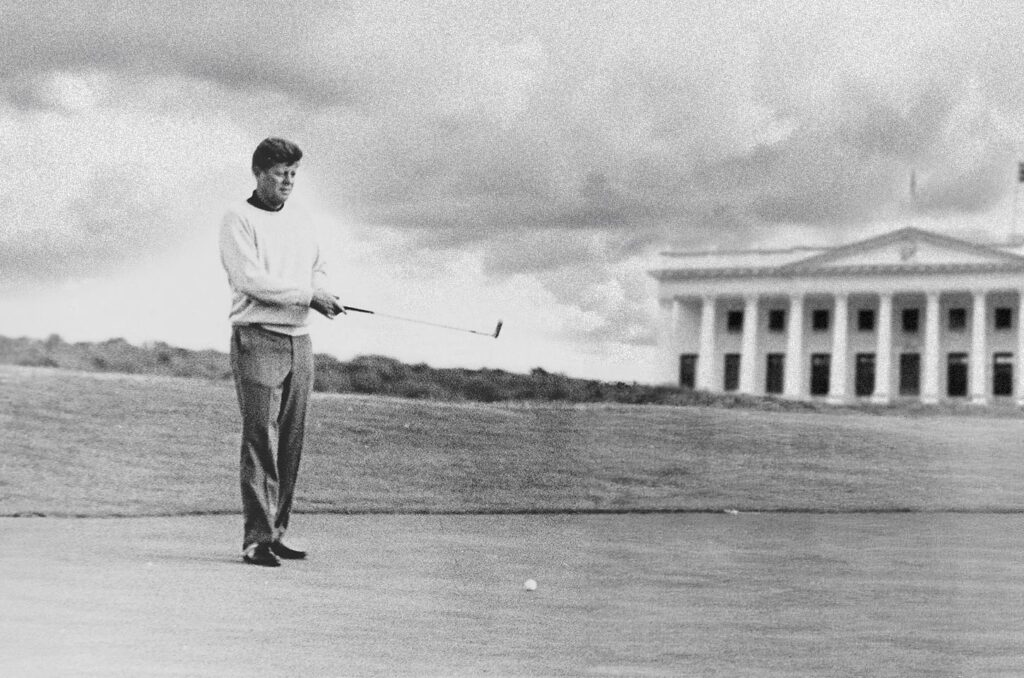
From William Howard Taft to Donald Trump, golf has been a defining pastime for American presidents. Discover which commanders-in-chief played, the exclusive clubs they belonged to, and how the game shaped presidential leadership, diplomacy, and culture.
Golf and the American presidency share a relationship that stretches back more than a century. Since William Howard Taft first took to the fairways in 1909, sixteen of the last nineteen presidents have played the game—making it the most popular recreational sport among U.S. commanders-in-chief. For clubs steeped in this tradition, effective golf club membership marketing can highlight presidential heritage as a powerful brand differentiator. For these leaders, golf has served as far more than a casual hobby. The course has functioned as an open-air boardroom for diplomatic negotiations, a sanctuary from the relentless pressures of the Oval Office, and a stage where presidential character is revealed in ways the West Wing never could. For a deeper look at the tradition, see our feature on the storied tradition of presidential golf.
“Golf undresses a man.” — Scottish Proverb
The way a president handles a bad lie, treats a playing partner, or responds to competition tells us something meaningful about how they govern. This article explores the presidents who embraced the game, the exclusive clubs that hosted them—an opportunity for creative storytelling—and the fascinating stories that unfolded between the first tee and the eighteenth green.
Why Presidents Play Golf
Golf provides something no other sport can offer a sitting president: four hours of relative privacy in a setting that encourages meaningful conversation. Clubs that understand this dynamic invest in thoughtful country club marketing to attract the right members. Unlike a formal state dinner or a crowded press event, the golf course creates an intimate atmosphere where relationships can develop organically. Walking the fairways with a foreign leader or congressional ally allows for candid exchanges that would be impossible in the structured protocol of official Washington.
The physical and mental demands of the game also offer a unique form of stress relief. Each shot requires total focus, forcing the mind to temporarily set aside the weight of national security briefings and policy debates. For presidents living under the most intense scrutiny in the world, those few hours of concentration on something other than governance can be genuinely restorative.
Of course, presidential golf has never been without controversy. From Taft’s earliest rounds to the present day, critics have questioned whether time spent on the links represents time away from the nation’s business. Yet the tradition endures, suggesting that what the game provides to those who hold the office is worth the occasional political risk.
The Presidents Who Played: A Complete Timeline
William Howard Taft (1909–1913): The First Presidential Golfer
Taft holds the distinction of being the first president to play golf publicly while in office, establishing a tradition that would endure for more than a century. At 350 pounds, Taft found golf to be one of the few physical activities he could comfortably enjoy, and he played frequently despite fierce criticism. In the early twentieth century, golf was widely viewed as an elitist sport played exclusively at private country clubs by wealthy businessmen. Newspapers ran editorial cartoons depicting the rotund president on the course instead of in the Oval Office, and political opponents attacked him for indulging in a “rich man’s game.” Taft carried a reported 20 handicap and could regularly shoot under 90, demonstrating genuine skill despite his physical limitations. For a complete ranking of presidential skill levels, see our top presidential golfers breakdown.
Woodrow Wilson (1913–1921): The Most Rounds of Any President
When it comes to sheer volume, no president comes close to Woodrow Wilson. Presidential golf historian Don Van Natta estimates Wilson played as many as 1,200 to 1,600 rounds during his time in office, hitting the course six days a week regardless of season. Wilson’s dedication was so extreme that Secret Service agents painted golf balls red (and sometimes black) so he could play in winter snow. While Wilson was never a particularly skilled golfer, the game served as a critical outlet during the extraordinary pressures of World War I. His physician had recommended golf for his health, and Wilson took the prescription to heart with an enthusiasm that no subsequent president has matched.
Warren G. Harding (1921–1923): The First Presidential Golf Legacy
Harding was a genuinely talented golfer and the first president to have a golf course named in his honor. His connection to the game carried a somber historical footnote: it was during a round of golf in Vancouver in 1923 that Harding first displayed signs of the heart failure that would claim his life shortly thereafter. His presidency may be remembered for its scandals, but Harding’s passion for golf was sincere and helped further normalize the game among political leaders.
Franklin D. Roosevelt (Pre-Presidency): A Champion Cut Short
Before polio robbed him of his mobility, Franklin Roosevelt was a formidable golfer. He served as secretary and treasurer of the Campobello Island Golf Club at age seventeen and won the club championship five years later. Though he was never able to play during his presidency, Roosevelt championed public access to golf by constructing more than 300 municipal courses through New Deal programs—fundamentally democratizing a sport that had been the exclusive province of the wealthy.
Dwight D. Eisenhower: The Golfer-in-Chief
No president is more synonymous with golf than Dwight D. Eisenhower. Over his two terms, Ike played between 800 and 900 rounds, averaging roughly two outings per week throughout his presidency. His love for the game was so well known that it became a defining feature of his public identity.
Eisenhower was personally invited to Augusta National Golf Club in 1948 by co-founder Clifford Roberts. He became a devoted member, and Roberts had a cabin constructed on the grounds in his honor—the Eisenhower Cabin, which remains one of Augusta’s most storied landmarks. Ike also had a putting green installed on the White House lawn, establishing a tradition that several subsequent presidents would continue. We’ve covered the full history of this iconic fixture in our piece on the White House lawn putting green.
Perhaps the most famous Eisenhower golf story involves Augusta’s seventeenth hole, where a large loblolly pine tree stood roughly 210 yards from the tee. Eisenhower hit the tree so frequently that he formally requested the club’s governing body remove it. Co-founder Clifford Roberts quickly adjourned the meeting before any vote could take place, recognizing the embarrassment of cutting down a tree because the president couldn’t hit around it. The tree became known as the “Eisenhower Tree” and stood as one of Augusta’s most famous landmarks until an ice storm destroyed it in 2014.
John F. Kennedy (1961–1963): The Best Golfer Who Never Wanted You to Know
Kennedy was almost certainly the most naturally gifted golfer to serve as president, maintaining a reported 7 handicap despite chronic back pain from his World War II injuries aboard PT-109. Yet he deliberately concealed his passion for the game. Kennedy’s advisors feared that frequent golf photos would invite unfavorable comparisons to Eisenhower, whose time on the course had become a political liability. White House photographers were often instructed not to release golf images, and Kennedy played primarily at exclusive private clubs where media access was restricted. Those who played with him reported a remarkably smooth, athletic swing that belied his obvious physical discomfort.
Richard Nixon (1969–1974): The Private Golfer
Nixon took a characteristically unconventional approach to presidential golf: he had a three-hole course built at his San Clemente, California home, allowing him to play without media coverage or public scrutiny. In a move that surprised the golf world, Nixon removed the White House putting green that Eisenhower had installed. His social discomfort was evident on the course, where playing partners noted his difficulty making casual conversation—a trait that mirrored his governing style.
Gerald Ford (1974–1977): The Pro-Am President
A former football star at the University of Michigan, Ford brought genuine athleticism to the golf course but became famous for his occasionally wild shots. He played frequently in pro-am tournaments and was known for hitting spectators with errant drives. Despite his reputation for wayward shots, Ford was a stickler for the rules and brought an infectious enthusiasm to every round. After leaving office, golf became one of his primary pursuits, and he remained active on the pro-am circuit for decades.
Ronald Reagan (1981–1989): Golf at the World’s Finest Courses
Reagan didn’t take up golf until later in life, but his natural athletic ability made him a respectable player. He enjoyed rounds at some of the world’s most prestigious courses, including Pebble Beach Golf Links and Augusta National. Reagan’s most dramatic golf moment came in 1983, when he was playing at Augusta National and a gunman took hostages in the club’s pro shop, demanding to speak with the president and forcing Reagan to cut his round short. Though his presidential rounds were limited, Reagan’s association with the game’s most exclusive venues reinforced golf’s connection to presidential prestige.
George H.W. Bush (1989–1993): Golf Royalty
George H.W. Bush may have had the deepest golf pedigree of any American president. His grandfather, George Herbert Walker, was a former president of the USGA and the founder of the Walker Cup, one of international golf’s most prestigious competitions. His father, Prescott Bush, also served as USGA president. Bush himself was inducted into the World Golf Hall of Fame in 2011 under the Lifetime Achievement category.
Bush was a member of several exclusive clubs, including Augusta National and Winged Foot Golf Club. He was also a founding member of the Traditions Club, a private club in Bryan, Texas. On the course, Bush was legendary for his pace of play, famously finishing 18 holes in under two hours—a feat that earned him the informal title of “speed golf champion.” He reinstalled the White House putting green in 1991, restoring Eisenhower’s tradition after Nixon’s removal. The Bush family’s charity tournament at Cape Arundel Golf Club in Kennebunkport, Maine, became an annual tradition that continues to draw participants from across the political spectrum.
Bill Clinton (1993–2001): The Social Golfer
Clinton played frequently during and after his presidency, approaching golf as a social activity as much as a competitive one. He played casual rounds with celebrities, world leaders, and political allies, bringing his natural charisma to every foursome. Clinton also popularized the concept of “Billigans”—his personal variation on the mulligan that became part of presidential golf lore. Clinton may have played more top-100 courses than any other president, teeing it up at both PGA Tour stops in South Florida, Pebble Beach, and numerous other marquee venues.
George W. Bush (2001–2009): Golf and the Weight of War
The younger Bush played golf earlier in his presidency but made the deliberate decision to stop during the Iraq War, recognizing that images of the president on the golf course while troops were in combat would be politically untenable. He shifted his fitness regimen to running and mountain biking, demonstrating a keen awareness of the optical risks that have always accompanied presidential golf.
Barack Obama (2009–2017): The Consistent Player
Obama logged more than 300 rounds during his two terms, often playing at municipal golf courses and military bases rather than the ultra-exclusive private clubs favored by some predecessors. His consistent presence on the course drew both admiration and criticism, with entire websites devoted to tracking his rounds. Obama’s approach to golf reflected his broader political style: steady, disciplined, and largely unfazed by the scrutiny that came with each outing.
Donald Trump: The Golf Course Owner-President
Trump brought an entirely new dimension to presidential golf as the first president to own and operate golf courses while in office. His portfolio of Trump-branded properties spans the United States, Scotland, and Ireland, and he has played frequently at his own clubs throughout his time in office. Trump has used golf as a diplomatic tool, hosting Japanese Prime Minister Shinzo Abe for multiple rounds and building personal relationships with world leaders on the fairways. A White House golf simulator was first installed during his first term in 2019.
Joe Biden (2021–2025): The Occasional Golfer
Biden took up golf relatively late in life, not beginning to play until 2001. As a member of Wilmington Country Club in Delaware, he played occasionally during his presidency, though far less frequently than many of his predecessors. His low-key approach to the game kept presidential golf out of the spotlight during his administration, representing a quieter chapter in the long relationship between the Oval Office and the first tee.
Advertisement
The Exclusive Clubs Where Presidents Play
Presidential golf has always been intertwined with some of the most exclusive private clubs in the world. These venues offer the security, privacy, and prestige that the office demands, and membership at many of them represents the pinnacle of social standing in American life. For an in-depth look at what defines true club exclusivity, explore our guide to the most exclusive private members’ clubs.
Augusta National Golf Club — Augusta, Georgia
Augusta National stands as the most iconic presidential golf club in America. Founded by Bobby Jones and Clifford Roberts in 1932, the club hosts the annual Masters Tournament and maintains an invitation-only membership of approximately 300 individuals drawn from the highest echelons of business, politics, and sports. There is no application process, and prospective members who ask to join reportedly see their chances evaporate. Presidents Eisenhower, Reagan, and George H.W. Bush all played at Augusta, with Eisenhower’s long membership being the most celebrated. The Eisenhower Cabin on the grounds remains a testament to his deep connection with the club. The initiation fee is estimated between $250,000 and $500,000, though Augusta’s true currency is influence and achievement rather than money alone.
Burning Tree Club — Bethesda, Maryland
Located just minutes from the White House, Burning Tree Club has been the most convenient refuge for golfing presidents since its founding in 1922. The club has hosted presidents including Franklin Roosevelt, Truman, Eisenhower, and Kennedy, along with Supreme Court justices, cabinet members, and foreign dignitaries. With invitation-only membership capped at around 600 and an initiation fee of $75,000, Burning Tree offers the proximity and discretion that sitting presidents require. Its guest list over the decades reads like a who’s who of Washington power.
Pebble Beach Golf Links — Pebble Beach, California
While technically a public course, Pebble Beach occupies a unique place in presidential golf history. Reagan played here regularly, and Clinton was among several presidents who have teed it up along the stunning Monterey Peninsula coastline. Pebble Beach’s combination of world-class design, breathtaking scenery, and major championship pedigree has made it a bucket-list destination for golfing presidents.
Cape Arundel Golf Club — Kennebunkport, Maine
Cape Arundel holds a special place in presidential golf as the home of the Bush family’s annual charity tournament. This public course in coastal Maine offered a stark contrast to the ultra-exclusive clubs on this list, reflecting the Bush family’s desire to use golf as a vehicle for community engagement and charitable giving. George H.W. Bush played here regularly, and the tournament he established continues to draw participants from across the sports and political worlds.
Other Notable Presidential Golf Venues
Several other clubs hold presidential significance. Winged Foot Golf Club in Mamaroneck, New York counted George H.W. Bush among its members. Wilmington Country Club in Delaware served as Joe Biden’s home course. Congressional Country Club in Bethesda, Maryland has hosted multiple presidents given its proximity to Washington. And the White House Putting Green itself—first installed by Eisenhower, removed by Nixon, and reinstated by George H.W. Bush—remains perhaps the most exclusive “course” in the world: a private practice facility with a membership of one. Many of these clubs have earned recognition on the Platinum Clubs of America list, the industry’s gold standard for private club excellence.
Golf as a Tool of Presidential Diplomacy
The intersection of golf and diplomacy has produced some of the most consequential informal conversations in American political history. The four-hour format of a round of golf creates a natural environment for relationship-building that no state dinner or bilateral meeting can replicate. Walking side by side between shots, sharing the frustrations and small victories of the game, leaders develop a rapport that can translate into real diplomatic progress.
“It’s good exercise, but there’s also the chance for dialogue with people in politics.” — Mike Trostel, Former USGA Historian
Trump’s golf diplomacy with Japanese Prime Minister Shinzo Abe stands as a modern example. The two leaders played together five times, and their personal relationship, forged in part on the fairways, contributed to a strong bilateral dynamic. After Trump’s 2024 election victory, South Korean President Yoon Suk Yeol reportedly resumed playing golf specifically to build a similar personal connection.
Eisenhower regularly used his rounds at Augusta National and Burning Tree as opportunities for informal policy discussions with political allies and foreign leaders. The relaxed atmosphere of the golf course allowed for candid conversations that might have been impossible in the formal setting of the White House. This tradition of “fairway diplomacy” remains one of the most compelling reasons presidents continue to play.
What Golf Reveals About Presidential Character
Golf historians and political commentators have long observed that a president’s behavior on the course often mirrors their approach to governance. Lyndon Johnson’s legislative persistence was reflected in his willingness to take as many as 300 swings per round. Nixon’s social discomfort made casual conversation with playing partners difficult. Gerald Ford was a stickler for the rules, while Clinton popularized his more flexible “Billigans.” George H.W. Bush’s famous speed of play reflected his action-oriented approach to leadership.
The game also reveals how presidents handle pressure. Kennedy’s smooth swing despite chronic pain demonstrated his determination to project strength. George W. Bush’s decision to stop playing during wartime showed political awareness and personal sacrifice. Each president’s relationship with golf tells a story about who they were beyond the podium and the policy briefings.
The Enduring Legacy of Presidential Golf
From Taft’s controversial first rounds to the modern era of golf course ownership and fairway diplomacy, the relationship between the American presidency and the game of golf has only deepened over time. The tradition transcends party lines and political ideology: Democrats and Republicans, liberals and conservatives have all found common ground on the links.
For the private clubs that host presidential play, the association carries enormous prestige and historical significance. Augusta National’s Eisenhower Cabin, Burning Tree’s legacy of political power, and the Bush family’s charity tournament at Cape Arundel all demonstrate how presidential golf enriches the culture and legacy of private club life. For clubs looking to leverage their own heritage and prestige, see our golf marketing strategies for private clubs.
As USGA historian Rand Jerris observed, the golf course may be the one place where presidents are allowed to be human beings. For a few hours at a time, these leaders set aside the weight of the free world and become what they are at their core: regular people chasing a little white ball around a beautiful piece of land, seeking the same satisfaction and frustration that the game delivers to millions of players around the world.
Frequently Asked Questions About Presidential Golf
Which president played the most golf?
Woodrow Wilson played the most golf of any U.S. president, logging an estimated 1,200 to 1,600 rounds during his presidency. He played six days a week, year-round, and even had Secret Service agents paint golf balls red so he could play in winter snow. Dwight D. Eisenhower comes in second with 800 to 900 rounds over two terms.
Which president was the best golfer?
John F. Kennedy is widely considered the best golfer among U.S. presidents, maintaining a reported 7 handicap despite chronic back pain from World War II injuries. He deliberately kept his golf playing private to avoid political comparisons to Eisenhower. His smooth, athletic swing is still admired by golf historians. See our full ranking of the top presidential golfers.
Which presidents were members of Augusta National Golf Club?
Dwight D. Eisenhower was the most famous presidential member of Augusta National, with a cabin on the grounds named in his honor. Presidents Ronald Reagan and George H.W. Bush also played at Augusta National. Eisenhower’s relationship with the club helped elevate Augusta’s national profile during the 1950s.
Who was the first president to play golf?
William Howard Taft is recognized as the first U.S. president to play golf publicly while in office, beginning the tradition in 1909. While President William McKinley was reportedly the first to putt a ball, Taft was the first to embrace the game as a regular activity. He faced significant criticism for playing what was considered a “rich man’s game.”
Which presidents did not play golf?
Of the last 19 presidents since William Howard Taft, only Herbert Hoover, Harry Truman, and Jimmy Carter reportedly did not play golf while in office. Franklin Roosevelt was an avid golfer before polio but was unable to play during his presidency.
Does the White House have a golf course?
The White House has a putting green on its South Lawn, first installed by President Dwight D. Eisenhower. It was removed by Richard Nixon and later reinstated by George H.W. Bush in 1991. A golf simulator was installed inside the White House in 2019 during Donald Trump’s first term. Read the full history in our article on the White House lawn putting green.