A Strategic Guide by Private Club Marketing
Executive Summary
The private motorsports club has emerged as the 21st century’s answer to the traditional country club. From Monticello Motor Club’s $77,000+ memberships to The Thermal Club’s desert compound of private garages and race-ready circuits, a new category of exclusive automotive communities is capturing the passion and investment of car enthusiasts, collectors, and performance driving devotees. These aren’t racetracks with membership programs—they’re comprehensive lifestyle destinations where automotive passion meets country club hospitality.
This report identifies ten critical membership marketing trends shaping the future of private driving clubs. From the rise of garage condominiums to the emergence of EV-dedicated facilities, these trends reveal how the intersection of automotive culture, real estate development, and experiential luxury is creating an entirely new private club category with extraordinary growth potential.
Key Statistics:
- Monticello Motor Club memberships start at $77,000 with annual dues of $7,500+
- The Thermal Club garage condos sell from $400,000 to over $2 million
- The collector car market exceeded $30 billion in annual transactions in 2024
- Over 40 private motorsports clubs now operate across North America
- High-performance driving experiences represent a $2+ billion market growing 8-10% annually
Trend 1: The Garage Condominium Revolution
The Data
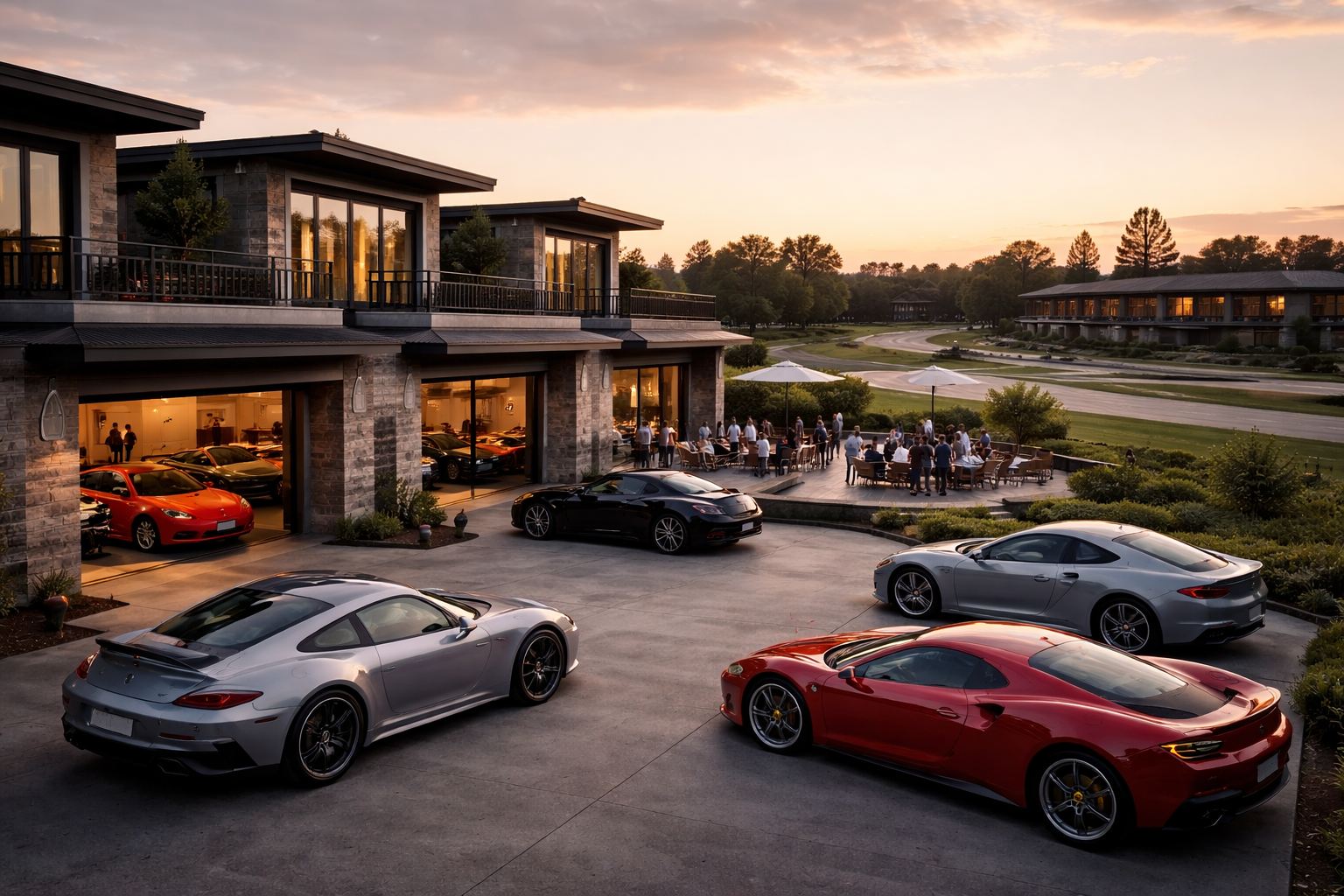
The garage condominium—a private, climate-controlled automotive storage and social space adjacent to track facilities—has transformed the private motorsports club model. The Thermal Club pioneered the concept in California’s Coachella Valley, offering garage condos ranging from $400,000 to over $2 million. These aren’t storage units; they’re customizable second homes designed around automotive passion, complete with lounges, viewing decks, and direct track access.
This real estate integration fundamentally changes the membership proposition. Like ski clubs requiring property purchase, garage condo ownership creates deep investment and commitment. Members become stakeholders in the community’s success. The model has proven so successful that nearly every new private motorsports club now incorporates garage real estate as a core offering.
Marketing Implications
- Market lifestyle over storage: Garage condos as automotive second homes, not parking spaces
- Showcase customization options: Lifts, workshops, entertainment areas, and personal touches
- Target collectors: Climate-controlled storage for valuable vehicles as primary appeal
- Create tiered options: From single-car condos to multi-vehicle compounds for diverse budgets
Trend 2: Country Club Hospitality Standards
The Data
The most successful private motorsports clubs have adopted traditional country club hospitality standards. Monticello Motor Club features a 45,000-square-foot clubhouse with fine dining, spa services, and luxury accommodations. M1 Concourse offers a members’ lounge rivaling any private city club. The expectation has shifted from “racetrack with amenities” to “country club with a racetrack.”
This hospitality evolution recognizes that track time represents a fraction of the member experience. Members bring families, host clients, and socialize with fellow enthusiasts. The quality of dining, the sophistication of the clubhouse, and the attentiveness of staff now differentiate clubs as much as track configuration. Members expect white-glove service whether they’re arriving for a track day or a Saturday brunch.
Marketing Implications
- Invest in clubhouse quality: Dining, lounges, and social spaces that rival traditional private clubs
- Train staff to country club standards: Hospitality excellence in every interaction
- Market the complete experience: Track time plus lifestyle amenities equals membership value
- Target non-driving family members: Amenities that make the club appealing for everyone
Advertisement
Trend 3: Professional Instruction Integration
The Data
Private driving clubs are evolving from track access providers to comprehensive driving education destinations. Professional instruction programs—from foundational car control to advanced racing techniques—have become core offerings. Clubs employ former professional racers, offer manufacturer-certified programs, and provide progression pathways from novice to competition-ready.
This education focus serves multiple purposes: it improves safety, increases member engagement, and creates ongoing revenue through coaching services. Members who improve their skills become more passionate, more engaged, and more likely to upgrade vehicles and maintain membership. The instruction program becomes both safety infrastructure and retention strategy.
Marketing Implications
- Develop comprehensive instruction programs: From beginner to advanced, with clear progression pathways
- Hire credentialed instructors: Professional racing backgrounds add credibility and appeal
- Create skill-based membership tiers: Access levels based on demonstrated competency
- Market improvement, not just access: Members become better drivers, not just track users
Trend 4: Manufacturer Partnership Programs
The Data
Luxury automotive manufacturers are increasingly partnering with private clubs to offer exclusive driving experiences. Porsche Experience Centers, BMW Performance Driving Schools, and Ferrari’s Corso Pilota programs demonstrate manufacturer appetite for controlled, premium environments. Private clubs that secure these partnerships gain instant credibility, programming content, and access to brand-loyal customer bases.
For manufacturers, private clubs offer ideal venues for new model launches, customer appreciation events, and owner education programs. The partnership creates mutual benefit: clubs gain programming and prestige while manufacturers access qualified, enthusiast audiences in controlled settings. Some clubs have become de facto regional headquarters for manufacturer driving programs.
Marketing Implications
- Pursue manufacturer partnerships: OEM relationships add credibility and programming
- Host launch events: New model reveals and press events attract attention
- Create brand-specific programming: Porsche days, Ferrari track time, and marque-focused events
- Leverage brand audiences: Manufacturer customer lists as membership prospect pools
Trend 5: The Collector Community Model
The Data
The collector car market exceeded $30 billion in annual transactions in 2024, and private motorsports clubs have become natural gathering points for this community. Beyond track driving, clubs now host concours events, car shows, and collector auctions. The social dimension—connecting with fellow enthusiasts who share passion for specific marques or eras—has become as valuable as track access itself.
This evolution recognizes that many members own vehicles they rarely drive at speed. A collector with a $5 million vintage Ferrari may visit the club primarily for social events, storage, and the community of fellow enthusiasts. Clubs that cater exclusively to performance driving miss this significant demographic; those that embrace collector culture capture members with exceptional spending capacity.
Marketing Implications
- Develop collector programming: Concours, car shows, and appreciation events beyond track days
- Create marque-specific communities: Porsche owners, Ferrari collectors, vintage enthusiasts
- Offer collector-focused storage: Climate control, security, and preservation as primary benefits
- Partner with auction houses: Events that attract high-net-worth collectors to the property
Trend 6: EV and Hybrid Integration
The Data
The electrification of high-performance vehicles is transforming private motorsports clubs. Tesla Plaids, Porsche Taycans, and Rimac Neveras now appear alongside traditional combustion vehicles on track. Forward-thinking clubs are investing in charging infrastructure, creating EV-specific programming, and adapting facilities for the unique requirements of electric performance driving.
This isn’t just accommodation—it’s opportunity. The EV performance segment attracts a different demographic: tech entrepreneurs, sustainability-minded enthusiasts, and early adopters who may not have engaged with traditional car culture. Clubs that embrace electrification capture these new enthusiasts while existing internal combustion members discover the unique performance characteristics of electric vehicles.
Marketing Implications
- Invest in charging infrastructure: High-speed charging at garages and paddock areas
- Create EV-specific events: Electric track days, Tesla gatherings, and EV education programs
- Target tech-sector enthusiasts: EV owners represent a distinct, affluent demographic
- Position as forward-looking: Embracing automotive future while honoring tradition
Trend 7: Simulation and Technology Integration
The Data
Professional-grade racing simulators have become standard amenities at leading private motorsports clubs. These aren’t video games—they’re training tools capable of replicating specific track configurations, weather conditions, and vehicle dynamics. Members can learn a new circuit virtually before driving it physically, practice techniques safely, and compete in sim racing leagues during off-hours or inclement weather.
Beyond simulation, data acquisition technology has transformed track driving. Members expect telemetry analysis, video overlay, and performance coaching informed by precise data. Clubs that provide sophisticated data services—helping members understand and improve through analytics—create additional value and engagement beyond raw track access.
Marketing Implications
- Invest in simulator facilities: Professional-grade equipment for training and entertainment
- Offer data acquisition services: Telemetry, video, and analysis for performance improvement
- Create sim racing leagues: Competition and community that extends beyond track hours
- Market technology leadership: Position club as cutting-edge, not just traditional
Trend 8: Corporate and Entertainment Hosting
The Data
Private motorsports clubs have become premier venues for corporate entertainment, client appreciation, and experiential marketing. The combination of exclusive access, adrenaline-fueled experiences, and luxury hospitality creates memorable events that traditional venues cannot match. Companies use track days to reward top performers, close major deals, and differentiate their brand.
This corporate business creates significant ancillary revenue while introducing potential members to the club experience. A corporate guest who experiences a track day may become a membership prospect; their employer may become a recurring client. Smart clubs balance member exclusivity with strategic corporate access that generates both revenue and membership pipeline.
Marketing Implications
- Develop corporate programs: Team building, client entertainment, and incentive packages
- Target event planners and executive assistants: Decision-makers for corporate entertainment budgets
- Create membership conversion pathways: Corporate guests as prospective members
- Balance corporate and member access: Revenue without diluting member experience
Trend 9: Rally and Touring Programs
The Data
Private motorsports clubs are extending their value proposition beyond home facilities through curated driving tours and rally experiences. Multi-day road trips through scenic routes, international driving adventures, and participation in prestigious rallies like the Mille Miglia or Copperstate 1000 create experiences that transcend track driving. These programs build deep member bonds and justify membership beyond local track access.
The touring model also creates natural reciprocity with international clubs and automotive destinations. A member might join a club-organized trip to the Nürburgring, Monaco Grand Prix, or Japanese automotive pilgrimage. These experiences—impossible to arrange independently with equivalent access and curation—become powerful membership differentiators.
Marketing Implications
- Develop signature tours: Annual rallies and driving experiences unique to your club
- Create international experiences: Bucket-list destinations and iconic driving roads
- Partner with prestigious events: VIP access to major races and automotive gatherings
- Market adventure and camaraderie: Experiences that create lifelong memories and friendships
Trend 10: Next-Generation Member Development
The Data
The future of motorsports clubs depends on cultivating next-generation enthusiasts. Leading clubs are developing youth programs, karting facilities, and family-focused driving education that create passion early. Teen driving programs that combine car control skills with enthusiasm development build the membership pipeline while providing genuine safety value.
This approach recognizes that automotive passion is often inherited—children who grow up at the track become adult members. Clubs that welcome families, create age-appropriate programming, and engage young drivers are investing in their 20-year membership future. The alternative—aging out with existing members—represents existential risk.
Marketing Implications
- Develop youth programming: Karting, teen driving courses, and family track days
- Create junior membership pathways: Progression from youth to adult membership
- Market safety education: Teen driving skills as responsible parenting
- Engage member children early: Build passion that converts to lifetime membership
Strategic Recommendations for 2026
Private motorsports clubs represent one of the fastest-growing segments of the luxury club landscape. The combination of experiential exclusivity, real estate integration, and passionate community creates a compelling membership proposition that traditional clubs struggle to match. The clubs that will dominate in 2026 are those that embrace the full “automotive country club” model—combining track excellence with hospitality sophistication.
Immediate Priorities
- Evaluate hospitality standards: Does your clubhouse rival traditional private clubs?
- Develop instruction programs: Professional coaching as core offering, not afterthought
- Invest in EV infrastructure: Charging capabilities are now table stakes
Medium-Term Investments
- Explore real estate integration: Garage condominiums as membership model evolution
- Pursue manufacturer partnerships: OEM relationships that add credibility and programming
- Develop collector programming: Concours, shows, and enthusiast events beyond track days
Long-Term Vision
- Build community over facility: Passionate enthusiast connections that transcend amenities
- Develop next-generation pipeline: Youth programs that ensure 20-year membership sustainability
- Position as lifestyle destination: Automotive country club, not racetrack with membership
The future of private motorsports clubs isn’t about lap times—it’s about lifestyle. As the category matures from enthusiast niche to established luxury segment, the clubs that will capture disproportionate value are those that deliver country club sophistication with automotive passion. The racetrack is the anchor, but the community, hospitality, and experiences that surround it determine membership value. For enthusiasts seeking to transform automotive passion into lifestyle belonging, the automotive country club has arrived.
About Private Club Marketing
Private Club Marketing is a specialized agency serving luxury private clubs including golf, tennis, social, yacht, and wellness clubs. We combine deep industry expertise with data-driven marketing strategies to help clubs attract, engage, and retain high-net-worth members.
Our services include membership marketing strategy, content creation, brand development, digital marketing, and industry analysis. We work with clubs across North America to navigate the evolving private club landscape.
Learn more at PrivateClubMarketing.com
Sources & References
- Monticello Motor Club – Membership and Facility Information, 2024-2025
- The Thermal Club – Garage Condominium Sales and Development Data
- M1 Concourse – Private Garage and Track Club Model
- Autobahn Country Club – Membership Tier Documentation
- Hagerty – Collector Car Market Statistics, 2024
- Bring a Trailer – Auction Transaction Data, 2024
- Porsche Cars North America – Experience Center Programming
- BMW Performance Driving School – Curriculum and Certification
- Ferrari North America – Corso Pilota Program Overview
- SEMA – Automotive Aftermarket Industry Report, 2024
- McKinsey & Company – Future of Mobility Report, 2024
- Private Club Marketing – Industry Research and Analysis, 2024-2025