The Wellness Mandate: Why Health-Centered Programming Has Become a Strategic Imperative

Picture of Editor

Editor

Private Club Marketing's editorial and research is conducted in conjunction with its advisory and development team.

Wellness has moved from a nice-to-have amenity to a defining expectation in today’s membership landscape. Private club wellness now shapes how members evaluate value, engagement, and long-term loyalty—extending far beyond fitness into recovery, nutrition, mental wellbeing, and daily habits. As affluent consumers organize their lives around health, clubs that treat wellness as an integrated experience rather than a single department are seeing stronger retention and deeper engagement. The competitive advantage no longer comes from adding more offerings, but from aligning the entire club experience with how members want to live.

Join our Newsletter

Wellness has moved from a nice-to-have amenity to a defining expectation in today's membership landscape. The global wellness market now exceeds $1.8 trillion, with U.S. consumers spending more than $500 billion annually on wellness—a figure growing at 10% year over year. Private club wellness now shapes how members evaluate value, engagement, and long-term loyalty—extending far beyond fitness into recovery, nutrition, mental wellbeing, and daily habits. As affluent consumers organize their lives around health, clubs that treat wellness as an integrated experience rather than a single department are seeing stronger retention and deeper engagement.

January brings the annual ritual of wellness resolutions—gym memberships purchased, diets attempted, intentions declared. By February, most will have faded. This cycle has repeated so long that it's become a cultural joke, the predictable gap between aspiration and action.

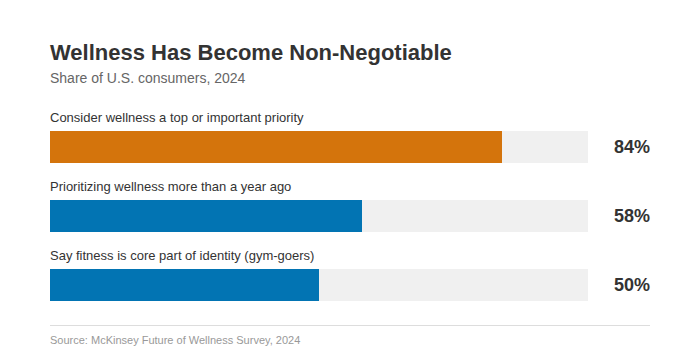
But something different is happening beneath the surface. McKinsey reports that 58% of U.S. consumers now prioritize wellness more than they did a year ago, with 84% considering wellness a top or important priority in their lives. For a growing segment of affluent consumers, wellness has shifted from periodic intention to organizing principle. These aren't people who think about health in January; they're people for whom health considerations shape daily decisions about how they eat, move, sleep, work, and spend their discretionary income.

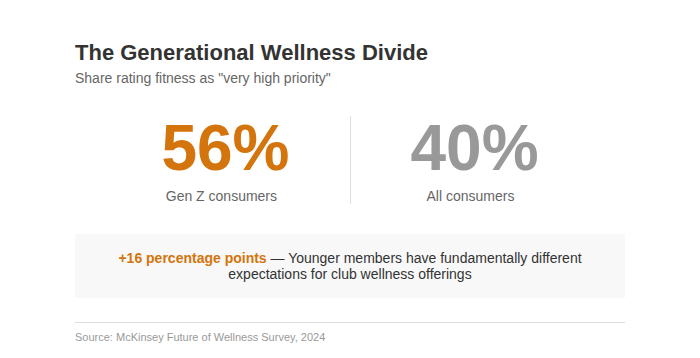
The generational shift is particularly striking: 56% of Gen Z consumers consider fitness a “very high priority” compared to just 40% of consumers overall. Half of U.S. gym-goers now say fitness is a core part of their identity. For this cohort, a private club that doesn't take wellness seriously isn't a club that's missing an amenity—it's a club that's fundamentally misaligned with how they want to live.

The implications for private clubs extend far beyond adding yoga classes or upgrading the fitness center. Wellness has evolved from a category of programming to a lens through which the entire club experience is evaluated. And the clubs that understand this evolution are discovering that wellness investment may deliver the highest return of any capital they deploy.

The Expanded Definition

Traditional club wellness meant fitness—a weight room, maybe some group exercise classes, perhaps a pool. This narrow definition persists at many clubs, where “wellness” and “fitness” remain essentially synonymous.

Contemporary wellness encompasses vastly more. Physical fitness remains important but sits alongside nutrition, mental health, sleep, stress management, recovery, longevity, and preventive care. The affluent consumer investing in wellness might work with a functional medicine doctor, track biometrics through wearable devices, follow a personalized nutrition protocol, practice meditation, optimize sleep environment, and engage in regular recovery practices like cold plunge, sauna, or massage. Fitness is one component of an integrated approach to healthspan—not just living longer but living better.

This expansion creates both challenge and opportunity for private clubs. The challenge: members' wellness expectations are shaped by the broader marketplace, where specialized providers offer depth that generalist clubs struggle to match. The opportunity: clubs can integrate wellness experiences in ways that fragmented providers cannot, creating seamless access to multiple modalities within a single membership relationship.
What Members Are Seeking

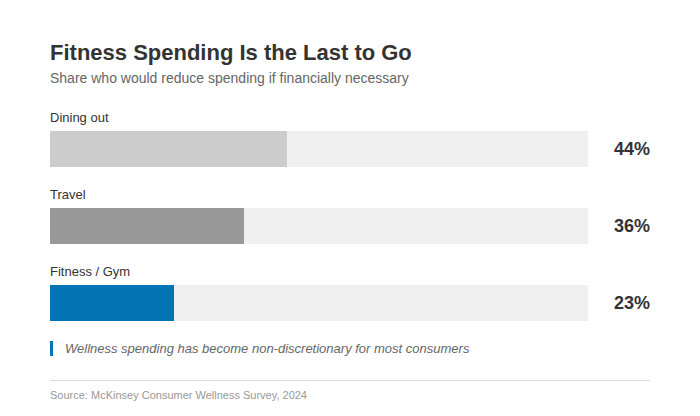
Member surveys and industry research reveal consistent themes in what wellness-focused consumers seek from their clubs. Americans are projected to spend $60 billion on fitness in 2026, with the average gym-goer now spending $101.80 per month—a 19% increase from last year. Critically, only 23% say they would reduce fitness spending if financially necessary, compared to 44% who would cut dining and 36% who would cut travel. Wellness has become non-negotiable.

Quality over quantity in fitness. Members don't need more equipment; they need better guidance. Personal training, small-group instruction, and programming that produces results matter more than square footage or machine count. The club with a modest fitness facility and exceptional trainers often outperforms the club with vast spaces and generic staff.

Recovery and regeneration facilities. Cold plunge pools, saunas (particularly infrared), steam rooms, and dedicated stretching areas have moved from luxury additions to expected amenities. Members who push their bodies hard understand that recovery is where adaptation actually happens, and they want facilities that support it. This shift is evident in the emergence of standalone recovery clubs—BASK in Detroit, Cold Plunge in Philadelphia, PORTAL in Minneapolis—concepts that would have been unthinkable a decade ago.

Nutrition that supports health goals. The traditional club dining experience—heavy portions, indulgent preparations, alcohol-centered social culture—conflicts with how health-conscious members want to eat. They're looking for menus that offer nutritious options without sacrificing culinary quality, nutrition information that enables informed choices, and social environments where healthy eating doesn't feel like deprivation.

Mental wellness support. Stress management, meditation instruction, and mental health resources have moved from taboo to sought-after. Members are increasingly open about the mental dimensions of wellbeing and want their clubs to acknowledge and support this aspect of health.

Expertise and guidance. Perhaps most importantly, members want access to knowledgeable professionals who can help them navigate the overwhelming wellness landscape. Which practices actually work? Which are marketing hype? How should they prioritize given their specific circumstances? Trusted guidance has become a primary value proposition.
The Retention Connection

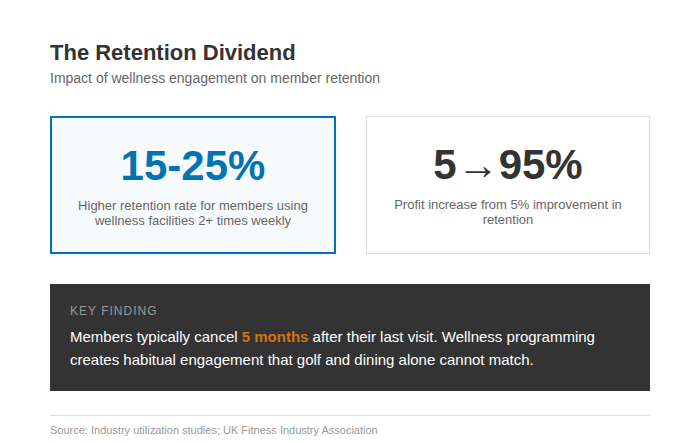
Wellness programming may be the highest-ROI retention investment a club can make. The logic is straightforward: wellness activities create regular engagement habits that dramatically reduce attrition. Industry research confirms that increasing member retention by just 5% can increase profits by 25-95%, making every percentage point of reduced churn significantly valuable.

Consider the difference between two member patterns. Member A belongs for access to the golf course, plays occasionally on weekends, and otherwise engages minimally with the club. Member B uses the fitness center three mornings a week, attends a group class regularly, and schedules periodic massage appointments. Member A's relationship with the club is episodic and easily disrupted by schedule changes, weather, or competing interests. Member B has woven the club into daily life rhythm—the relationship is habitual, reinforced multiple times weekly, and far harder to abandon.

Data from clubs that track utilization patterns confirms this intuition. Members who use wellness facilities at least twice weekly show retention rates 15-25% higher than those who engage primarily with golf or social dining. The frequent engagement creates switching costs that transcend rational evaluation of membership value. UK fitness industry data shows members typically cancel about five months after their last visit—proving that engagement frequency directly predicts retention.

Wellness also creates community in ways that some traditional club activities don't. The regulars in the 6 AM fitness class or the Thursday yoga session develop relationships that become independent reasons to maintain membership. Leaving the club means leaving these connections—a barrier that doesn't exist for members whose engagement is purely transactional.
Programming That Works

Effective wellness programming balances several tensions: broad appeal versus specialized depth, expert-led versus self-directed, structured versus flexible. The clubs getting it right typically share certain approaches.

Signature programs create identity. Rather than offering generic versions of what every gym provides, successful clubs develop distinctive programs that become associated with their brand. Consider what Equinox has done at the premium end: their “Optimize by Equinox” program commands $40,000 annually for a comprehensive longevity protocol including biomarker testing, personalized training, nutrition coaching, and sleep optimization. The waitlist demand despite this price point demonstrates that members will pay substantially for integrated, expert-guided wellness when the programming is exceptional.

Pathways accommodate different entry points. Not everyone wants high-intensity training or advanced practices. Effective programs meet members where they are, providing on-ramps for beginners, progressions for those developing capability, and advanced options for serious practitioners. The deconditioned 55-year-old and the competitive athlete should both find appropriate offerings.

Assessment and personalization add value. Generic programs produce generic results. Clubs that offer fitness assessments, body composition analysis, movement screening, and personalized programming provide guidance that members struggle to access elsewhere. This expertise justifies premium positioning and creates relationships that outlast any particular program.

Community elements build connection. Group programs, challenges, and events create social bonds around shared health pursuits. The January weight loss challenge, the spring training group for a local race, the wellness retreat that becomes an annual tradition—these shared experiences transform individual wellness journeys into community endeavors.
The Investment Case

Wellness investment requires capital that many clubs find difficult to allocate. Fitness facility renovation, spa development, and programming enhancement compete with other priorities. Boards may question whether wellness investment will generate returns that justify the expenditure.

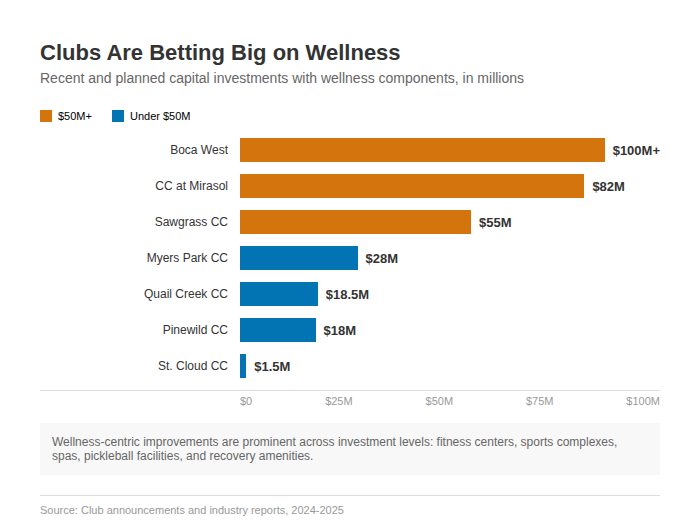
Yet clubs across the country are making significant bets on wellness-centered renovation. The Country Club at Mirasol in Palm Beach Gardens is investing $82 million in a multi-year renovation that includes a new indoor pickleball facility with seven courts and modernized grab-and-go dining options—recognizing that today's members want both active lifestyle amenities and nutrition that fits their schedules. Sawgrass Country Club in Florida has committed $55 million to capital improvements including fitness center expansion. Pinewild Country Club in Pinehurst is more than doubling its clubhouse from 12,800 to 26,000 square feet in an $18 million transformation. Boca West has announced more than $100 million in planned updates.

Not all investments require nine figures. Quail Creek Country Club in Naples completed an 18.5 million dollar, 33,000-square-foot Sports Center and Spa that has become central to member engagement. Myers Park Country Club in Charlotte's master plan includes a 24,000-square-foot sports complex with 5,600 square feet dedicated to fitness and expanded locker facilities with steam rooms. St. Cloud Country Club in Minnesota invested $1.5 million in renovations including pickleball courts and a digital golf simulator—proving that meaningful wellness improvements exist at multiple price points.

The investment case rests on three pillars. First, retention value: as discussed, members who engage with wellness programming retain at significantly higher rates. The financial value of reduced attrition often exceeds the investment required to create it. Second, revenue generation: personal training, spa services, nutrition programs, and wellness retreats generate ancillary revenue that can produce direct return on investment. Third, competitive positioning—and this is where the urgency becomes clear.
The Competitive Reality

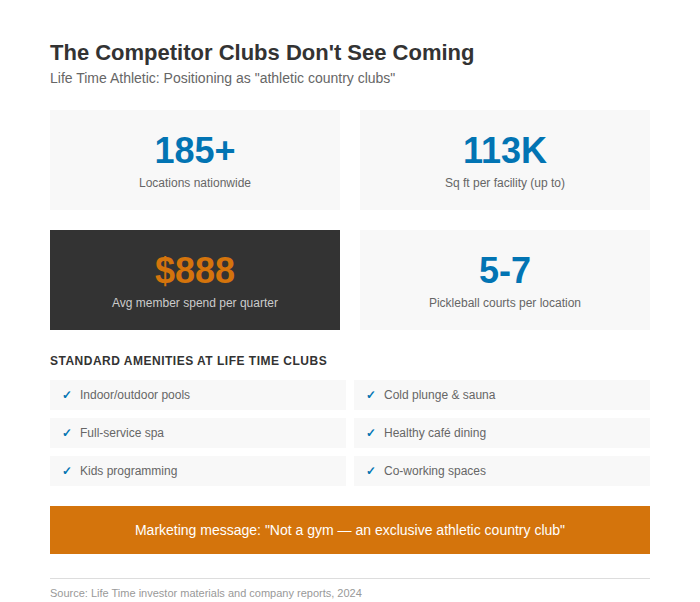
The wellness-focused competitors threatening traditional clubs aren't theoretical—they're expanding aggressively into the same affluent markets clubs serve. Life Time operates more than 185 “athletic country clubs” across North America, with facilities ranging from 57,000 to 113,000 square feet. These aren't gyms; they're comprehensive wellness ecosystems featuring multiple pools with beach club atmospheres, five to seven pickleball courts, cold plunge and sauna circuits, full-service spas, healthy dining cafés, children's programming from three months to eleven years, and even co-working spaces.

Life Time members spend an average of $888 over a three-month period on dues and additional services—a figure that approaches or exceeds many club quarterly assessments. The company is expanding into high-demand markets including Castle Pines in Colorado, multiple Texas locations, the Boston Prudential Center, and Arlington, Virginia. Their marketing explicitly positions Life Time as “not a gym—an exclusive athletic country club,” directly targeting the country club demographic.

For traditional clubs, the threat is real. A member who joins Life Time for its wellness facilities may find they no longer need their golf or social club membership—or at minimum, they're dividing their engagement and loyalty. Clubs without credible wellness offerings are increasingly losing members to these alternatives, particularly among younger demographics who prioritize fitness and wellness in their lifestyle decisions.
The Spa Evolution

Club spas have traditionally focused on relaxation and pampering—massage, facials, and body treatments positioned as indulgent escapes. This model still has its place, but the most successful club spas are evolving toward a therapeutic and performance orientation that serves the broader wellness mission.

This evolution includes sports massage and manual therapy that support athletic performance and recovery, aesthetics services that approach medical spa territory, body composition analysis and metabolic testing, partnerships with medical providers for services like IV therapy or hormone optimization, and recovery-focused treatments that complement fitness programming.

Facility design for modern spa expectations often requires substantial investment. Recovery facilities—plunge pools, saunas, steam rooms, dedicated quiet areas—require significant square footage and infrastructure. Clubs considering spa renovation should plan for this expanded footprint, as recovery amenities have moved from differentiators to baseline expectations among wellness-oriented members.

Nutrition as Wellness

Food service at most clubs operates in tension with member health goals. Rich preparations, generous portions, and menus designed primarily for taste satisfaction don't align with how health-conscious members want to eat. Many resolve this tension by simply eating elsewhere—a lost revenue opportunity and a missed connection point.

Wellness-forward clubs are rethinking food and beverage through a health lens. Specific approaches include menus with clear nutritional information including macros for members tracking intake, preparation methods that preserve nutrition without sacrificing flavor, protein-forward options for members in training, plant-based selections that satisfy rather than disappoint, grab-and-go healthy options for members coming from workouts, and sophisticated non-alcoholic options for those moderating alcohol.

Some clubs have gone further, offering nutrition consultation services, meal planning support, or prepared meal programs that members can take home. These services extend the club's wellness value beyond the grounds and into members' daily lives—creating touchpoints and revenue opportunities that traditional club dining doesn't reach.

Medical Partnerships and Mental Wellness

The line between wellness and healthcare is blurring. Affluent consumers increasingly approach health proactively, seeking optimization rather than waiting for illness. Services like executive health screenings, preventive diagnostics, hormone optimization, and longevity medicine are growing rapidly—and private clubs are beginning to incorporate them through partnerships with healthcare providers.

Mental health has similarly shed much of its stigma among affluent professionals. The executives and entrepreneurs who form club membership bases increasingly recognize that mental wellness underlies everything else—that stress, anxiety, and burnout undermine physical health, relationships, and professional performance. Clubs can address mental wellness through meditation instruction, breathwork classes, stress management programming, and counseling services through partnerships with therapists. The physical environment itself can support mental wellness through quiet spaces designed for reflection, natural elements, and intentional design that creates calm.

Starting Where You Are

Not every club can undertake major wellness facility investment immediately. But every club can begin evolving toward a more wellness-centered approach within existing resources.

Programming changes often require minimal capital. Better classes, improved personal training, meditation offerings, and nutrition education can launch within existing facilities. The key is quality of instruction—which requires investing in people rather than equipment. Menu evolution can happen incrementally. Partnerships extend capability without capital—the right relationships with personal trainers, nutritionists, mental health professionals, and healthcare providers can deliver wellness depth that would be impossible to build internally.

Culture shift may matter most of all. When leadership genuinely values wellness, when staff embody healthy practices, when the club environment celebrates health rather than just indulgence—these cultural elements shape member experience in ways that transcend any particular program or facility.

The Wellness Club

For some clubs, wellness will remain one offering among many. For others, it may become the organizing principle around which the entire experience revolves—a wellness club that happens to offer golf and dining rather than a country club that happens to have a fitness center.

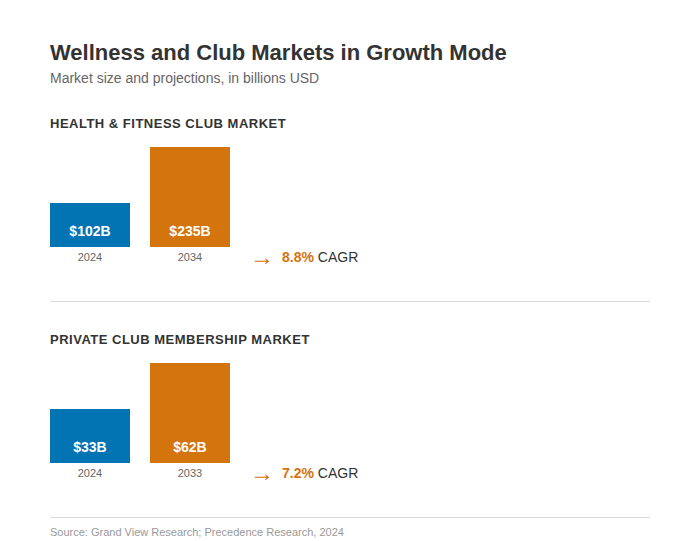
Neither approach is inherently superior. The right choice depends on membership composition, competitive landscape, and club identity. But every club needs to make an explicit choice about wellness positioning rather than drifting along with legacy facilities and assumptions. The private club membership market, currently valued at $32.7 billion and projected to reach $61.7 billion by 2033, will increasingly belong to clubs that align with how contemporary affluent consumers want to live.

The members walking through your doors this January with wellness intentions deserve better than the usual fate of resolutions. They deserve a club that understands what they're trying to achieve, provides genuine support for achieving it, and creates an environment where healthy living is normal rather than novel. The clubs that deliver this will find that wellness investment pays returns far beyond what spreadsheets can capture—in loyalty, engagement, and members who feel their club truly understands how they want to live.

The Wellness Mandate: Why Health-Centered Programming Has Become a Strategic Imperative

Wellness has moved from a nice-to-have amenity to a defining expectation in today’s membership landscape. Private club wellness now shapes how members evaluate value, engagement, and long-term loyalty—extending far beyond fitness into recovery, nutrition, mental wellbeing, and daily habits. As affluent consumers organize their lives around health, clubs that treat wellness as an integrated experience rather than a single department are seeing stronger retention and deeper engagement. The competitive advantage no longer comes from adding more offerings, but from aligning the entire club experience with how members want to live.

Join our Newsletter

Wellness has moved from a nice-to-have amenity to a defining expectation in today's membership landscape. The global wellness market now exceeds $1.8 trillion, with U.S. consumers spending more than $500 billion annually on wellness—a figure growing at 10% year over year. Private club wellness now shapes how members evaluate value, engagement, and long-term loyalty—extending far beyond fitness into recovery, nutrition, mental wellbeing, and daily habits. As affluent consumers organize their lives around health, clubs that treat wellness as an integrated experience rather than a single department are seeing stronger retention and deeper engagement.

January brings the annual ritual of wellness resolutions—gym memberships purchased, diets attempted, intentions declared. By February, most will have faded. This cycle has repeated so long that it's become a cultural joke, the predictable gap between aspiration and action.

But something different is happening beneath the surface. McKinsey reports that 58% of U.S. consumers now prioritize wellness more than they did a year ago, with 84% considering wellness a top or important priority in their lives. For a growing segment of affluent consumers, wellness has shifted from periodic intention to organizing principle. These aren't people who think about health in January; they're people for whom health considerations shape daily decisions about how they eat, move, sleep, work, and spend their discretionary income.

The generational shift is particularly striking: 56% of Gen Z consumers consider fitness a “very high priority” compared to just 40% of consumers overall. Half of U.S. gym-goers now say fitness is a core part of their identity. For this cohort, a private club that doesn't take wellness seriously isn't a club that's missing an amenity—it's a club that's fundamentally misaligned with how they want to live.

The implications for private clubs extend far beyond adding yoga classes or upgrading the fitness center. Wellness has evolved from a category of programming to a lens through which the entire club experience is evaluated. And the clubs that understand this evolution are discovering that wellness investment may deliver the highest return of any capital they deploy.

The Expanded Definition

Traditional club wellness meant fitness—a weight room, maybe some group exercise classes, perhaps a pool. This narrow definition persists at many clubs, where “wellness” and “fitness” remain essentially synonymous.

Contemporary wellness encompasses vastly more. Physical fitness remains important but sits alongside nutrition, mental health, sleep, stress management, recovery, longevity, and preventive care. The affluent consumer investing in wellness might work with a functional medicine doctor, track biometrics through wearable devices, follow a personalized nutrition protocol, practice meditation, optimize sleep environment, and engage in regular recovery practices like cold plunge, sauna, or massage. Fitness is one component of an integrated approach to healthspan—not just living longer but living better.

This expansion creates both challenge and opportunity for private clubs. The challenge: members' wellness expectations are shaped by the broader marketplace, where specialized providers offer depth that generalist clubs struggle to match. The opportunity: clubs can integrate wellness experiences in ways that fragmented providers cannot, creating seamless access to multiple modalities within a single membership relationship.

What Members Are Seeking

Member surveys and industry research reveal consistent themes in what wellness-focused consumers seek from their clubs. Americans are projected to spend $60 billion on fitness in 2026, with the average gym-goer now spending $101.80 per month—a 19% increase from last year. Critically, only 23% say they would reduce fitness spending if financially necessary, compared to 44% who would cut dining and 36% who would cut travel. Wellness has become non-negotiable.

Quality over quantity in fitness. Members don't need more equipment; they need better guidance. Personal training, small-group instruction, and programming that produces results matter more than square footage or machine count. The club with a modest fitness facility and exceptional trainers often outperforms the club with vast spaces and generic staff.

Recovery and regeneration facilities. Cold plunge pools, saunas (particularly infrared), steam rooms, and dedicated stretching areas have moved from luxury additions to expected amenities. Members who push their bodies hard understand that recovery is where adaptation actually happens, and they want facilities that support it. This shift is evident in the emergence of standalone recovery clubs—BASK in Detroit, Cold Plunge in Philadelphia, PORTAL in Minneapolis—concepts that would have been unthinkable a decade ago.

Nutrition that supports health goals. The traditional club dining experience—heavy portions, indulgent preparations, alcohol-centered social culture—conflicts with how health-conscious members want to eat. They're looking for menus that offer nutritious options without sacrificing culinary quality, nutrition information that enables informed choices, and social environments where healthy eating doesn't feel like deprivation.

Mental wellness support. Stress management, meditation instruction, and mental health resources have moved from taboo to sought-after. Members are increasingly open about the mental dimensions of wellbeing and want their clubs to acknowledge and support this aspect of health.

Expertise and guidance. Perhaps most importantly, members want access to knowledgeable professionals who can help them navigate the overwhelming wellness landscape. Which practices actually work? Which are marketing hype? How should they prioritize given their specific circumstances? Trusted guidance has become a primary value proposition.

The Retention Connection

Wellness programming may be the highest-ROI retention investment a club can make. The logic is straightforward: wellness activities create regular engagement habits that dramatically reduce attrition. Industry research confirms that increasing member retention by just 5% can increase profits by 25-95%, making every percentage point of reduced churn significantly valuable.

Consider the difference between two member patterns. Member A belongs for access to the golf course, plays occasionally on weekends, and otherwise engages minimally with the club. Member B uses the fitness center three mornings a week, attends a group class regularly, and schedules periodic massage appointments. Member A's relationship with the club is episodic and easily disrupted by schedule changes, weather, or competing interests. Member B has woven the club into daily life rhythm—the relationship is habitual, reinforced multiple times weekly, and far harder to abandon.

Data from clubs that track utilization patterns confirms this intuition. Members who use wellness facilities at least twice weekly show retention rates 15-25% higher than those who engage primarily with golf or social dining. The frequent engagement creates switching costs that transcend rational evaluation of membership value. UK fitness industry data shows members typically cancel about five months after their last visit—proving that engagement frequency directly predicts retention.

Wellness also creates community in ways that some traditional club activities don't. The regulars in the 6 AM fitness class or the Thursday yoga session develop relationships that become independent reasons to maintain membership. Leaving the club means leaving these connections—a barrier that doesn't exist for members whose engagement is purely transactional.

Programming That Works

Effective wellness programming balances several tensions: broad appeal versus specialized depth, expert-led versus self-directed, structured versus flexible. The clubs getting it right typically share certain approaches.

Signature programs create identity. Rather than offering generic versions of what every gym provides, successful clubs develop distinctive programs that become associated with their brand. Consider what Equinox has done at the premium end: their “Optimize by Equinox” program commands $40,000 annually for a comprehensive longevity protocol including biomarker testing, personalized training, nutrition coaching, and sleep optimization. The waitlist demand despite this price point demonstrates that members will pay substantially for integrated, expert-guided wellness when the programming is exceptional.

Pathways accommodate different entry points. Not everyone wants high-intensity training or advanced practices. Effective programs meet members where they are, providing on-ramps for beginners, progressions for those developing capability, and advanced options for serious practitioners. The deconditioned 55-year-old and the competitive athlete should both find appropriate offerings.

Assessment and personalization add value. Generic programs produce generic results. Clubs that offer fitness assessments, body composition analysis, movement screening, and personalized programming provide guidance that members struggle to access elsewhere. This expertise justifies premium positioning and creates relationships that outlast any particular program.

Community elements build connection. Group programs, challenges, and events create social bonds around shared health pursuits. The January weight loss challenge, the spring training group for a local race, the wellness retreat that becomes an annual tradition—these shared experiences transform individual wellness journeys into community endeavors.

The Investment Case

Wellness investment requires capital that many clubs find difficult to allocate. Fitness facility renovation, spa development, and programming enhancement compete with other priorities. Boards may question whether wellness investment will generate returns that justify the expenditure.

Yet clubs across the country are making significant bets on wellness-centered renovation. The Country Club at Mirasol in Palm Beach Gardens is investing $82 million in a multi-year renovation that includes a new indoor pickleball facility with seven courts and modernized grab-and-go dining options—recognizing that today's members want both active lifestyle amenities and nutrition that fits their schedules. Sawgrass Country Club in Florida has committed $55 million to capital improvements including fitness center expansion. Pinewild Country Club in Pinehurst is more than doubling its clubhouse from 12,800 to 26,000 square feet in an $18 million transformation. Boca West has announced more than $100 million in planned updates.

Not all investments require nine figures. Quail Creek Country Club in Naples completed an 18.5 million dollar, 33,000-square-foot Sports Center and Spa that has become central to member engagement. Myers Park Country Club in Charlotte's master plan includes a 24,000-square-foot sports complex with 5,600 square feet dedicated to fitness and expanded locker facilities with steam rooms. St. Cloud Country Club in Minnesota invested $1.5 million in renovations including pickleball courts and a digital golf simulator—proving that meaningful wellness improvements exist at multiple price points.

The investment case rests on three pillars. First, retention value: as discussed, members who engage with wellness programming retain at significantly higher rates. The financial value of reduced attrition often exceeds the investment required to create it. Second, revenue generation: personal training, spa services, nutrition programs, and wellness retreats generate ancillary revenue that can produce direct return on investment. Third, competitive positioning—and this is where the urgency becomes clear.

The Competitive Reality

The wellness-focused competitors threatening traditional clubs aren't theoretical—they're expanding aggressively into the same affluent markets clubs serve. Life Time operates more than 185 “athletic country clubs” across North America, with facilities ranging from 57,000 to 113,000 square feet. These aren't gyms; they're comprehensive wellness ecosystems featuring multiple pools with beach club atmospheres, five to seven pickleball courts, cold plunge and sauna circuits, full-service spas, healthy dining cafés, children's programming from three months to eleven years, and even co-working spaces.

Life Time members spend an average of $888 over a three-month period on dues and additional services—a figure that approaches or exceeds many club quarterly assessments. The company is expanding into high-demand markets including Castle Pines in Colorado, multiple Texas locations, the Boston Prudential Center, and Arlington, Virginia. Their marketing explicitly positions Life Time as “not a gym—an exclusive athletic country club,” directly targeting the country club demographic.

For traditional clubs, the threat is real. A member who joins Life Time for its wellness facilities may find they no longer need their golf or social club membership—or at minimum, they're dividing their engagement and loyalty. Clubs without credible wellness offerings are increasingly losing members to these alternatives, particularly among younger demographics who prioritize fitness and wellness in their lifestyle decisions.

The Spa Evolution

Club spas have traditionally focused on relaxation and pampering—massage, facials, and body treatments positioned as indulgent escapes. This model still has its place, but the most successful club spas are evolving toward a therapeutic and performance orientation that serves the broader wellness mission.

This evolution includes sports massage and manual therapy that support athletic performance and recovery, aesthetics services that approach medical spa territory, body composition analysis and metabolic testing, partnerships with medical providers for services like IV therapy or hormone optimization, and recovery-focused treatments that complement fitness programming.

Facility design for modern spa expectations often requires substantial investment. Recovery facilities—plunge pools, saunas, steam rooms, dedicated quiet areas—require significant square footage and infrastructure. Clubs considering spa renovation should plan for this expanded footprint, as recovery amenities have moved from differentiators to baseline expectations among wellness-oriented members.

Nutrition as Wellness

Food service at most clubs operates in tension with member health goals. Rich preparations, generous portions, and menus designed primarily for taste satisfaction don't align with how health-conscious members want to eat. Many resolve this tension by simply eating elsewhere—a lost revenue opportunity and a missed connection point.

Wellness-forward clubs are rethinking food and beverage through a health lens. Specific approaches include menus with clear nutritional information including macros for members tracking intake, preparation methods that preserve nutrition without sacrificing flavor, protein-forward options for members in training, plant-based selections that satisfy rather than disappoint, grab-and-go healthy options for members coming from workouts, and sophisticated non-alcoholic options for those moderating alcohol.

Some clubs have gone further, offering nutrition consultation services, meal planning support, or prepared meal programs that members can take home. These services extend the club's wellness value beyond the grounds and into members' daily lives—creating touchpoints and revenue opportunities that traditional club dining doesn't reach.

Medical Partnerships and Mental Wellness

The line between wellness and healthcare is blurring. Affluent consumers increasingly approach health proactively, seeking optimization rather than waiting for illness. Services like executive health screenings, preventive diagnostics, hormone optimization, and longevity medicine are growing rapidly—and private clubs are beginning to incorporate them through partnerships with healthcare providers.

Mental health has similarly shed much of its stigma among affluent professionals. The executives and entrepreneurs who form club membership bases increasingly recognize that mental wellness underlies everything else—that stress, anxiety, and burnout undermine physical health, relationships, and professional performance. Clubs can address mental wellness through meditation instruction, breathwork classes, stress management programming, and counseling services through partnerships with therapists. The physical environment itself can support mental wellness through quiet spaces designed for reflection, natural elements, and intentional design that creates calm.

Starting Where You Are

Not every club can undertake major wellness facility investment immediately. But every club can begin evolving toward a more wellness-centered approach within existing resources.

Programming changes often require minimal capital. Better classes, improved personal training, meditation offerings, and nutrition education can launch within existing facilities. The key is quality of instruction—which requires investing in people rather than equipment. Menu evolution can happen incrementally. Partnerships extend capability without capital—the right relationships with personal trainers, nutritionists, mental health professionals, and healthcare providers can deliver wellness depth that would be impossible to build internally.

Culture shift may matter most of all. When leadership genuinely values wellness, when staff embody healthy practices, when the club environment celebrates health rather than just indulgence—these cultural elements shape member experience in ways that transcend any particular program or facility.

The Wellness Club

For some clubs, wellness will remain one offering among many. For others, it may become the organizing principle around which the entire experience revolves—a wellness club that happens to offer golf and dining rather than a country club that happens to have a fitness center.

Neither approach is inherently superior. The right choice depends on membership composition, competitive landscape, and club identity. But every club needs to make an explicit choice about wellness positioning rather than drifting along with legacy facilities and assumptions. The private club membership market, currently valued at $32.7 billion and projected to reach $61.7 billion by 2033, will increasingly belong to clubs that align with how contemporary affluent consumers want to live.

The members walking through your doors this January with wellness intentions deserve better than the usual fate of resolutions. They deserve a club that understands what they're trying to achieve, provides genuine support for achieving it, and creates an environment where healthy living is normal rather than novel. The clubs that deliver this will find that wellness investment pays returns far beyond what spreadsheets can capture—in loyalty, engagement, and members who feel their club truly understands how they want to live.

Unlocking Real Estate Opportunities: The Rise Of Private Social Clubs

ACCESS PASSWORD: socialclubs2024

private club marketing