
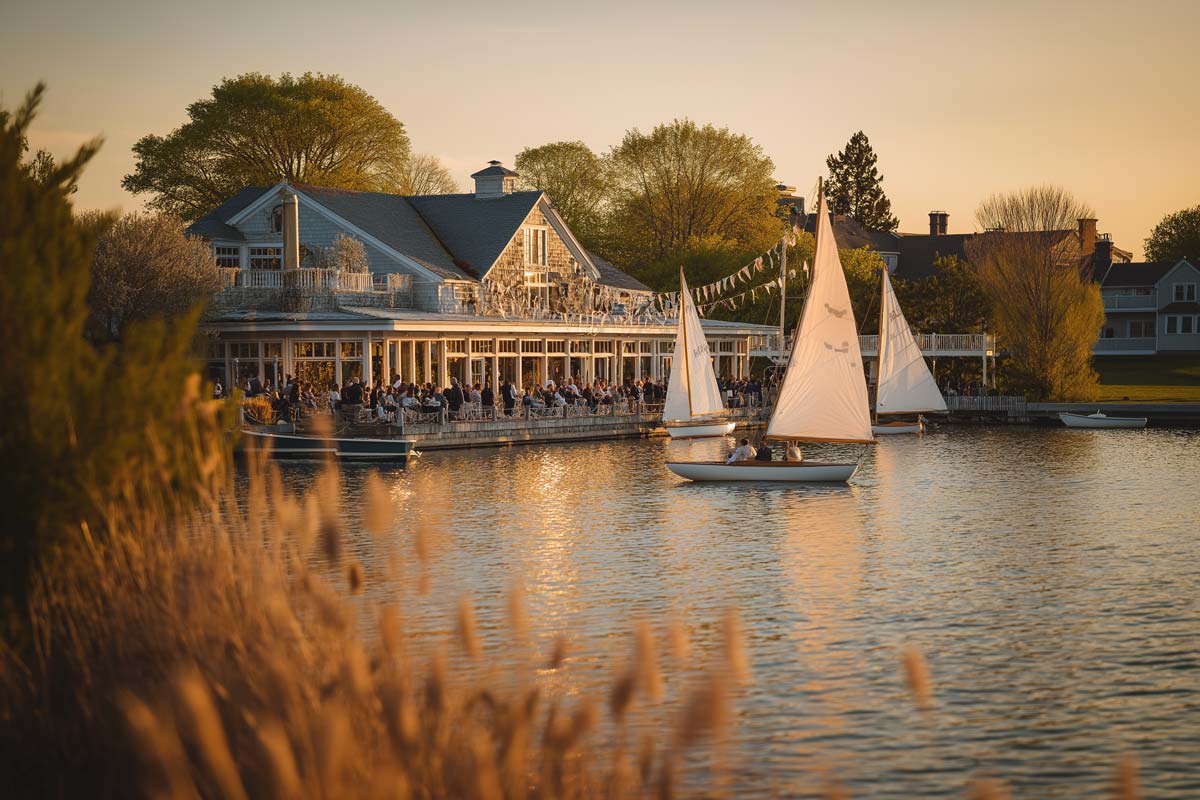
The first warm Saturday of March does something particular to waterfront real estate. It fills the docks. It fills the parking lots. And for the membership directors of America’s premier yacht and waterfront clubs, it signals the opening of the most consequential selling season of the year — a window that closes faster than most boards appreciate, and rewards, almost exclusively, those who prepared for it in January.
Spring is not merely a seasonal uptick for waterfront clubs. It is the annual moment when the emotional chemistry of membership aspiration is most potent: the water is inviting, social calendars are filling, and the psychological friction of a major financial commitment is at its lowest. Prospects who have spent winter passively observing the club’s digital presence, imagining themselves docked at a slip or seated at a terrace table at golden hour, are primed to act. The clubs that capture this moment do not simply open their doors wider. They engineer a system — one that converts aspiration into enrollment, and enrollment into long-term referral.
According to Club Benchmarking’s 2024 State of the Industry Report, private clubs running structured spring membership campaigns generate an average of 23% more new member revenue than those relying on passive inquiry processes. The National Club Association found that 68% of new private club members credit a personal referral as the primary reason they investigated membership — a figure that, in yacht club contexts, climbs even higher given the tight social networks of the boating community. Meanwhile, boat ownership among millennials grew 19% between 2020 and 2024, the fastest rate of any demographic segment, expanding the addressable prospect pool at precisely the moment that legacy clubs are competing against more flexible, lower-barrier waterfront offerings.
The data also surfaces a structural tension that makes spring strategy uniquely complex for waterfront clubs. Research now consistently shows that between 30% and 50% of yacht club members do not own boats — they join for the waterfront lifestyle, dining, community, and access to the water without the burden of vessel ownership. This “social sailor” population represents both an enormous expansion of the addressable prospect pool and a genuine identity challenge: how does a club that defines itself by maritime heritage market to people whose relationship to the water is aspirational rather than operational? The answer, for the clubs executing this best, is not to dilute the brand. It is to stage the experience so that aspiration becomes participation.
The Waitlist Is Not a Passive Queue — It Is an Active Asset
In the golf and country club world, the shift from passive waitlist management to proactive prospect cultivation took the better part of a decade to take hold. In the yacht club segment, that shift is happening now — and the clubs moving fastest are establishing competitive advantages that will compound over multiple membership cycles. The core insight is straightforward: a waitlisted prospect at a waterfront club has already self-selected into a highly specific lifestyle identity. They have raised their hand. Treating that commitment as an administrative placeholder rather than an emotional signal is one of the most persistent and costly errors in club membership management.
The clubs capturing the most revenue this season are engineering waitlists as proactive marketing instruments — not waiting for qualified candidates to flow through.
St. Francis Yacht Club in San Francisco — consistently ranked among the top five yacht clubs in the country by Club Leaders Forum’s Platinum Clubs of America — has developed what its membership team describes as a “proximity model” for waitlisted candidates. Rather than leaving prospects in a quiet queue, the club invites them to observe key racing events, attend select social programming, and engage with the club’s 130-plus annual competition days before their membership slot formally opens. By the time an offer arrives, a significant portion of new members have already spent meaningful time at the facility, dramatically reducing the window between offer and signed agreement — and yielding conversion rates that clubs relying solely on correspondence cannot match.
This approach aligns with what behavioral economists call the endowment effect — the tendency for people to assign greater value to things they have already experienced or feel partial ownership over. When a prospect has stood on the dock during a major regatta, tasted the dining program, and introduced themselves to a half-dozen members before their membership is official, the psychological work of conversion is largely complete. The club is not selling them on a concept. It is confirming a decision they have already made emotionally.
The Endowment Effect
Waterfront clubs have a structural advantage that inland clubs cannot replicate: the experience they sell is visible, tactile, and publicly spectacular. Regattas, sunset cruises, dock parties — these are organic marketing events that require only deliberate access management to become powerful conversion tools. Inviting waitlisted prospects to observe, not just imagine, closes the psychological gap between aspiration and commitment faster than any email sequence.
The clubs that execute this best develop quarterly touchpoints that move prospects emotionally and informationally closer before a spot officially opens — invitations to non-member events, behind-the-scenes dock tours during off-peak hours, early access to the racing calendar. The result is that by the time a membership slot opens, the prospect has already psychologically committed to joining.
Structuring the Spring Drive for Maximum Conversion
A spring membership drive executed at the highest level has three distinct phases: activation, acceleration, and anchoring. Collapsing them into a single undifferentiated push — or treating the entire season as one email blast — is the most common structural error in club marketing planning.
Phase 1: Activation
Late February – Early March
Shift from brand awareness to offer-driven messaging. Segment the waitlist by profile — racing-primary, cruising-primary, social/dining-primary — and deploy tailored communications aligned to each prospect’s reason for joining.
Phase 2: Acceleration
March – April
Personalized, one-to-one outreach at maximum intensity. Host a spring preview on the water that functions simultaneously as an experience driver and a natural referral moment. Guests bring guests.
Phase 3: Anchoring
Late April – May
Urgency-driven communications that make the cost of waiting tangible. Communicate specific spot availability, upcoming fee adjustments, and slip access windows — factual and data-grounded, not promotional.
The activation phase is where most clubs underinvest. Sending a single announcement to the full waitlist — “Spring membership spots are now available” — misses the segmentation opportunity that is the primary lever of high-performing spring campaigns. CMAA’s Annual Membership Marketing Data shows that segmented email campaigns achieve open rates between 38% and 44% in private club contexts, compared to an industry average of roughly 27% for undifferentiated communications. In the yacht club segment, where a competitive racer has almost nothing in common with a social member who wants a dock table at sunset, segmentation is not a sophistication. It is a basic operational necessity.
Email Open Rates: Segmented vs. Undifferentiated Spring Campaigns (CMAA, 2024)
San Diego Yacht Club — a two-time America’s Cup winner and perennial Platinum Club honoree — has built its spring drive around exactly this segmentation architecture. The club’s membership team operates with distinct communication tracks for racing, cruising, and social members, each receiving content and event invitations calibrated to their engagement style. The club’s junior sailing program, which has produced Olympic medalists and is widely recognized as one of the strongest youth development programs in the country, is featured prominently in communications to family-primary prospects — a segment whose conversion is often driven less by slip access than by the question of what their children will do on summer mornings. That specificity, applied consistently across the three-phase arc, is a meaningful driver of the club’s consistently strong spring enrollment numbers.
Where Most Clubs Lose Momentum
The anchoring phase is where waterfront clubs most frequently squander the goodwill built during activation and acceleration. Manufactured urgency — vague language about “limited availability” with no specific numbers — reads as promotional in an environment where exclusivity is already the baseline proposition. The most effective anchoring messages are forensically factual: a specific number of slips becoming available this season, a specific date on which initiation fees will increase. According to Club Benchmarking, private club initiation fees rose an average of 8.7% in 2024. That figure, communicated clearly and confidently to a waitlisted prospect, is not a sales tactic. It is useful information.
Modernizing Membership Pathways Without Losing Exclusivity
The structural tension at the center of yacht club marketing in 2026 is the same one that every legacy membership institution is navigating: how to expand the prospect pool without diluting the brand equity that makes membership desirable in the first place. The rise of the social sailor — the non-boat-owner who wants the waterfront experience without the vessel — gives this tension a specific waterfront manifestation. Ignoring this demographic means leaving a substantial proportion of qualified, high-value prospects unaddressed. Over-accommodating them without a coherent membership architecture undermines the club’s identity in the eyes of its core constituency.
The clubs navigating this most successfully are not choosing between exclusivity and accessibility. They are creating tiered membership architectures that preserve the premium signaling of full membership while establishing clearly delineated pathways for social and associate members — pathways that are aspirational in design and engineered to convert upward over time. Marina slip demand currently exceeds supply by 30 to 40 percent in premium coastal markets, a supply constraint that, properly communicated, reinforces exclusivity at the full-membership level while making associate and social tiers genuinely compelling to the next tier of prospects.
3-Year Membership Growth: Single-Tier vs. Tiered Model (Club Benchmarking, 2024)
Annapolis Yacht Club, founded in 1886 on the Chesapeake Bay and consistently ranked among the top five yacht clubs in the country by Club Leaders Forum, has refined this tiered architecture in ways worth examining closely. The club organizes the traditional Annapolis to Newport Race — one of the most iconic offshore events in American sailing — giving its marketing team an event of genuine national stature around which to construct spring prospect engagement. But the club’s recent membership growth has been driven not by racing prestige alone, but by deliberate programming built around the Chesapeake Bay lifestyle that appeals to non-racing prospects: waterfront dining, family programming, and social cruising events that create meaningful entry points for the social sailor segment. Membership requires sponsorship from at least two existing members, maintaining the referral imperative at the structural level of the application process itself.
The clubs navigating the exclusivity-accessibility tension most successfully are not choosing between them — they are engineering tiered architectures where every pathway points upward.
The Tiering Paradox
Counterintuitively, clubs with well-structured tiered membership often see higher conversion rates on their top-tier full memberships than those with a single, undifferentiated offer. When a prospect enters as a social or associate member and experiences the facility firsthand, the endowment effect does its work. The conversion from associate to full membership is not a new sales process — it is the completion of one that began the day they first walked the dock.
| Dimension | Single-Tier Model | Tiered Membership Model |
|---|---|---|
| Prospect Pool | Boat owners and established members only | Includes social sailors, young professionals, families |
| Conversion Path | Single decision point — high friction | Graduated entry — lower initial barrier |
| 3-Year Growth (Index) | 100 | 119 (Club Benchmarking, 2024) |
| Referral Dynamics | Referral concentrated at full-member level | Referral active across all tiers |
| Attrition Risk | Higher — single commitment point | Lower — graduated engagement builds attachment |
Advertisement
Referral Engineering: Turning New Members Into Acquisition Channels
No marketing channel in private club acquisition is more efficient than the personal referral. In the yacht and waterfront club segment, this dynamic is particularly pronounced: the social networks of active boaters and waterfront lifestyle enthusiasts are tight, trust-governed, and deeply tribal. A recommendation from a trusted member operates in an entirely different register of credibility than any digital advertisement. The challenge for membership marketing directors is that referrals do not happen at a meaningful rate by accident. They happen by design, when clubs create systems that make referring natural, well-timed, and rewarding.
A 2023 study by the Cornell School of Hotel Administration found that new members of social clubs are most likely to refer within the first 90 days of membership, and that clubs failing to activate referral behavior within that window see referral rates drop by more than half over the subsequent twelve months. The implication is direct: onboarding at a yacht club is not an administrative process. It is a referral activation strategy. Every decision made in the first 90 days — from the welcome kit to the first event invitation to the first one-on-one conversation with the membership director — should be evaluated through the lens of its referral potential.
The most effective waterfront clubs build referral mechanics directly into their onboarding architecture. Within the first 48 hours of a membership agreement being signed, new members receive a personalized welcome from the general manager and — critically — a set of guest invitations for upcoming spring programming that they can extend at their own discretion. By giving new members the social currency of hosting before they have attended their first event as members, the club accelerates the referral window from months to days, and gives the new member an immediate, tangible expression of the exclusivity they have just purchased: the ability to bring someone else inside.
New Member Referral Likelihood by Month Post-Joining (Cornell SHA, 2023)
The 90-Day Window
Members recruited through referral are 2.4 times more likely to refer others in their first three years than members who joined through direct inquiry, according to Club Benchmarking’s 2024 data. A cohort of 20 spring members who were each recruited by referral, and who are each systematically activated as referral sources themselves, does not produce 20 new prospects. Over a three-year horizon, it produces a compounding pipeline that funds subsequent spring drives with minimal external marketing spend.
Revitalizing Programming for Multi-Generational Engagement
The demographic arithmetic of yacht club membership is shifting in ways that make multi-generational programming a structural requirement for long-term sustainability rather than a discretionary addition to the spring calendar. Millennial boat ownership grew 19% between 2020 and 2024 — the fastest rate of any demographic — driven by pandemic-era outdoor orientation and a broader shift toward experiential spending among younger affluent consumers. This cohort is entering the prime prospect window for yacht club membership, but their expectations around programming, flexibility, and the experiential value of dues are materially different from those of the members who built today’s clubs.
The clubs with the strongest multi-generational membership health are, almost without exception, those with the strongest youth sailing and waterfront programs — not because junior members are immediate revenue contributors, but because a family whose children spend summers at the club develops a depth of institutional attachment that adult programming alone cannot replicate. San Diego Yacht Club’s nationally recognized junior sailing program, which operates year-round and produces competitive sailors at every level from beginner to Olympic, is a direct contributor to the club’s membership retention and referral strength. Parents who watch their children progress through a world-class junior program are among the most loyal and most active referral sources in the membership body.
For clubs without an existing junior program of that scale, the spring drive is the natural moment to announce programming expansions that signal multi-generational commitment. A new learn-to-sail series for members’ children, a junior racing clinic, or a family-oriented Sunday dock brunch — none of these are operationally complex, but communicated deliberately to the family-primary segment of the waitlist, they answer the question that is often left unasked in waterfront club marketing: What will my family do here?
Annapolis Yacht Club’s programming model illustrates this balance effectively. The club organizes events spanning the full spectrum of member engagement — from elite offshore racing to casual social cruises to junior learn-to-sail days on the Chesapeake — creating a programming architecture where a competitive sailor and a non-boat-owning family can both find a genuine foothold. The result is a membership body broad enough to sustain the club’s financial model without becoming so diffuse that its identity grows unclear.
5-Year Member Retention: Strong Junior Program vs. No Junior Program (CMAA, 2024)
The Measurement Gap
Too many clubs evaluate programming through attendance rather than engagement depth. A dock party with two hundred guests may look successful on a spreadsheet, but if seventy percent were existing friends, the new member integration value is minimal. Club Benchmarking’s 2024 analysis found that clubs in the top quartile for new member social integration at the ninety-day mark had five-year retention rates 18 percentage points higher than clubs in the bottom quartile — even after controlling for facilities quality, dues structure, and location.
The Strategic Imperative for 2026
The window for spring membership success at waterfront clubs is shorter than most marketing calendars account for and more consequential than most boards appreciate. Prospects who are not converted during the spring window frequently do not re-engage until the following year — if at all. The competitive environment has intensified: boutique waterfront clubs, fractional ownership models, and boat club memberships like Freedom Boat Club, which crossed 90,000 members in 2024, are competing for the same discretionary leisure dollars with more flexible, lower-barrier offerings. Legacy clubs that rely on institutional reputation alone to do the conversion work are operating with a structural disadvantage that compounds season over season.
The clubs capturing the most ground this spring share a common operating posture: they treat the waitlist as a relationship portfolio, the spring drive as a three-phase system, the onboarding window as a referral activation strategy, and multi-generational programming as a long-term retention instrument. None of these postures require resources that most clubs do not already have. They require clarity, consistency, and the institutional will to treat the season with the urgency it genuinely demands.
- Waitlist as relationship portfolio: Treat your waitlist as a curated audience of self-selected prospects — not an administrative queue. Develop quarterly on-water touchpoints that build emotional ownership before a spot opens.
- Segment before you send: Racing-primary, cruising-primary, and social-primary prospects require distinct communication tracks. The 38–44% open rates achieved by segmented spring campaigns are not available to clubs broadcasting a single message to a heterogeneous list.
- Referral activation from day one: Build referral mechanics into the first 48 hours of onboarding. The 90-day window is real. Miss it and referral rates drop by more than half.
- Price transparency as a conversion tool: Communicate fee increases with data and confidence. The clubs seeing 15%+ conversion lifts are framing price as a market signal, not a barrier.
- Multi-generational programming as retention infrastructure: Families whose children are active at the club retain at higher rates and refer more frequently. Junior programming is not a cost center. It is a pipeline.
The tools and strategies are available. The question is whether the organizational will exists to deploy them with the urgency that the season demands.
Sources
Club Benchmarking, State of the Industry Report, 2024.
National Club Association, Membership Trends Survey, 2024.
Club Management Association of America (CMAA), Annual Membership Marketing Data, 2024.
Cornell School of Hotel Administration, Member Referral Behavior in Social Clubs, 2023.
McKinsey & Company, High-Touch Service Marketing in the Experience Economy, 2024.
Club Leaders Forum, Platinum Clubs of America Rankings, 2023–24.
Private Club Marketing, Charting New Waters: 10 Membership Marketing Trends Transforming Private Yacht Clubs in 2026, 2025.
Mordor Intelligence, Recreational Boating Market Report, 2025.