
Ten Days. Two Deals. One Question.
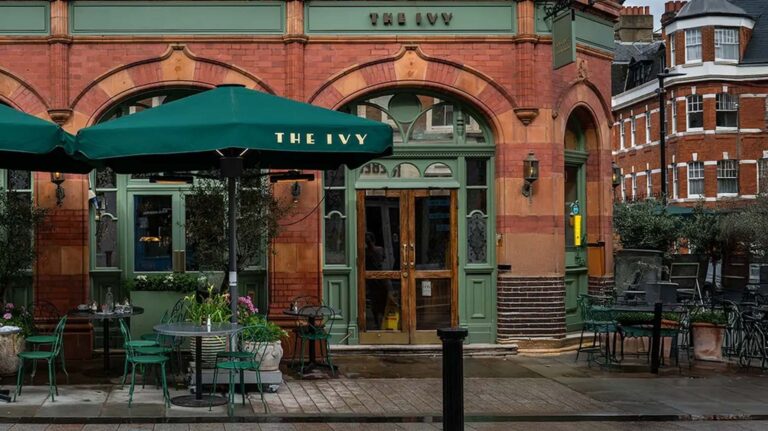
On April 11, Richard Caring sold Annabel’s, The Ivy, and Scott’s to Abu Dhabi’s DIAFA for £1.4 billion — a multiple of 24 times earnings that we argued repriced the entire private club asset class.
Eleven days later, according to an email to KSL Capital Partners investors reviewed by Forbes, Apollo Global Management has agreed to sell Invited Clubs — the largest private club operator in North America, with 125 owned clubs and roughly $350 million in EBITDA — back to KSL for $2.6 billion.
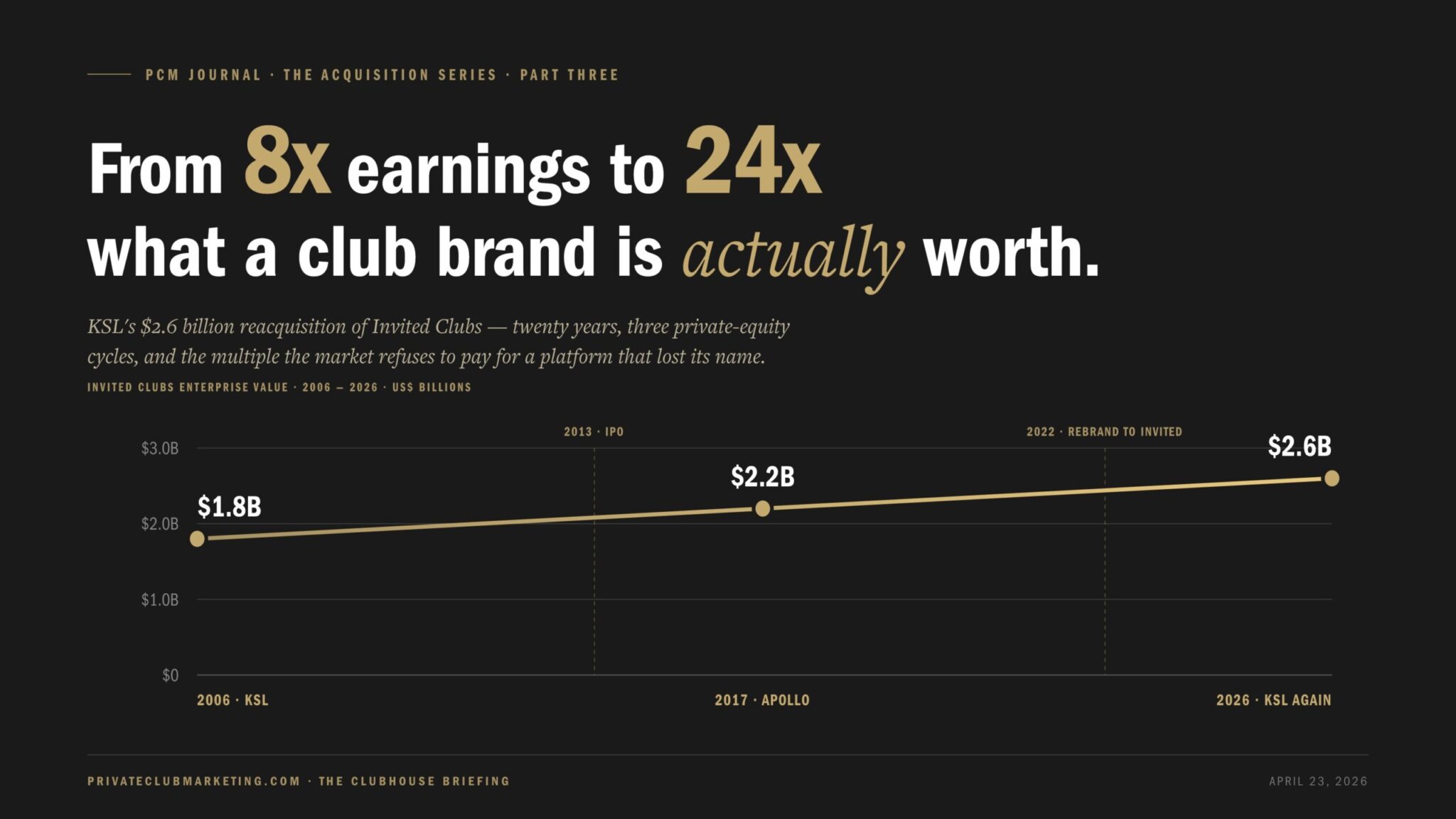
That’s eight times earnings. A third of the multiple Caring commanded. And it is the most honest answer American private-club boards are ever going to get to the question, what is our brand actually worth?
The Second Flip
The transaction, first reported by Reuters and detailed by Forbes on April 22, is unusual for a simple reason: this is the same private-equity firm buying the same company it sold twelve years earlier. KSL originally took ClubCorp private in 2006 for $1.8 billion. It shepherded the company through the 2008 financial crisis, took it public again in September 2013 at an $880 million equity value, and gradually sold down its stake over the next four years. In 2017, Apollo took the company private again at a $1.1 billion equity value — a 22% return to IPO stockholders — plus $1.1 billion of assumed debt for a $2.2 billion enterprise value.
Nine years later, Apollo is handing the business back to KSL for $400 million more than it paid. Not a home run. Not a disaster. A modest mark-up during a genuine boom in American golf, on a platform that — as industry insiders have been quietly acknowledging for years — has seen cost-cutting erode its brand prestige over two decades under financial ownership.
Over the same nine years of Apollo ownership, US golf participation rose 40% — from 34.2 million players in 2019 to 48.1 million in 2025. Invited’s enterprise value rose 18%.
Why This Is Priced at 8x, Not 24x
This is the part that should make every American club board sit up straight.
Caring’s Troia Restaurants — the parent of Annabel’s, The Ivy, Scott’s, and a disciplined 40-location UK expansion of the Ivy Brasserie format — traded at 24 times adjusted earnings. Invited Clubs, with 125 owned American clubs including PGA Tour hosts Firestone and TPC Craig Ranch, is trading at 8 times.
There are legitimate structural reasons for that gap. Caring’s business is F&B-heavy, brand-concentrated, and urban. Invited’s is real-estate-heavy, membership-dues driven, and spread across twenty-plus states with all the maintenance capex that implies. You cannot directly compare the multiples as if they were identical businesses.
But you can read what the gap is telling you. The institutional-capital market is willing to pay roughly three times as much per dollar of earnings for a club portfolio perceived as iconic, brand-led, and under brand-operator stewardship as it is for a club portfolio perceived as a distribution platform optimized by financial owners over two decades.
That’s not an accident. That’s the market quantifying what two decades of financial ownership does to a club brand. Joel Paige, senior vice president of resorts at Escalante Golf (25 clubs), told Forbes the 2022 rebrand away from ClubCorp was a mistake — “I hope they go back to the name ClubCorp. I think it was a mistake to get away from that brand recognition they have.” Multiple industry insiders told Forbes that cost-cutting on staff and course maintenance over the same period has eroded the brand’s prestige.
A 24x multiple is what the market pays when it believes the brand will be protected. An 8x multiple is what the market pays when it suspects the brand already isn’t.
The Deal KSL Is Actually Buying
KSL is not simply reacquiring its old asset. According to Forbes, the plan is to merge Invited with KSL’s existing Heritage Golf Group, which has expanded from 6 courses at its 2020 acquisition to 47 today. The combined entity would control roughly 172 clubs — a position unrivaled in American golf, and larger than competitors like Arcis Golf (60+) or Concert Golf (39, acquired by Bain Capital in November 2025 for $1.4 billion).
The operational read is even more interesting than the financial one. Heritage’s CEO, Mark Burnett, spent eleven years as ClubCorp’s president and chief operating officer before leaving in 2018 in the wake of the Apollo takeover. One industry insider told Forbes that Heritage is the more nimble of the two businesses, and that Burnett’s management style should prevail in any post-merger operational structure.
Read that carefully. The same executive who ran ClubCorp’s operations through the first KSL era is now running the smaller, more agile portfolio KSL is about to merge its reacquisition into. This isn’t just a financial flip — it’s a deliberate attempt to rebuild the operating culture of the original ClubCorp, minus the corporate baggage Apollo added over the intervening decade.
Whether that works is the question. But it does mean this transaction carries more operating intent than a typical PE-to-PE handoff.
The Golf Boom Is Real. So Is the Margin Pressure.
The backdrop to the deal is a sport in genuine expansion. The National Golf Foundation tracked 48.1 million American golfers in 2025 — 29.2 million on traditional courses, 18.9 million off-course at venues like Topgolf or in simulators. That’s up from 34.2 million total and 24.3 million on-course in 2019. The post-pandemic surge in flexible work and outdoor recreation has produced a structurally larger golf economy than existed before Covid.
Roughly 16,000 golf courses operate in the U.S. About a quarter of them are private. No single operator controls more of that private segment than Invited.
But participation growth is not the same as operating margin growth. A private club is a low-margin business in the best of times — fertilizer, machinery, turf specialists, executive chefs, pickleball buildouts, fitness-center capex, and the growing retention cost of keeping members who now have more choice than ever. The 8x multiple the market assigned to Invited reflects real expectations about how hard the operational lift is, regardless of how many Americans are picking up a club.
What Invited Members Should Watch
If you hold a membership at any of the 125 clubs Invited owns, the next twelve months are not theoretical. They are a transition window during which operating priorities will be reset under new ownership with stated merger intent.
One industry insider told Forbes the expected consolidation of Invited’s operations with Heritage’s will lead to further cost-cutting measures and job losses. That’s the baseline scenario any member should plan around. Three specific things are worth watching:
What Independent Clubs Should Take From This
The strategic read for the thousands of independent American private clubs — member-owned, board-governed, not on any financial sponsor’s clock — is that the Invited transaction makes the independent position measurably more valuable, not less.
1. Your governance is your moat, quantified. The 16-point multiple gap between 8x (platform consolidator) and 24x (brand-protected operator) is the market’s opinion of what financial ownership does to a club brand over time. A member-owned club with a long-tenured board cannot be flipped. That structural unsaleability is a competitive asset in an environment where 125 American clubs just changed financial hands in a single transaction. Your governance is something to market, not something to take for granted.
2. Local identity is the product institutional capital cannot manufacture. Every Invited club has a name that existed before ClubCorp, before KSL, before Apollo. Firestone. TPC Craig Ranch. The rituals, the longtime members, the architecture, the specific clubhouse. That’s what doesn’t scale. An independent club’s heritage — specifically and non-portably local — is the one asset a private-equity rollup can never replicate. Paige’s warning that ClubCorp lost brand equity by dropping its own name applies in reverse to every independent club considering how aggressively to lean into its own identity.
3. Brand decisions are financial decisions, and the math just got published. If brand equity is worth three times the EBITDA multiple, every capital project, every dues decision, every investment in member experience, and every choice about how to market the club is a balance-sheet decision. Most independent clubs dramatically underprice their own brand equity when they plan capex and set dues. Institutional capital has just quantified what it’s willing to pay for clubs that got those decisions right versus clubs that got them wrong. American boards should take the hint.
Jan 2026
Apr 11, 2026
Apr 22, 2026
The Optimistic Case, and the Honest One
Joel Paige, notably, is more optimistic about Invited’s next chapter than pessimistic. “They wouldn’t just buy this to squeeze a little bit out and sell it,” he told Forbes. “They have a plan here, whether it’s consolidation or aggregation or bringing more technology into the company. They’re very good operators.”
KSL’s track record supports that view. The firm manages $23 billion in assets and has posted double-digit annual net returns in most of its funds. Its Alterra Mountain Company, a 2017 portfolio investment, now owns 19 ski resorts including Steamboat and Deer Valley. Heritage has gone from 6 courses to 47 under its ownership. There is a real operating engine here, and Mark Burnett’s return to a ClubCorp-adjacent role is not a financial accident — it is a deliberate personnel decision about how to rebuild the operating culture.
The honest case is that even the best-run private-equity owner is, by definition, a temporary one. KSL’s investors expect to exit this asset again — sometime between 2031 and 2034 at the latest — at a multiple high enough to justify the capital deployed. Every operating decision made between now and then is filtered through that clock. That is not a criticism of KSL. It is an observation about what private ownership of 125 American clubhouses structurally is.
The Question, Restated
The Annabel’s article closed with a question: What would your brand be worth today?
The Invited deal sharpens it.
If your club traded tomorrow, would it clear 8 times earnings, or 24? And what are the specific, documented decisions your board has made in the last five years that determine which answer applies?
The gap between those two multiples is not a rounding error. It is the measurable, market-priced difference between a club that protected its brand and a platform that didn’t. Every board in America should be able to answer that question by Monday — in writing, with evidence, to the membership that is paying attention.
Free Download
The 2026 Private Club Benchmark Report
The membership, amenity, and pricing data reshaping private clubs — from a 1,200-club analysis. Enter your details and we'll send it to your inbox.