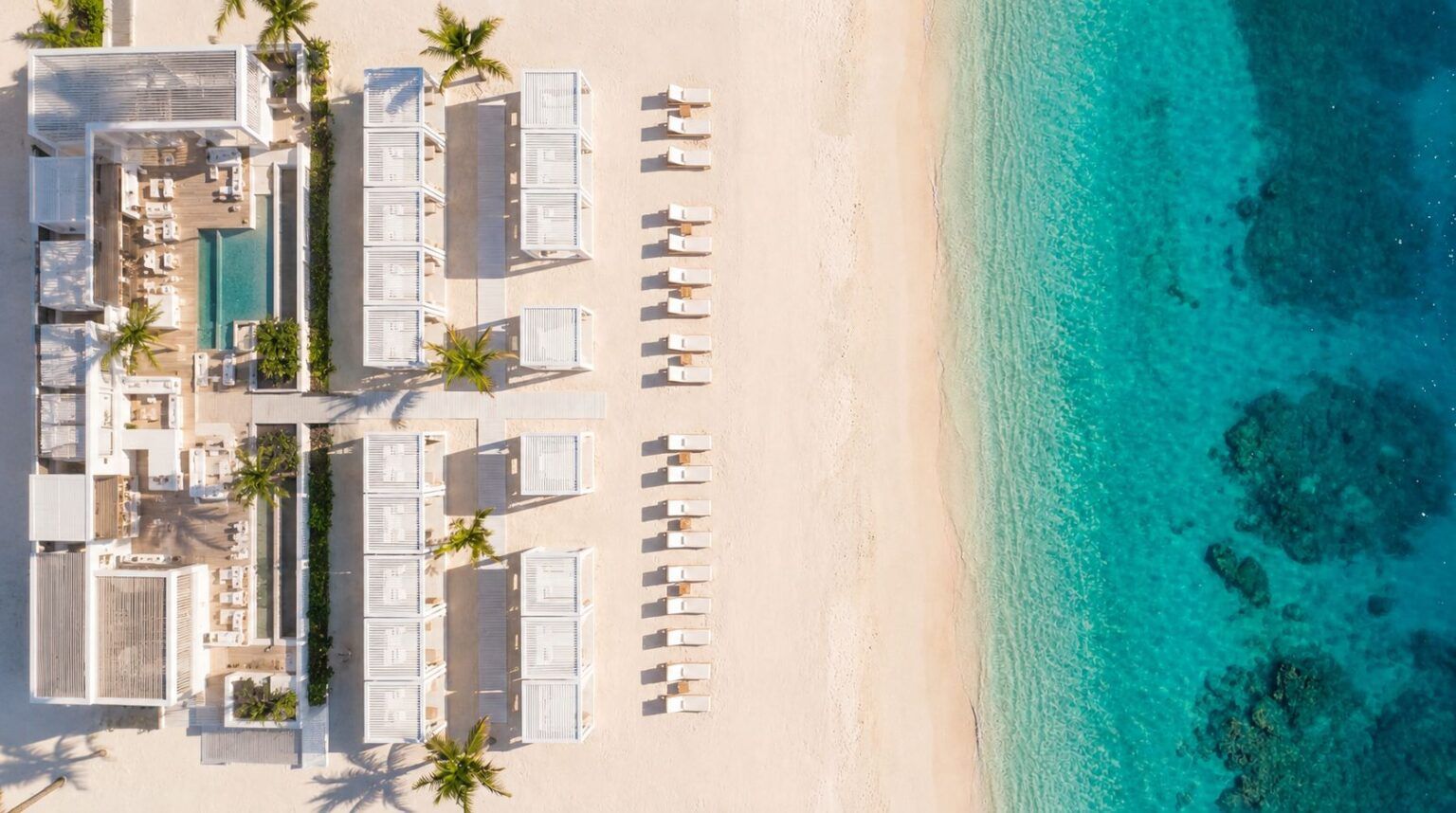
According to the Knight Frank Wealth Report 2025, Dubai leads five-year prime residential growth at 147% and Palm Beach at 117%. Thermal and mineral springs market forecast of $97.6B by 2028 and 230+ pipeline projects per the GWI Global Wellness Economy Monitor 2024.
Why Beach Clubs Are Having a Moment
Three forces are converging. First, capital. Knight Frank’s family-office survey found that 25% of family offices with active residential portfolios plan new acquisitions in the next 18 months, with sunbelt and resort markets leading the bid — resort markets posted nearly 30% five-year growth versus 19% for global cities, per the Wealth Report 2025. The five-year prime residential price growth figures below, drawn from the Knight Frank Wealth Report 2025 PIRI 100 index, illustrate exactly where that capital is flowing.According to the Knight Frank Wealth Report 2025 PIRI 100 index, five-year prime residential price growth by market (2019–2024): Dubai 147%, Palm Beach 117%, Miami 84.3%, Orange County 66.5%, St Tropez 58.4%, Algarve 57.8%.
Second, lifestyle diversification by luxury operators. The Deloitte Global Powers of Luxury 2026 report found that 9.8% of luxury executives plan moderate-to-major investment in extending their brand universes into hospitality, wellness, and design — with momentum strongest in Japan (20%), France (14%), and the Middle East (13.3%). Hospitality leads omnichannel investment among Deloitte’s Global Powers of Luxury 2026 surveyed categories at 14.2%. The breakdown by market, sourced from the same Deloitte report, is shown below. Third, the wellness layer. The GWI Global Wellness Economy Monitor 2024 projects the thermal and mineral springs sector alone will grow at 9.2% annually through 2028, reaching $97.6 billion globally, with more than 230 new projects in the development pipeline. Beach clubs are absorbing that playbook — saunas, cold plunges, longevity programming — and folding it into the seafront experience.The 8 Openings (and Markets) to Watch
Below are the eight named openings — and the markets they sit in — that club professionals should be tracking through 2026. Each represents a different thesis on what a modern beach club should be.- 1. Delano Members Club — Miami Beach, FL. Miami’s five-year prime residential growth of 84.3%, per the Knight Frank Wealth Report 2025, cooled in 2024 but the cultural pull remains — Coldwell Banker’s Global Luxury Trend Report 2025 notes the city draws global wealthy buyers with “events like Art Basel, a diverse culinary scene, and a cosmopolitan population.” The clearest 2026 signal is the Delano Members Club, opened this spring as part of the Delano’s six-year rebuild. Membership is capped at 200 founding members and includes a private fourth-floor club with pool, Technogym studio, The Source by Delano spa, and a curated cultural program of gallery visits, DJ residencies, and guest-chef moments. Founding members receive a complimentary two-night stay at any Delano globally — a template the brand has flagged for London and New York next.
- 2. Port Royal Club — Naples, FL. Florida’s Gulf Coast is the article’s purest private-club case study. Hurricane Ian destroyed the original Port Royal Club in 2022; members voted unanimously to fund a $100 million ground-up rebuild on the same beachfront site. The new clubhouse, targeted for Q4 2026, is one of the most restricted private clubs in North America — you cannot buy in without owning a home in the Port Royal neighborhood. Initiation rose from $315,000 to $400,000 on January 1, 2026; annual dues are $16,200. Champalimaud Design and Hart Howerton are delivering a 62,000-square-foot West Indies clubhouse with Gulf-view dining, upgraded pool and spa, hurricane-resilient architecture, and a 150-person banquet hall. The clearest signal yet that the ultra-exclusive tier remains insulated from macro pressure.
- 3. Shell Bay — Hallandale Beach, FL. Between Miami and Fort Lauderdale, Shell Bay sits on 150 acres between the Atlantic and the Intracoastal Waterway. Membership initiation exceeds $1 million — one of the most expensive private-club entries in the country — and the Greg Norman-designed 18-hole course is the first new private golf course in the Miami area in 25 years. The 48-slip marina is the social anchor, the waterfront residences (108 units, from $2 million) complete in 2026, and the Auberge-managed boutique hotel and destination spa follow in 2027. For an industry watching how waterfront infrastructure replaces the golf course as the membership hook, Shell Bay is the clearest US data point. The Witkoff Group and PPG Development are behind it.
- 4. Zannier Île de Bendor — Côte d’Azur, France. Up 58.4% over five years, per Knight Frank’s Wealth Report 2025, the Mediterranean’s most enduring beach-club market is also the most contested — expect tighter, more curated openings tied to villa rentals and yacht-tender access rather than open-deck day clubs. The defining 2026 opening is Zannier Île de Bendor, which opened May 1 on a private 17-acre island seven minutes by boat from the Provençal fishing town of Bandol. Zannier’s five-year transformation of the island originally developed by pastis magnate Paul Ricard delivers 93 keys across three zones — Delos (1960s Riviera glamour), Soukana (wellness-focused), and Madrague (private-garden villas) — anchored by a beach club, dive center, and 1,200-square-meter wellness spa with hammam, indoor/outdoor pools, and movement studio. Boat-only access creates exclusivity without a formal membership tier.
- 5. Nobu Beach Inn — Barbuda, Caribbean. Robert De Niro discovered the Barbuda site more than 30 years ago on a boat trip from Antigua and has spent a decade assembling the project. Nobu Beach Inn at The Beach Club, Barbuda, opening late 2026, is intentional scarcity at the brand-statement level: 36 bedrooms across 17 villas on 400 acres with two miles of beachfront. De Niro, James Packer, and Daniel Shamoon are the principals; the broader development includes Beach Club Villas and Estates with 25 four-to-five-bedroom beachfront residences from $12 million. The beach club component includes an infinity pool, indoor/outdoor spa, kids club, outdoor cinema, padel and tennis courts, and dive excursions to neighboring islands. The Caribbean’s most ambitious anti-density luxury play of the decade.
- 6. Six Senses The Palm — Dubai, UAE. Dubai prices are up 147% in five years — the top market in Knight Frank’s PIRI 100 index. Knight Frank’s Wealth Report 2025 identifies Palm Jebel Ali as “a new prime market,” with $1.1 billion in luxury sales between January and September 2024 and cash purchases accounting for 89% of emirate-wide transaction value. The most credible 2026 beach-club opening in the market is Six Senses The Palm, the brand’s first UAE property, debuting Q3 2026 on the West Crescent of Palm Jumeirah. The 61-suite hotel embeds within a 172-unit branded-residences complex — residents receive complimentary gym and spa membership at the 60,000-square-foot social and wellness club, making the club the residential tie-in mechanism. Private beach. Signature longevity and biohacking programs. IHG is the parent.
- 7. Six Senses AMAALA — Red Sea Coast, Saudi Arabia. AMAALA is the article’s wildcard and thesis-extender. Red Sea Global — the sovereign developer backed by Saudi Arabia’s Public Investment Fund — has built a 68-kilometer coastline destination designed from the ground up around wellness and yachting. Six Senses AMAALA, opening in phases through 2026, is one of eight luxury brands debuting in Phase One (alongside Rosewood, Four Seasons, Ritz-Carlton, Equinox, Clinique La Prairie, Nammos Resort, and Jayasom). The anchor is the AMAALA Yacht Club, with a 116-berth marina accommodating yachts to 140 meters, paired with the Corallium Marine Life Institute — a reef restoration and ocean science layer. Six Senses contributes 100 pool suites and villas, 25 branded residences, and its signature wellness arsenal: cryotherapy, Watsu pool, salt rooms, sound dome, vitality pools. The largest state-sponsored beach club experiment of the decade.
- 8. Alila Mayakoba — Riviera Maya, Mexico. The hot-springs-meets-beach hybrid the article has been gesturing at lands cleanly in Alila Mayakoba, which opened February 12, 2026 — Hyatt’s first Alila in Latin America and the Caribbean. The 182-room property sits within the broader Mayakoba resort community alongside Fairmont, Rosewood, and Banyan Tree, with shared beach access threading the four hotels into a single ecosystem. The beach club delivers fire-roasted seafood feasts by the shore, live music, and an outdoor hydrotherapy circuit drawing on Mayan temazcal steam traditions — the clearest example in this list of the wellness layer the GWI Global Wellness Economy Monitor 2024 flagged as a 9.2% annual growth category. Charles Davidson’s framing of bathing as a “reality experience in an increasingly virtual world,” from the ISPA European Spa Leaders’ Resource 2026, applies here as literally as it does anywhere on this list.
What Separates the New Generation
Three things, all of them lifted from luxury hospitality rather than legacy club operations. Social wellness as the anchor product. Alice Lightfoot, director of spa and fitness at Jumeirah Carlton Tower, told the ISPA European Spa Leaders’ Resource 2026 that “demand for social membership clubs has surged in recent years,” with members “no longer simply looking for a traditional club atmosphere, but expect cutting-edge wellness facilities with highly effective technology, health-focused food, exclusive networking opportunities and curated private experiences.” Beach clubs that show up in 2026 with only a pool and a poke bowl will struggle. Hyper-personalization as table stakes. Deloitte’s Global Powers of Luxury 2026 identifies “a surge in demand for hyper-personalization and data enabled services” as the foremost luxury consumer trend for the next 12 months. Translate that to beach club operations: dynamic cabana pricing, member preference systems, and AI-supported concierge — Deloitte notes adoption is split between assessment and selective implementation, with “roughly one in ten executives already embedding the technology in core functions.” Lifestyle ecosystems, not single venues. The same Deloitte Global Powers of Luxury 2026 report flags lifestyle diversification — extending brand universes “into sectors like hospitality, wellness, design, and home” — as a major five-year growth vector. Expect 2026 openings to arrive paired with branded residences, concept restaurants, and members’ clubs in the nearest gateway city.According to the Deloitte Global Powers of Luxury 2026, share of luxury executives planning moderate-to-major investment in extending their brand universes into hospitality, wellness, and design: Japan 20%, France 14%, Middle East 13.3%, global average 9.8%.
What It Means for Existing Beach and Country Clubs
Most existing private beach and country clubs were not built for this competitive set. Three immediate implications:- Re-underwrite the wellness footprint. If thermal and mineral springs are growing at 9.2% annually, per the GWI Global Wellness Economy Monitor 2024, and members increasingly arrive expecting saunas, cold plunges, and longevity-oriented programming, a tired locker-room-and-massage spa is now a churn risk, not a sunk cost.
- Audit the social membership tier. The ISPA European Spa Leaders’ Resource 2026 describes the Jumeirah model member as someone who wants “intentional rest and connectivity, where work, leisure, and wellness blend seamlessly.” Many legacy beach clubs have no product for that member — and the new openings will.
- Defend the value-for-money story. Coldwell Banker’s Global Luxury Trend Report 2025 notes that even HNWIs “are not entirely immune to rising costs,” and that wealthy buyers “are less willing to pay premium prices for properties or locations that don’t deliver clear, tangible value.” Initiation fees and dues need a defensible narrative; the new clubs will arrive with one pre-built.
Free Download
The 2026 Private Club Benchmark Report
The membership, amenity, and pricing data reshaping private clubs — from a 1,200-club analysis. Enter your details and we'll send it to your inbox.