
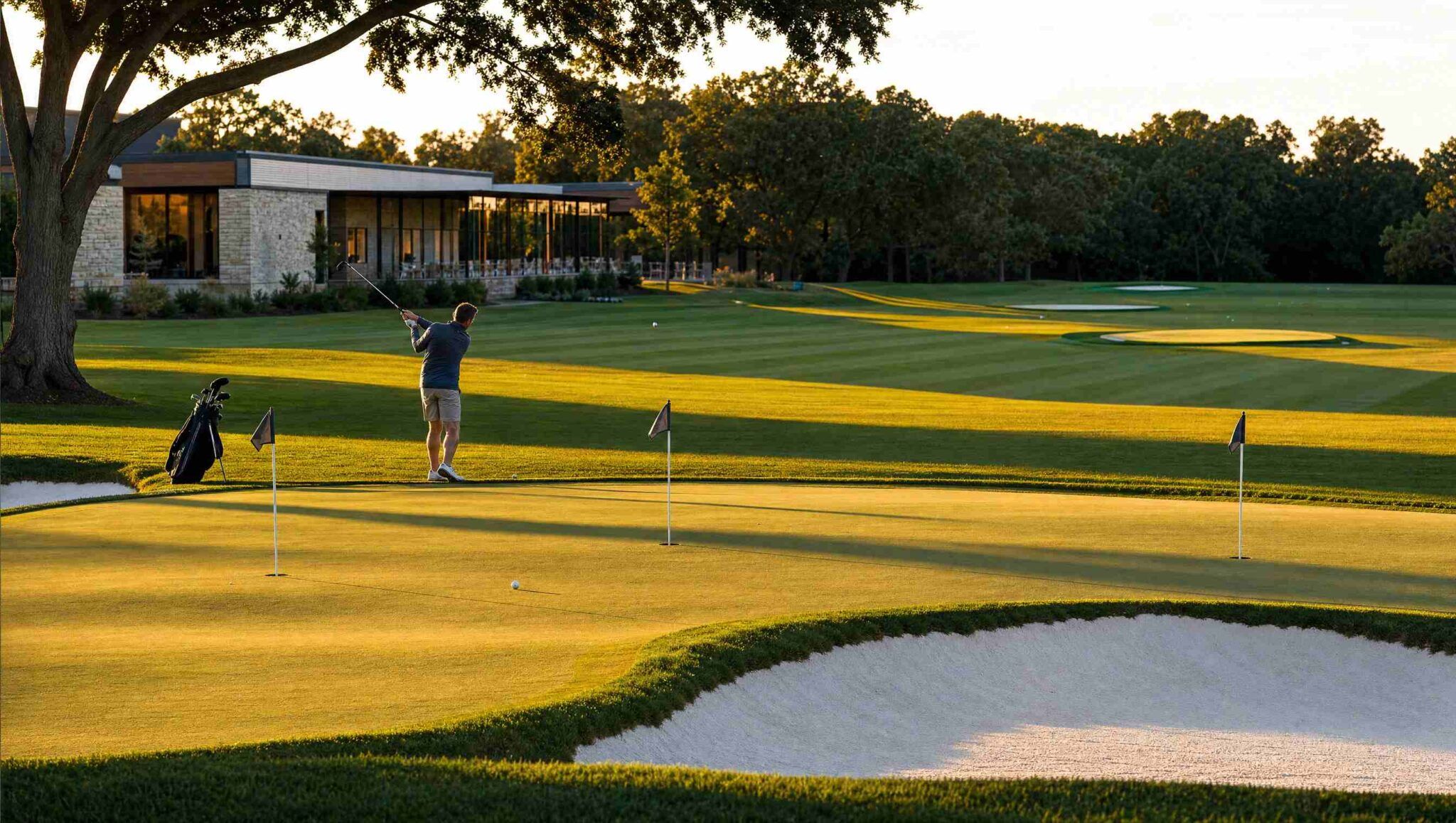
February at Pebble Beach has become, in the last decade, the unofficial state of the union for NFL golf. The AT&T Pebble Beach Pro-Am’s celebrity field functions as a public leaderboard for a competition that runs year-round in locker rooms, on practice ranges, and in the group chats of active and retired football players who have collectively decided that golf — not fishing, not pickleball, not hunting — is the sport through which they will define their off-field identity. The galleries at Pebble don’t just come to watch the professionals. They come to watch Josh Allen birdie the 18th while Tom Brady watches from the fairway, and to understand the hierarchy that the official handicap index makes legible.
That hierarchy, in 2026, is more competitive and more accurately documented than at any previous point in the NFL’s history. The World Handicap System has made it harder to sandbag, amateur tournament records are public, and a generation of players raised on the Golf Channel knows that their handicap is, functionally, a public credential. What follows is the most comprehensive ranking of NFL player golf handicaps available in 2026 — active players first, then the retired legends who define what the ceiling looks like.
Active NFL Players: Ranked by Handicap
The numbers below reflect reported handicap indices from documented tournament appearances, official pro-am fields, and verified sources. Where ranges are given, they reflect variance across multiple appearances or player self-reporting that differs from official indices.
The Elite Tier (Plus-Handicap to 4)
Ryan Succop, kicker (retired/free agent) — +2.6 handicap. The former Tennessee Titans kicker holds what may be the lowest handicap index ever reliably attributed to a working NFL player. A +2.6 means Succop plays to better than scratch — he is expected to shoot under par on a scratch-rated course. His game is not a hobby. It is the second career he has been building since his first one began.
Brett Kern, punter — 0.4 handicap. The long-tenured NFL punter is another specialist with a near-scratch index. Specialists in the NFL have always had a disproportionate representation in the elite golf tier — their schedules during the week are less physically demanding than skill-position players, their hand-eye coordination is professionally calibrated, and their culture has historically centered on golf as the way serious practitioners spend the four days between games.
Adam Thielen, wide receiver (Carolina Panthers) — 0.6 handicap. The veteran receiver is the best golfer of any traditional skill-position player on any active NFL roster. A 0.6 handicap means he occasionally shoots under par in competition — a level of play that would qualify for serious amateur tournaments in most states. Thielen has competed at the American Century Championship and consistently finishes at the competitive end of the celebrity leaderboard.
Jake Elliott, kicker (Philadelphia Eagles) — approximately 2 handicap, according to Sports Illustrated’s 2023 profile of Elliott. The Eagles’ Super Bowl-winning kicker qualified for the 118th Philadelphia Open Championship at the Philadelphia Cricket Club in 2022, according to the Golf Association of Philadelphia’s tournament coverage. Elliott has approached the sport with an infrastructure — coaching, fitting, practice regimen — that reflects genuine competitive intent.
Josh Allen, quarterback (Buffalo Bills) — 3.5 handicap. The 2025 NFL MVP and the most scrutinized amateur golfer in the sport right now. Tiger Woods played with Allen at the 2024 Genesis Invitational Pro-Am and told reporters, “We’re very similar across the board.” That endorsement, from the most accomplished golfer in history, is the definitive assessment of Allen’s ceiling. At 14-under through the 2024 Pebble Beach Pro-Am alongside tour player Keith Mitchell — finishing tied for sixth in the overall field — Allen produced the best competitive golf performance of any active quarterback on record.
Aaron Rodgers, quarterback (New York Jets) — 4 handicap. The four-time MVP and multiple American Century Championship winner entered 2024 with an officially adjusted 4 handicap that drew some controversy — PGA Tour player Keith Mitchell publicly called the number “crap” after Rodgers won his Pebble Beach pro-am bracket. Whether that critique is fair is debatable. What is not debatable is that Rodgers has been the most decorated amateur competitor in NFL golf for the better part of a decade, with multiple wins at Lake Tahoe against fields that include former Tour players and current amateur standouts.
The Competitive Mid-Tier (5 to 10)
Patrick Mahomes, quarterback (Kansas City Chiefs) — approximately 7.7 handicap. Mahomes is a devoted golfer who has suggested his official handicap understates his actual ability — “I would say 7, but I’m closer to 4-5,” he told Golf Digest, attributing the discrepancy to not posting every round. He and Travis Kelce won The Match VIII in June 2023 against Steph Curry and Klay Thompson, demonstrating both partners’ ability to perform under the kind of spotlight pressure that separates competitive amateurs from recreational ones.
Travis Kelce, tight end (Kansas City Chiefs) — 10 handicap. A 10-handicap who won the American Century Championship long-drive contest with a 362-yard carry in 2023 and nearly aced the 16th at the 2026 WM Phoenix Open. Kelce is golf’s most entertaining ambassador at the celebrity level — a 10 who generates genuine excitement on a par-3 in front of 20,000 people.
Alex Smith, quarterback (retired) — 7 handicap. The former Chiefs and Washington quarterback appeared in the 2026 Pebble Beach Pro-Am field with a 7 handicap, a number that reflects the same disciplined, process-oriented approach he brought to football. Smith’s golf game, like his QB career, is technically sound and devoid of unnecessary risk.
Tom Brady, quarterback (retired) — 8 handicap. Brady’s 8-handicap at the 2024 and 2025 Pebble Beach Pro-Ams is consistent, publicly documented, and subject to the kind of scrutiny that comes with being the most famous athlete in the sport. He has appeared in multiple editions of The Match, played regularly at Medalist Golf Club in Hobe Sound, Florida, and at the exclusive Augusta National-adjacent venues that populate the retirement geography of elite NFL veterans. His game is real. It is simply no longer the best among active-era quarterbacks.
The Recreational Competitive Tier (11 to 18)
Ron Rivera, head coach (retired) — approximate 12 handicap. Multiple NFL coaches maintain serious golf games, and Rivera’s has been documented through coaching staff events and charity tournaments. The former Commanders head coach is representative of a coaching culture where golf serves as the primary relationship-maintenance mechanism during the season and the organizing activity of the offseason.
Steve Young, quarterback (retired) — 13 handicap. The Hall of Fame 49ers quarterback entered the 2026 Pebble Beach Pro-Am at 13, a number that places him in the solid mid-amateur range. Young has been a fixture at Pebble Beach for years, representing the generation of 49ers quarterbacks who made the tournament a San Francisco Bay Area institution.
George Kittle, tight end (San Francisco 49ers) — approximately 14-16 handicap. Kittle has been spotted at Bandon Dunes and participates in offseason golf outings, including the trip organized by Kelce in 2024. His game is enthusiastic and improving.
Dak Prescott, quarterback (Dallas Cowboys) — approximately 12-15 handicap. The Cowboys starter is a regular at golf events in the Dallas market and has been seen at Bent Tree Country Club and other elite North Texas private facilities. His handicap has fluctuated with his offseason availability.
Justin Herbert, quarterback (Los Angeles Chargers) — approximately 12 handicap. Herbert’s reserved public persona extends to his golf game — he plays, he plays well enough, and he does not amplify it through social media or celebrity appearances with the frequency of Allen or Kelce.
Saquon Barkley, running back (Philadelphia Eagles) — approximately 14-16 handicap. The Eagles star has spoken about his golf interest and played in celebrity events, with reported scores consistent with a mid-teen handicap.
Retired NFL Legends: The Gold Standard
If active NFL players define the current golf hierarchy, the retired legends define what professional athleticism, financial freedom, and decades of practice can produce. Several former players have approached the game with an intensity that belongs in a different category entirely from celebrity golf.
Tony Romo, quarterback — scratch (0 handicap). The most accomplished golfer ever produced by the NFL, active or retired. Romo has received multiple sponsor exemptions to play in PGA Tour-sanctioned events, most notably the Corales Puntacana Resort and Club Championship, where he competed against touring professionals and held his own. He is a genuine scratch golfer by any measure — not a celebrity who claims scratch on the honors course at his home club, but a player who has proven the number in PGA Tour fields. His trajectory from 7-handicap during his Cowboys career to scratch in retirement represents the full expression of what an elite athlete with unlimited time and resources can do with a golf game.
John Elway, quarterback — 1.4 handicap, according to Golf Channel’s coverage of Elway’s 2018 U.S. Senior Open qualifying attempt. Elway attempted to qualify for the U.S. Senior Open at The Broadmoor in May 2018, shooting a 10-over 80 to finish tied for 18th, according to ESPN’s report on the qualifier. That attempt — coming from a Hall of Fame quarterback serving as the tournament’s honorary chairman — should be understood as a genuine competitive effort rather than a publicity exercise. Elway’s game has also been documented at the American Century Championship, where his reported handicap has placed him among the elite amateur competitors in that field.
Peyton Manning, quarterback — approximately 4-8 handicap. Manning’s golf game is one of the most frequently discussed and least precisely documented in retired-athlete circles. Reported figures range from 4 to 8 depending on the source and the year, which likely reflects the natural variation of a player who plays a great deal of golf but who does not maintain a rigorous formal handicap index. His presence at Augusta National — he is a known enthusiast of the course — and his regular appearances at charity events suggest a player in the 6-8 range who occasionally produces rounds that would merit a lower number.
Jerry Rice, wide receiver — approximately 4-6 handicap. Rice has been playing golf seriously since his 49ers career and has spoken about the parallels between the discipline required to run precise routes and the precision demanded by a good golf swing. His physical conditioning — maintained at an almost comical level well into his sixties — gives him advantages on the course that most senior amateurs cannot replicate.
Emmitt Smith, running back — approximately 10 handicap. Smith is a regular at celebrity events and has spoken about golf as his primary athletic outlet in retirement. His game is competitive at the celebrity level, and his approach — organized, structured, and resistant to the complacency that overtakes many amateur players — reflects the habits that made him the most productive running back in NFL history.
The AT&T Pebble Beach Pro-Am: NFL Golf’s Annual Showcase
No single event does more to document and publicize the NFL’s golf culture than the AT&T Pebble Beach Pro-Am, held each February at Pebble Beach Golf Links, Spyglass Hill Golf Course, and Monterey Peninsula Country Club. The tournament’s pro-am format pairs PGA Tour professionals with celebrity amateurs for three rounds before the professionals play the final round alone — and the celebrity bracket, tracked separately, produces its own leaderboard of genuine competitive interest.
The 2026 field included Travis Kelce (10 handicap), Alex Smith (7), Steve Young (13), and a supporting cast of actors, musicians, and athletes who fill the 156-player field. Josh Allen’s appearances have consistently drawn the event’s largest celebrity galleries, while Aaron Rodgers’ multiple wins alongside tour player Ben Silverman established the bar for what celebrity-pro cooperation looks like at its best. Tom Brady’s repeated appearances transformed his post-retirement identity in ways that his broadcast work alone never could — on a golf course, Brady is relaxed, competitive, and genuinely enjoying himself in a way that wins a particular kind of public affection.
The Pebble Beach Pro-Am is, fundamentally, an advertisement for private club golf at the highest level. Three of the world’s most celebrated private and resort courses — courses that charge peak-season rates measured in hundreds of dollars per round and that maintain waiting lists for tee times — become the backdrop for a nationally televised event that reaches millions of viewers who will never play them. The NFL’s participation in that tableau is not accidental. Football players are the most culturally proximate celebrities to the private club world: physically dominant, financially successful, and authentically interested in a sport whose culture rewards exactly the competitive instincts that made them professional athletes.
NFL vs. NBA vs. MLB: The Amateur Golf Culture Comparison
Golf has penetrated all four major North American sports leagues, but it has not penetrated them equally, and the character of the penetration differs in instructive ways.
The NBA has produced the sport’s most technically accomplished athlete-golfer in Stephen Curry, whose +1.5 handicap is genuinely extraordinary for any non-professional — a figure that would qualify him for USGA national amateur events. But the NBA’s golf culture is concentrated at the top of the talent distribution in a way that the NFL’s is not. Several dozen NFL players maintain documented single or low-double-digit handicaps. In the NBA, serious amateur golf is largely a phenomenon of superstar players — LeBron James, who has described himself as “addicted” to golf in retirement, and a relative handful of others — rather than a pervasive locker-room culture.
Major League Baseball presents the closest analogy to the NFL in terms of golf’s structural role in the sport’s culture. Starting pitchers, who spend four days between starts sitting in a dugout with little to do, have historically used golf the way NFL players use it: as the organizing activity of idle time during a long season. The difference is that baseball’s off-day golf culture has never produced the kind of publicly visible, nationally televised celebrity golf moment that the NFL now generates through Pebble Beach. Baseball’s golf culture is clubhouse-intimate; the NFL’s has become a broadcast product.
The NHL occupies an interesting position in this comparison. Canadian players, in particular, have traditionally gravitated toward golf — the geographical and seasonal logic is obvious — and the average NHL locker room likely contains more serious golfers per capita than any other major professional sports league. But the NHL’s overall media footprint, and its celebrity golf participation, remains limited relative to the NFL’s.
How NFL Stars Get Private Club Access
The story of how NFL players navigate private club membership is, at its core, a story about the intersection of celebrity capital and traditional institutional culture — and it is a story that private clubs are still working out how to tell about themselves.
The conventional membership pathway — application, sponsorship letters, committee review, waiting list — was designed for a different era’s definition of qualified candidate. NFL players represent a category of applicant that most private club membership committees never explicitly discussed when they drafted their bylaws: young, enormously wealthy, culturally prominent, physically imposing, and genuinely passionate about golf, but without the multigenerational country club biography that traditional membership structures were designed to evaluate.
The most elite clubs — Augusta National, Pine Valley, Cypress Point — solve this problem by simply being invitation-only, which removes the application awkwardness entirely and places the burden on the club to decide whether an NFL player fits its membership culture. Josh Allen’s reported membership at Oak Hill is instructive: Oak Hill is a serious championship-quality institution that has hosted multiple major championships, and Allen’s membership there signals an interest in competitive golf history rather than social convenience. That kind of alignment between a player’s golf values and a club’s institutional identity is, increasingly, the basis on which successful memberships are built.
For clubs in markets adjacent to NFL franchise cities — the suburbs of Buffalo, Kansas City, Dallas, Los Angeles — the question of how to attract players who will be genuine participants rather than absentee members is one that requires deliberate strategy. Players who care about their handicaps, who bring their teammates to the course, who use the club’s practice facilities and spend time in its culture, are different members from players who join for the logo on the scorecard and appear twice a year. The former category — the Josh Allens and Travis Kelces of the roster — are the ones clubs should be engineering their membership offerings to attract.
That engineering requires more than a celebrity outreach program. It requires courses that challenge low-to-mid handicappers, practice facilities that professional athletes find credible, and a membership culture that treats genuine engagement with the game as the primary currency of status. The AT&T Pebble Beach Pro-Am, more than any other single event, shows what that combination looks like when it works: a field full of people who are legitimately passionate about golf, playing the sport at its highest public-facing level, creating cultural moments that resonate far beyond the gallery ropes.
More NFL Players Worth Watching on the Course
Beyond the headline names, a deeper tier of NFL players has established genuine golf credentials that deserve documentation. These are the players whose handicaps circulate in locker-room conversations and who show up at American Century, Pebble Beach, or regional pro-ams without the fanfare of a Kelce or an Allen but with games that earn respect from the professionals they play alongside.
Russell Wilson, quarterback has been a golf regular throughout his career, hosting the annual Wilson Celebrity Invitational in the Seattle area for years, according to the Seattle Seahawks’ coverage of the event. Wilson has also been seen playing regularly in the Denver market, including at Arrowhead Golf Course in Littleton, Colorado, according to Sports Illustrated’s report on a 2023 incident there. His reported handicap in the 10-12 range has not been independently confirmed, though his game reflects the same studied precision he brought to quarterback preparation.
Baker Mayfield, quarterback (Tampa Bay Buccaneers) — approximately 10-14 handicap. Mayfield has been spotted at American Century events and is a vocal golf enthusiast whose personality — brash, competitive, self-aware — translates to the course in ways that make him good company in a pro-am foursome. Reports from Bandon Dunes outings put him in the low-to-mid teen range.
Kyle Juszczyk, fullback (San Francisco 49ers) — approximately 14-18 handicap. The veteran fullback was part of the Bandon Dunes trip that Kelce organized in the summer of 2024, cementing his position as one of the NFL’s golf-culture participants. Juszczyk’s game is enthusiastic rather than elite, but his presence at premium destinations signals genuine commitment.
Micah Parsons, linebacker (Dallas Cowboys) — recreational, handicap not formally documented. One of the NFL’s most dynamic young players has discussed golf on social media with the enthusiasm of someone newly converted to the game. Whether that enthusiasm translates into the handicap structure of a serious amateur player remains to be seen.
Lamar Jackson, quarterback (Baltimore Ravens) — casual golfer. Jackson has not positioned himself within the celebrity golf circuit in the way Allen, Mahomes, or Rodgers have. He plays recreationally and has been seen at courses in the Baltimore and South Florida markets. His extraordinary physical gifts would translate to explosive ball speed, but his investment in the game has not publicly reached the level of his contemporaries at the position.
What a Low NFL Handicap Actually Requires
The gap between a 10-handicap and a 3.5-handicap — between Travis Kelce and Josh Allen — is not merely 6.5 strokes on a scorecard. It is the difference between two fundamentally different relationships with the game. A 10-handicap is an accomplished recreational player. A 3.5 is someone who has eliminated most of the catastrophic errors from their game, who manages a course intelligently over 18 holes, and whose bad rounds look like other people’s good rounds.
For an NFL player to reach a 3.5 handicap while maintaining an active professional career, the investment required is extraordinary. Allen’s documented 72-hole weekends at Sea Island, his midnight sessions on the practice range, his driver fittings at 8 a.m. after already playing 36 holes the day before — these are not the habits of a man with a peripheral interest in the game. They are the habits of someone for whom golf has become a second competitive vocation, prosecuted with all the resources — coaching, equipment, access to premium courses — that a $330 million NFL contract can fund, according to NFL.com’s report on Allen’s 2025 contract extension.
The physical prerequisites also matter in ways that are easy to underestimate. Elite NFL athletes have hand-eye coordination, tempo, and proprioceptive awareness that most amateur golfers will never develop regardless of practice volume. Ryan Succop’s +2.6 handicap is possible in part because a man who spent 14 seasons placing a football on a kicking tee and striking it with precision through an extremely controlled athletic motion, according to Pro Football Reference’s career record for Succop, has trained precisely the qualities that the golf swing demands. Adam Thielen’s 0.6 handicap reflects the same physical intelligence that made him one of the most precise route runners of his generation. The athleticism is not incidental — it is the foundation on which the golf game is built.
For clubs serious about building the membership pipeline that attracts this generation of NFL athlete-golfers — and for those interested in developing membership strategies that speak to the values that drive the game’s fastest-growing segment of serious amateur players — our membership consulting practice builds the positioning, programming, and recruitment infrastructure that makes elite acquisition sustainable. For the complete breakdown of where every NFL player ranks in 2026, see our full guide to the best NFL golfers.
Free Download
The 2026 Private Club Benchmark Report
The membership, amenity, and pricing data reshaping private clubs — from a 1,200-club analysis. Enter your details and we'll send it to your inbox.