
The most expensive square footage in most athletic clubs is not the weight floor or the group fitness studio. It is the underutilized corner where a cold plunge sits unused between the hours of 10am and 4pm, or the massage room that books only on weekends, or the infrared sauna that members discovered six months after joining because nobody told them it existed. Recovery programming has arrived at private athletic and wellness clubs — but in most cases it has arrived as amenity rather than strategy, and the revenue difference between those two postures is significant.
The clubs reaping the most from recovery science are not necessarily the ones with the most equipment. They are the ones that have built recovery into their programming architecture, their membership narrative, and their pricing strategy — treating modalities like cryotherapy, compression therapy, sleep optimization, and red light therapy not as spa add-ons but as the clinical, performance-oriented services their members increasingly expect and are already paying for elsewhere.
The Revenue Gap Between Amenity and Strategy
The distinction between an amenity and a programmatic revenue stream comes down to three variables: utilization rate, pricing architecture, and the degree to which the offering is integrated into membership identity. A cold plunge that members can use whenever they want, priced into general membership, at 30% utilization, is an amenity. The same cold plunge, structured into a recovery protocol program, with appointment-based booking and staff-guided sessions, at 75% utilization, is a revenue stream — and the two deliver categorically different financial outcomes.
According to the International Health, Racquet and Sportsclub Association, clubs that have formalized recovery programming as a distinct revenue category — with dedicated pricing, scheduling infrastructure, and staff credentialing — report ancillary revenue per member that is 40 to 60 percent higher than clubs where recovery amenities exist but are not programmatically structured. The gap is not the equipment. It is the intentionality.
Source: IHRSA Ancillary Revenue Report, 2024
What the Leading Clubs Are Building
Midtown Athletic Club in Chicago illustrates what recovery programming looks like when it is treated as a first-class offering rather than a locker room amenity. The club’s spa and recovery infrastructure — steam rooms, saunas, hot tubs, and massage services — is positioned as an integrated part of the athletic experience, not a separate wing members discover by accident. Critically, Midtown has built its recovery offering into the social architecture of the club: recovery spaces are adjacent to dining and social areas, making post-workout recovery a natural extension of the member’s time at the facility rather than an isolated transaction. The result is a club where recovery behavior and social behavior reinforce each other — exactly the dynamic that produces the retention multiplier the data supports.
The Jonathan Club in Los Angeles demonstrates how a heritage institution can lead on recovery without abandoning its identity. Ranked among the top clubs in the world by Platinum Clubs of America, the Jonathan Club operates full athletics and wellness facilities at both its Downtown Los Angeles and Santa Monica Beach locations — featuring whirlpool spas, steam rooms, saunas, and spa services alongside its fitness programming. What distinguishes the club’s approach is its investment in wearable data integration: the Jonathan Club has used MyZone technology to bring personalized biometric data into its athletic and wellness programming, dramatically increasing the precision with which staff can guide member training and recovery decisions. When a member’s effort and recovery data is visible to the people designing their programming, recovery stops being an afterthought and becomes the variable that determines what happens next on the court or in the weight room.
The Landings Golf & Athletic Club on Skidaway Island outside Savannah, Georgia takes the most comprehensive approach of the three. The club’s 52,000-square-foot Oakridge Wellness Center is not a fitness facility with a sauna attached — it is a genuine wellness destination that includes specialty training programs, chronic condition management, cardiac rehabilitation support, an on-site Wellness Bar, and indoor therapy pools alongside its group fitness and personal training offerings. The depth of clinical programming at The Landings — including its HeartStrong cardiac program and Titleist Performance Institute golf fitness integration — positions recovery not as a luxury but as a medical and performance imperative. For a residential club community where many members are in the second half of their active lives, that framing is precisely right, and the breadth of the Oakridge offering is a meaningful factor in both membership recruitment and long-term retention.
Recovery programming does not just generate ancillary revenue. It restructures a member’s relationship with the club — from a place they exercise to a place they take care of themselves. That is a categorically stronger retention anchor.
The Recovery Modalities Worth Building Around
Not all recovery technology delivers equal returns on investment in a club setting. The modalities that perform best commercially share three characteristics: they are experiential enough to justify a premium, short enough in session duration to allow high throughput, and credible enough scientifically that educated members will pay for them without skepticism. Based on adoption data from leading wellness clubs and the pricing trajectories of these services at standalone recovery studios, five modalities stand out as the strongest foundation for a club recovery revenue program.
Cryotherapy (Whole-Body and Localized)
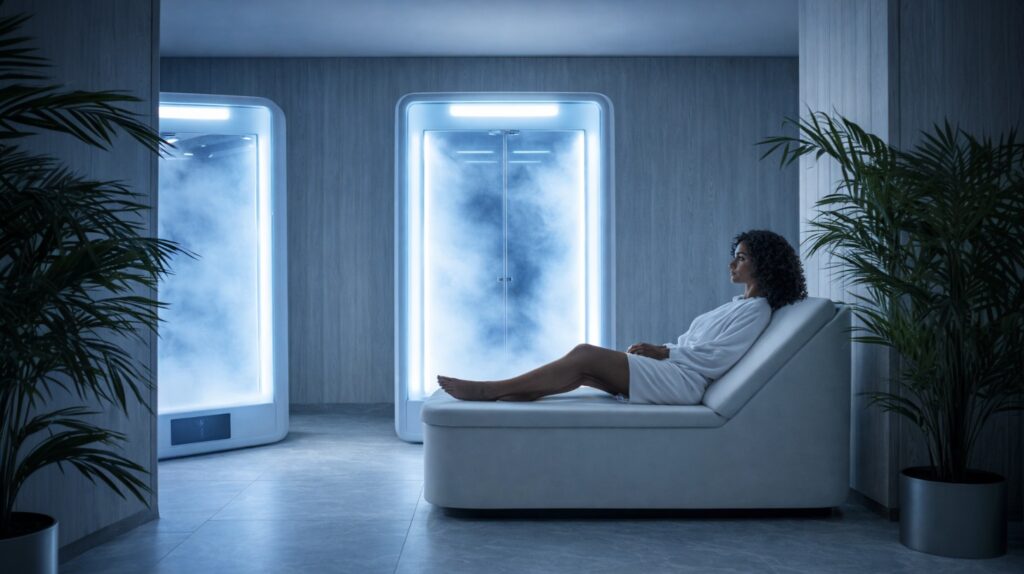
Whole-body cryotherapy sessions run two to three minutes and price between $40 and $85 per session at standalone studios. In a club context, bundled session packages and membership add-on tiers can generate $150 to $400 per member per month from dedicated users. The scientific literature on cryotherapy for inflammation reduction and muscle recovery is substantial enough that sports medicine–minded members accept it without extensive education. Capital costs are high — whole-body cryotherapy chambers range from $40,000 to $120,000 — but throughput potential of up to 20 sessions per hour makes the unit economics favorable at any club with meaningful athletic membership density.
Compression Therapy
NormaTec-style compression boots and full-body compression systems are among the highest-ROI recovery investments available to clubs: equipment costs are modest ($3,000 to $12,000 per unit), sessions run 20 to 30 minutes, and the experience is passive enough that members use the time to work, read, or decompress socially. Clubs that have installed compression therapy lounges — purpose-designed spaces with four to eight chairs in a social configuration — report that the lounge becomes a social anchor, increasing dwell time and food and beverage revenue simultaneously. This is the rare recovery modality that pays dividends across revenue categories at once, a dynamic Midtown Athletic Club has leveraged by positioning its recovery and social spaces in close physical proximity.
Red Light and Infrared Therapy
Red light therapy and infrared sauna represent the lowest barrier to entry of the major recovery modalities — both in terms of capital cost and member education required. Infrared saunas are already present in many athletic clubs but are chronically undermonetized, priced into general membership access rather than structured as bookable premium sessions. The clubs extracting the most revenue from these modalities have reframed them: private infrared sessions at $25 to $45, with premium add-ons such as aromatherapy protocols, guided breathwork audio, and post-session cold plunge pairing, convert a formerly ambient amenity into a repeatable booking that members treat as a ritual.
Float Therapy and Sensory Deprivation
Float tanks command the highest per-session pricing of any recovery modality — $75 to $120 per session at standalone studios — and carry a loyal, high-frequency user base. The member profile for float therapy skews toward high-stress executive profiles, endurance athletes, and members with chronic pain conditions, all of which are well-represented in affluent athletic club demographics. Float tanks require significant capital investment ($25,000 to $40,000 per tank) and maintenance discipline, but the premium positioning they signal for the overall club brand is disproportionate to their footprint.
Sleep Optimization and HRV-Based Recovery Labs
The most sophisticated — and least commonly implemented — recovery category in the private club space is sleep and readiness science. The Jonathan Club’s investment in MyZone biometric integration points toward where this is heading: when a club already has a member’s effort and recovery data in a structured system, sleep optimization programming is the natural next layer. Structured sleep optimization programs typically run $300 to $800 per engagement at medical spa and performance wellness clinics — the highest program pricing in the recovery stack — and the member demand, driven by wearable data adoption, is growing faster than the supply of clubs positioned to meet it.
Advertisement
Pricing Architecture: The Model Most Clubs Get Wrong
The most common pricing mistake in club recovery programming is binary thinking: either the modality is included in base membership or it is sold as a standalone à la carte service. Both approaches underperform relative to a tiered packaging model, and the difference compounds over time.
Inclusive base membership pricing, while appealing as a value proposition, destroys unit economics at any meaningful utilization rate and eliminates the psychological anchoring that makes recovery services feel premium. À la carte pricing creates friction at every purchase point and discourages the habitual use that builds the service into a member’s routine — and therefore into their retention calculus. The Landings’ Oakridge Wellness Center avoids both traps by offering recovery and specialty programming as distinct, credentialed services with their own pricing structure — personal training sessions, specialty TPI assessments, and HeartStrong program enrollments are each positioned as purposeful investments rather than incidental extras.
The Bundled Tier Model
The clubs generating the most recovery revenue use a three-tier model: a base membership that includes a defined monthly allotment of recovery credits, a mid-tier Performance add-on that expands access and includes guided protocols, and a premium Optimize tier that adds personalized programming, staff consultations, and wearable data integration. This structure captures revenue at every price point, encourages upgrade behavior, and makes recovery feel like a natural progression rather than an upsell.
Source: IHRSA Ancillary Revenue Benchmarking, 2024; Club Benchmarking, 2024
The Retention Multiplier Hidden in Recovery Data
Recovery programming’s most underappreciated value is not the revenue it generates directly — it is the retention lift it produces among members who use it. The mechanism is well-documented in health club research: members who use a club for multiple distinct purposes, rather than a single activity, have materially lower cancellation rates. Recovery services, because they are experientially distinct from workout programming and often require scheduling and intentional booking, function as a second distinct use case that anchors a member’s relationship with the facility.
IHRSA’s member retention research shows that every additional structured visit a member makes per month reduces their cancellation risk the following month by 33%. Recovery sessions, which tend to be scheduled in advance and tied to specific wellness goals, drive exactly this kind of incremental visitation. Midtown Athletic Club’s model — where recovery spaces, dining, and social areas are deliberately intertwined — means a member who comes in for a recovery session stays longer, spends more at the restaurant, and deepens the social connections that make the membership feel irreplaceable. A member who trains three times a week and books two recovery sessions is not just spending more; they are embedded in the club’s ecosystem in a fundamentally different way than a member who only trains.
Source: IHRSA Member Retention Report; Club Automation / Daxko, 2024
The Sleep Lab Opportunity: Where Almost Nobody Is Playing Yet
Of the recovery categories available to athletic and wellness clubs, sleep optimization is the one with the largest unmet demand and the smallest competitive field. The consumer wellness market has made sleep one of its defining categories — wearables like Whoop, Oura Ring, and the Apple Watch have put HRV data in front of millions of people who now track their readiness scores daily but have no structured professional support for acting on that data. The Jonathan Club’s investment in MyZone biometric integration already moves in this direction: when a club has a member’s effort and recovery data in a structured system, sleep optimization programming is the natural next layer, and the club is positioned to offer it with credibility that a standalone sleep studio cannot match.
A club sleep optimization program does not require a dedicated sleep lab. The minimum viable version is a certified sleep coach offering one-on-one consultations that connect a member’s wearable data to actionable protocols — sleep environment optimization, pre-sleep routine design, chronotype alignment with training schedules, and nutrition guidance. Priced at $150 to $300 per consultation, with package series in the $600 to $1,200 range, this is high-margin, low-overhead programming that positions the club at the frontier of performance wellness.
The First-Mover Window Is Open — But Not Indefinitely
Fewer than 8% of private athletic and wellness clubs currently offer any structured sleep optimization programming, according to Club Benchmarking’s 2024 wellness amenity survey. Standalone sleep clinics and performance wellness centers are actively expanding into this market. The clubs that build credible sleep programming in the next 18 to 24 months establish a category identity that competitors cannot quickly replicate — the kind of differentiation that appears in member recruitment conversations and stays there.
What the Leading Clubs Have in Common
The Landings, the Jonathan Club, and Midtown Athletic Club approach recovery from different angles — a sprawling residential wellness campus, a century-old urban social club with biometric integration, and a multi-discipline athletic facility with deeply social programming architecture. What they share is a refusal to treat recovery as incidental. Across all three, the common operational traits are consistent.
Dedicated Recovery Staff With Clinical Credentialing
The most important signal a club can send about its recovery programming is staff quality. The Landings’ Oakridge Wellness Center employs 16 certified trainers with specialized skill sets, and its HeartStrong and Chronic Condition Management programs are delivered by staff with clinical credentials appropriate to those populations. A certified strength and conditioning specialist, licensed athletic trainer, or credentialed recovery coach running recovery programming transforms the perception from spa amenity to performance service. Members pay meaningfully more — and use the service more consistently — when they perceive professional oversight.
Protocol-Based Programming, Not Just Equipment Access
Equipment access is the amenity. Protocols are the product. The Jonathan Club’s Body Sustainability Series — a membership education program where spa and fitness directors jointly guide members through recovery and injury prevention protocols — illustrates the difference precisely. A member who attends a “Happy Feet” session led by the spa director and walks away with a personalized foot care and mobility protocol has received a service. A member who uses the whirlpool spa without guidance has used an amenity. The former becomes a repeat booker. The latter becomes a lapsed member.
Wearable Data Integration
Clubs that connect recovery programming to wearable data create a personalization loop that standalone recovery studios cannot replicate. The Jonathan Club’s use of MyZone technology — which brings individual effort and recovery data into staff-guided programming decisions — demonstrates that this capability is not reserved for technology startups or luxury performance centers. It is achievable at any club willing to invest in the integration. When a staff member can look at a member’s HRV trend from the past two weeks and recommend a specific recovery modality based on their current recovery score, the service has moved from generic to individualized in a way that justifies premium pricing and produces lasting loyalty.
Social Architecture Around Recovery Spaces
Midtown Athletic Club’s design philosophy — deliberately positioning recovery spaces adjacent to dining and social programming rather than isolating them — converts individual recovery usage into communal behavior. Members who recover together form relationships that parallel treadmill use never produces. At The Landings, the Oakridge Wellness Bar functions as a social gathering point that extends member dwell time after workouts and recovery sessions alike. The clubs that have built recovery lounges as intentional social spaces report that recovery programming becomes a membership conversation point — the thing members mention when they recommend the club to a friend.
The Questions Worth Asking Now
The recovery economy is not a trend. It is a permanent reorientation of what health-conscious consumers expect from premium fitness and wellness membership. The competitive landscape is shifting: standalone recovery studios, medspas, and performance wellness centers are competing for the same member wallets with a focused offering that most athletic clubs have not yet matched with equivalent intentionality.
- Is your recovery programming priced as a service or included as an amenity? If it is included, you are subsidizing usage without capturing revenue — and signaling that the service is not worth paying for.
- Do you have staff credentialed to deliver recovery protocols, or just equipment available for self-use? The Landings employs 16 certified trainers and runs clinical specialty programs. That investment signals to members what recovery is worth.
- Are you connecting recovery to your training programming? The Jonathan Club’s MyZone integration shows what it looks like when biometric data drives recovery decisions rather than calendar availability.
- Have you explored sleep optimization as a distinct program category? The competitive field is nearly empty and member demand — driven by wearable data adoption — is real and growing faster than clubs are responding to it.
- Are your recovery spaces designed for social interaction? Midtown Athletic Club’s model shows that when recovery and social programming share physical space, the retention value of each multiplies.
Recovery science is not the next thing coming to private athletic clubs. It is already here — at the clubs willing to build the infrastructure to monetize it. The clubs that treat it as a differentiator today will find it has become table stakes by 2028.
Sources
- International Health, Racquet and Sportsclub Association (IHRSA). Member Retention Report: Focus on Member Interaction. 2024.
- IHRSA. Ancillary Revenue Benchmarking Report. 2024.
- Club Benchmarking. Wellness Amenity and Recovery Programming Survey. 2024.
- Global Wellness Institute. Global Wellness Economy Monitor. 2025.
- Club Automation / Daxko. Member Engagement and Retention Data. 2024.
- The National Club. Fit for Life: The Jonathan Club. 2015.
- The Landings Golf & Athletic Club. Oakridge Wellness Center Programming Overview. 2024.
- Midtown Athletic Club. Club Overview and Amenities. Midtown.com, 2025.
About Private Club Marketing
Private Club Marketing has generated over $100 million in membership revenues for some of the most prestigious clubs in America — including Monterey Peninsula Country Club, The Riviera Country Club, the Harvard Club of Boston, and The Vintage Club. If you’re ready to build a recovery revenue strategy for your athletic or wellness club, we’d love the conversation.