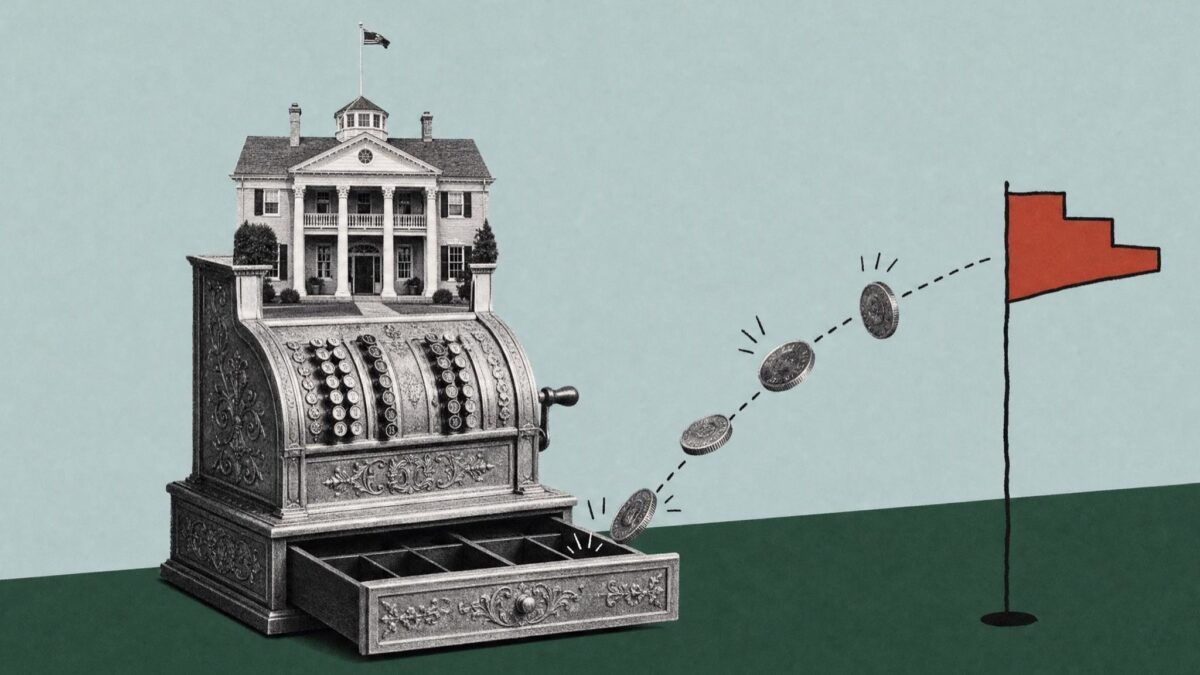


The price of belonging keeps climbing. According to GGA Partners’ Club Leader’s Perspectives Report (August 2024), average initiation fees across the private club industry rose 8.7% year-over-year, while annual operating dues grew 6.2%. At the very top of the market — the small set of clubs that define American exclusivity — the entry numbers run far above industry averages, and the waitlists are long enough that price is rarely the deciding factor.
This is what membership actually costs at the country clubs that sit at the top of the pyramid in 2026, why those numbers keep rising, and what general managers and membership directors should learn from the pricing architecture at the high end of the market.
The Industry Baseline: What “Average” Looks Like
Before talking about the top of the market, it helps to anchor on the middle. GGA Partners’ 2024 data shows the private club industry’s economic structure in clear terms:
- Average initiation fee: $58,000 (median: $34,000)
- Average annual operating dues: $10,700 (median: $9,100)
- Average capital dues: $1,200 (median: $1,100) — roughly 10% of operating dues
- Planned increases for the year ahead: initiation fees up another 8.7%, operating dues up 6.2%, capital dues up 12.5%
The distribution matters as much as the averages. GGA reported that only 8% of clubs charge initiation fees above $165,000, with another 2% in the $145,000–$164,999 band and 3% in the $125,000–$144,999 band. Together, 13% of all surveyed clubs charge initiation fees above $125,000 — and that slice is essentially the universe we’re discussing when we talk about the country’s most exclusive clubs. The vast majority of clubs (roughly 58%) sit below $45,000.
The shape of that distribution is more striking when you actually plot it:
Initiation fee distribution · GGA Partners, August 2024
In other words: the most exclusive clubs in America aren’t a step above the industry — they’re a different financial category entirely.
The Top of the Pyramid: How Initiation Fees Stack Up
At the most exclusive country clubs in the United States, initiation fees in 2026 typically run from the low six figures into the high six figures, with a handful of legacy clubs rumored to require seven-figure entry. GGA Partners’ data confirms this market exists in scale: roughly 13% of all surveyed clubs report initiation fees above $125,000, and demand at this end of the market has remained durable.
Based on available market reporting and industry analysis, the broad pattern at the top tier looks like this:
- Entry-level “exclusive”: $150,000–$250,000 initiation, found at established country clubs in major metros with strong waitlists
- Top-tier destination clubs: $250,000–$750,000+ initiation, typically golf-first clubs whose fees are widely reported in industry press but never officially published — this tier includes some of the most storied names in American golf
- Generational legacy clubs: Invitation-only with no published fee schedule — entry depends on sponsorship, not price
GGA Partners noted that more than one-third of clubs reported their waitlists increased in 2024 versus the prior year, with 34% of clubs reporting growing waitlists. At the most exclusive end of the market, waitlist depth — not pricing — is the binding constraint. Once you’re in that band, raising the initiation fee doesn’t shorten the line.
Annual Dues: The Quiet Number That Adds Up
Initiation fees get the headlines, but recurring dues are what members actually pay year after year. GGA reports the average full-member operating dues at $10,700 annually, with approximately 16% of clubs charging between $13,000 and $18,999, and 4% above $25,000.
At the most exclusive country clubs, annual operating dues in 2026 typically range from $18,000 to $35,000, with capital dues stacked on top. GGA’s data shows capital dues averaging $1,200 industry-wide, but with planned increases of 12.5% — double the rate at which operating dues are climbing. That’s an important signal: clubs are increasingly funding facility reinvestment through dedicated capital charges rather than baking it into operating dues.
For a member at a top-tier club, the recurring annual cost — operating dues, capital dues, F&B minimums, locker fees, cart fees, and assessments — often lands between $25,000 and $50,000 per year, on top of whatever was paid to walk in the door.
The Total Cost of Belonging: A Decade-Long View
If you take the most exclusive band of the market and project what a member actually spends across a typical 10-year tenure:
The total ten-year cost at America’s most exclusive country clubs comfortably runs $500,000 to over $1 million, before any special assessments for capital projects. And those assessments are coming: GGA reported that capital projects remain among the leading operational emphases, cited as a future challenge by 36% of club leaders, and that clubs with revenues over $10 million were far more likely to be “highly aggressive” in their capital investment outlook.
Why the Numbers Keep Climbing
Three forces are driving sustained pricing power at the top of the market.
Demand remains broadly strong, though moderating from its post-COVID peak. GGA Partners’ 2024 report noted “minor signs of softening demand” as the explosive membership growth of the pandemic era decelerates. Even so, 49% of clubs reported member numbers staying flat and 40% reported increases, with only 11% showing declines.
Member numbers · year-over-year change · GGA 2024
Waitlists at 34% of clubs grew year-over-year. Larger clubs with $10–$25 million in revenue were the most likely to maintain strong demand — exactly the cohort that includes the most exclusive properties.
Costs are real and escalating. GGA reported that 51% of club leaders said labor expenses exceeded budget in 2024, the single most-cited operational challenge. Clubs are passing those costs through to dues — and the most exclusive clubs, with the most labor-intensive service models, feel this acutely.
Capital reinvestment is accelerating. Clubs are funding wellness, racquet sports (especially pickleball and padel), and clubhouse renovations through capital dues and assessments rather than debt. GGA’s data shows capital dues set to rise at twice the rate of operating dues. Across the industry, wellness amenities, racquet sport expansion, culinary programming, and curated member events have emerged as the experience-led investments attracting Millennials and Gen Z to premium clubs — and all of it requires capital.
What Membership Directors Should Take From This
The pricing data tells a clear story for clubs operating below the very top of the market: there is significant room to refine pricing architecture without choking demand.
- Initiation fees and operating dues are diverging. GGA noted that while initiation fee averages have pulled well above their medians (showing some clubs charging dramatically more), operating dues averages and medians stay close. The exclusive clubs are pricing entry aggressively while showing restraint on what current members pay annually.
- Capital dues are underutilized. GGA’s data shows the distribution of capital dues skewing low — 33% of clubs charge under $500. Clubs funding renovations through assessments rather than predictable capital dues are leaving a transparent, defensible revenue tool on the table.
- Tiered membership architecture is the growth play. Industry analysis consistently points to young professional/under-40, social, seasonal, and corporate membership tiers as the structures driving membership growth at premium clubs. Tiering preserves exclusivity at the top while creating accessibility ramps that protect long-term pipeline.
- Waitlist depth is the real exclusivity signal. Pricing alone doesn’t make a club exclusive. The clubs with the deepest waitlists — and the most thoughtful sponsorship and approval processes — are the ones whose members value belonging most, and who are least sensitive to dues increases.
The cost of joining America’s most exclusive country clubs in 2026 is high and rising. But the more useful insight for the rest of the industry is this: the clubs commanding $200,000+ initiation fees and $25,000+ annual dues didn’t get there by raising prices. They got there by managing demand, investing in member experience, and pricing as a function of waitlist depth — not the other way around.
Free Download
The 2026 Private Club Benchmark Report
The membership, amenity, and pricing data reshaping private clubs — from a 1,200-club analysis. Enter your details and we'll send it to your inbox.