
Pickleball didn’t just enter private clubs — it conquered them. The sport now sits inside 56% of private clubs, ahead of gym/fitness centers (55%), golf simulators (36%), and spa/wellness facilities (24%) in amenity penetration, according to GGA Partners’ 2024 Club Leader’s Perspectives Report. But the same report reveals an uncomfortable truth: 41% of club leaders now cite pickleball as an overcapacity concern — second only to golf itself at 50%, and well ahead of fitness (30%) and tennis (23%).
That number is the quiet warning sign behind conversations happening in board rooms from Boca to Bel Air. The honeymoon is over. Membership committees that approved hasty tennis-to-pickleball conversions in 2021 and 2022 are watching court conflicts, noise complaints from neighboring homes, and lopsided demand patterns — and several of the country’s most strategic clubs are now asking whether more pickleball is really the answer, or whether the next decade’s racquet and amenity investment should look very different.
What the Capacity Data Actually Reveals
The headline number from GGA’s research is that 49% of clubs report being at capacity overall, with only 12% over-capacity and 40% reporting room to grow. But the aggregate masks a sharper truth at the amenity level. When club leaders were asked which specific amenities risk overcapacity, GGA’s data shows the picture shifts dramatically:
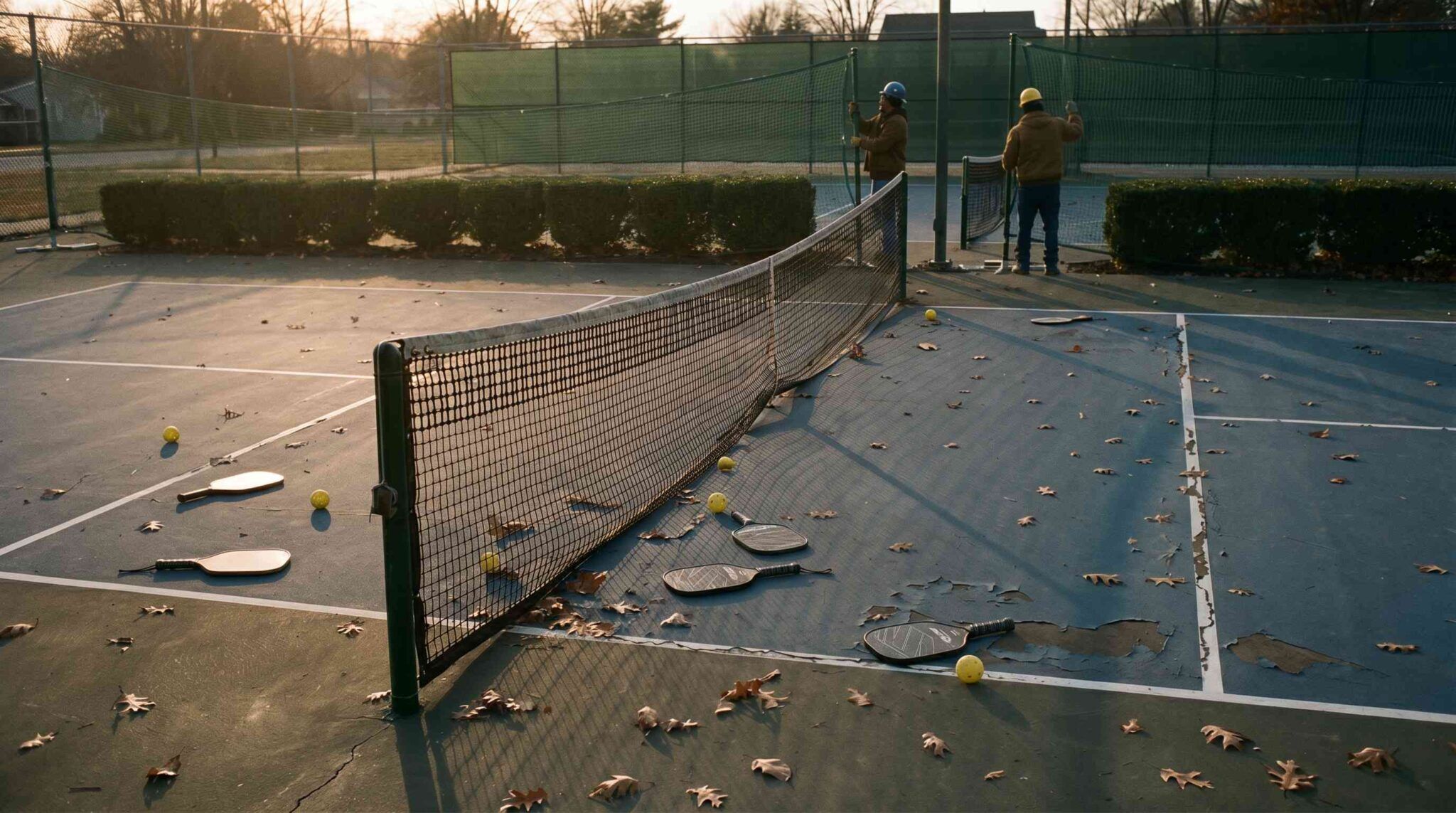
The pickleball figure is the inflection point. When tennis — a sport with established court inventory built over decades — sits at 23% capacity concern, and a sport that barely existed at most clubs five years ago is already at 41% concern with 56% market penetration, GGA’s data reveals that build-out hasn’t kept pace with adoption. Some clubs are responding by pouring more concrete. Others are starting to ask whether the right answer is actually fewer courts, not more.
The Strategic Case Against More Pickleball
Capacity data alone wouldn’t justify removing courts. What’s driving the rethink at top clubs is a convergence of three signals from GGA’s research and broader market analysis.
First, member emphasis is shifting. When asked to prioritize their 2024 strategic focus areas, only 31% of club leaders selected “Unique or New Amenities” — well behind Membership Experience & Engagement (81%), Staff Attraction & Retention (72%), Strategic Planning (61%), and Food & Beverage (47%). The pickleball arms race assumed that amenity novelty itself was the differentiator. Boards are increasingly concluding that the experience around an amenity — service, programming, atmosphere, member culture — is the real differentiator, not the latest court surface.
Second, the surrounding club economics make every square foot competitive. GGA reports that labor expenses ran over budget at 51% of clubs, with more than half of leaders spending more than expected on payroll. In an environment where labor and capital are both squeezed, an amenity that drives session-based use but generates limited ancillary food, beverage, retail, or wellness revenue compares unfavorably to spaces that anchor multi-hour, multi-spend visits.
Third, demand is plateauing at the margins. Pickleball ramps are front-loaded: enthusiastic first-year participation followed by injury-driven attrition. Clubs that built out aggressively in 2021 are precisely the clubs now reporting the 41% capacity concern figure — a concentration of demand that may have already peaked in early-adopter properties.
What Top Clubs Are Quietly Exploring Instead
The replacement strategies emerging at thoughtful clubs fall into three buckets, each backed by signals in the data.
Padel, the racquet sport with room to grow. The same GGA report shows padel currently sitting at just 2% of club amenities — a number that today looks similar to where pickleball was a decade ago. Growth Market Reports’ Global Private Club Membership analysis explicitly identifies “racquet sports (notably pickleball and padel)” as a primary experience-led growth vector for clubs targeting Millennial and Gen Z members. For the strategically positioned club, padel offers what pickleball offered five years ago: a differentiated, photogenic, social racquet experience without the saturation. The footprint is larger, the build cost higher, and the talent pool of teaching pros thinner — but the differentiation is real and durable.
Wellness real estate, with measurable ROI. The most compelling financial case for a court conversion may not be another court at all — it’s wellness. According to data published in RLA Global’s Wellness Real Estate Report 2025 and reviewed in the European Spa Leaders’ Resource 2026, hospitality properties classified as Major Wellness (where wellness and leisure revenue exceeds $1 million annually or 10% of total revenue) generated 56% higher TRevPAR than Minor Wellness properties, and more than doubled the performance of properties offering no wellness program at all. Average daily rates ran $220 at Major Wellness properties versus $187 at properties with no wellness offering — an 18% premium. Hospitality numbers don’t translate one-to-one to private clubs, but the directional message is unmistakable: wellness pays. With only 24% of clubs currently offering Spa/Wellness amenities at all — per GGA’s own survey data — the differentiation runway is substantial.
Longevity and medi-wellness, the next frontier. The European Spa Leaders’ Resource 2026 identifies medi-wellness — services that blend conventional medicine with wellness-oriented care — and longevity programming as the fastest-evolving wellness category. Clinique La Prairie’s CEO Simone Gibertoni describes a model integrating genetic testing, epigenetic age testing, AI-driven diagnostics, and biomarker tracking, noting that in 2021 the clinic was the first longevity-focused clinic worldwide to integrate epigenetic testing into its programmes. For private clubs serving aging-but-active membership rosters, a partnership with a medi-wellness provider — diagnostics-led longevity assessments, recovery suites, advanced bodywork — converts a 2,000-square-foot court footprint into one of the highest-margin amenities in the club. Critically, it also drives the kind of weekly, repeat, multi-hour visits that pickleball does not.
The Conversion Playbook
For a board weighing whether to remove a pickleball court, the question isn’t whether members enjoy the sport — they do. The question is whether the marginal court is the highest-and-best use of that real estate over a 10-year horizon. A few principles emerge from the data:
- Don’t remove what isn’t over capacity. If your club is among the 59% that GGA’s data shows does not yet report pickleball overcapacity, you have demand runway. The conversion conversation is for clubs already at capacity who are tempted to add — and should consider adding something else.
- Convert one, not all. The clubs handling this most gracefully are converting a single court to padel or to a wellness/recovery suite, leaving meaningful pickleball capacity intact, and watching member behavior over a season. Reversibility matters.
- Tie the conversion to membership experience, not amenity novelty. With 81% of club leaders ranking Membership Experience & Engagement as their top 2024 emphasis, the replacement amenity should make a tangible weekly difference in how members experience the club — not just give the marketing committee something new to photograph.
- Watch your wellness numbers. Moving from Minor Wellness toward Major Wellness category — meaningful spa, recovery, and programming revenue — has a documented financial ceiling that few other amenity categories can match.
The Bigger Pattern
The private club industry now spans 5,659 clubs generating $32.6 billion in annual revenue and employing 573,000 people, according to the 2024 Economic Impact Study conducted jointly by Club Benchmarking, CMAA, and the National Club Association (NCA). The clubs that grow into the next decade aren’t the ones that chased every amenity trend. They’re the ones that read the capacity data carefully, asked which amenities drove genuine member retention versus which ones drove a brief surge of social media interest, and made the unsexy decision to convert square footage when the moment was right.
Pickleball isn’t going anywhere. But the era of “more courts is always the answer” is ending — and the clubs that recognize the inflection first will own the wellness, longevity, and racquet-diversification advantages while everyone else is still pouring concrete.
Free Download
The 2026 Private Club Benchmark Report
The membership, amenity, and pricing data reshaping private clubs — from a 1,200-club analysis. Enter your details and we'll send it to your inbox.