

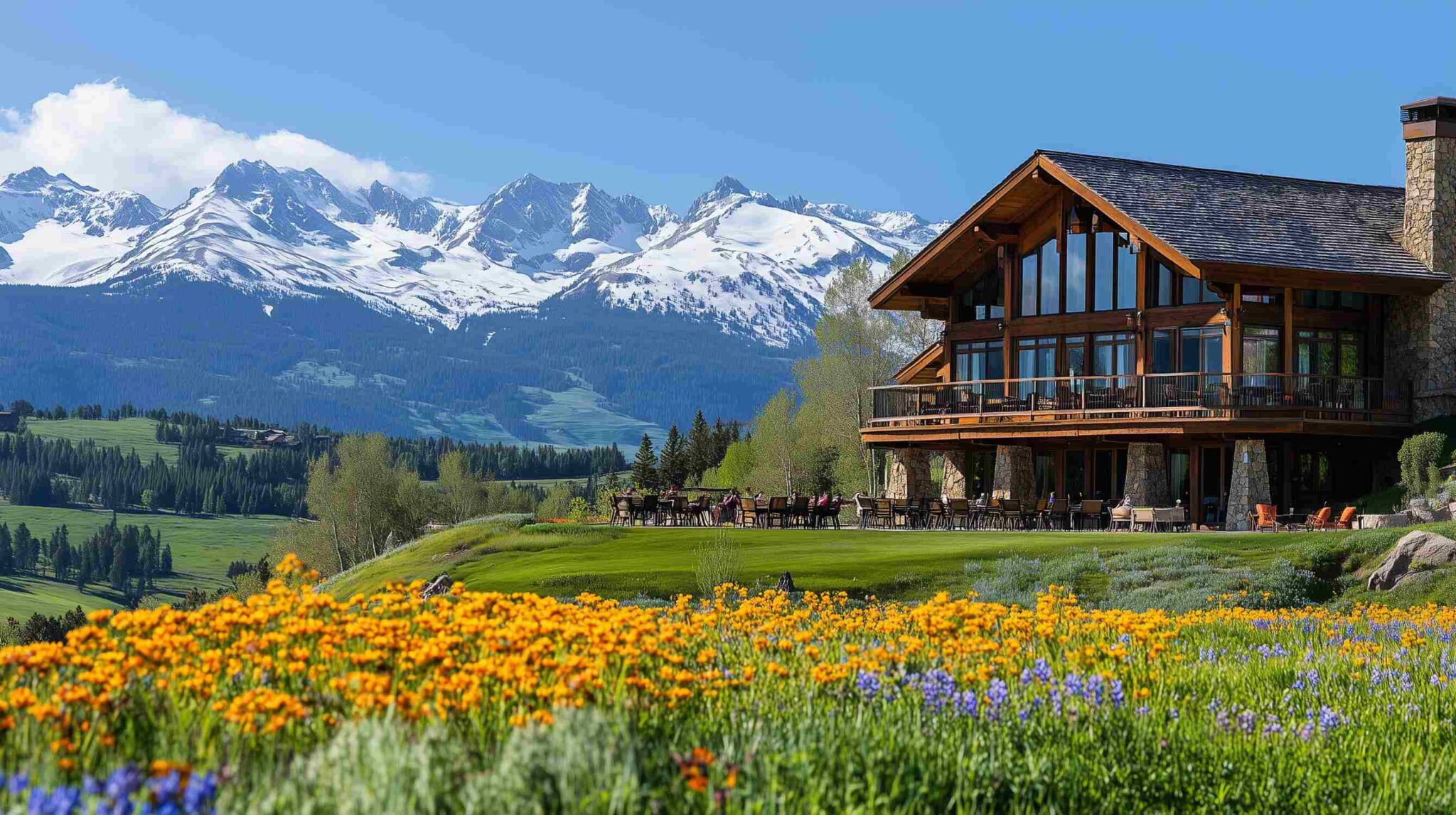
For decades, mountain clubs operated on a simple — and brutal — economic model: make your money between December and April, then survive the other seven months. Chairlifts went silent, dining rooms emptied, and the only people left on property were grounds crews and the occasional hiker who wandered in from the trail.
That era is over.
The most ambitious mountain clubs in the American West have fundamentally reengineered their business models, turning summer from a cost center into a revenue engine. According to DestiMetrics/Inntopia data through 2016, summer visitor volume at mountain resorts increased nearly 45% from 2008 levels, while summer revenue surged more than 95% during the same period. At properties like the Yellowstone Club, Spanish Peaks Mountain Club, and Telluride Ski & Golf Club, the warm months aren’t the off-season anymore — they’re the other season.
Here’s how the best mountain clubs are closing the gap — and what their playbook means for the future of year-round private club economics.
The clubs that are ahead of the curve understand something important: the goal isn’t to replicate winter revenue in summer. It’s to build a year-round revenue model where summer contributes enough to eliminate the cash flow valleys that historically forced mountain communities into hibernation — and, crucially, where summer programming becomes a membership selling point in its own right.
Steamboat Springs’ city finance director has confirmed the city collects roughly a third of its annual sales tax revenue in summer. And Aspen Snowmass has become a recognized industry benchmark for summer programming, having built a year-round calendar of events and outdoor offerings that draws visitors well beyond the ski season. These aren’t anomalies — they’re the new benchmark.
Mountain clubs are uniquely positioned to capitalize on this trend. Outdoor dining at 8,000 feet elevation, with views of alpine meadows and distant peaks, is an experience that simply doesn’t exist at sea-level clubs. The Club at Cordillera in Edwards, Colorado — with multiple golf courses and its Chaparral Restaurant — understands this. So does Whitefish Mountain Resort in Montana, where scenic chairlift rides deliver guests to slope-side dining venues with panoramic views of the Flathead Valley.
The playbook for summer F&B at mountain clubs includes farm-to-table partnerships with local ranchers and producers (grass-fed beef, wild-caught trout, foraged mushrooms), outdoor cooking events like asado nights and fire-pit dinners that translate the mountain lifestyle into a culinary format, and elevated wine and spirits programming that capitalizes on members’ vacation-mode willingness to spend on premium experiences.
95%+
Summer Revenue Growth Since 2008
45%
Summer Visitor Volume Growth
92%
Summer Visitation vs. Winter Levels
19.3%
Avg. F&B Revenue Lift Jan–July
The Economics of Seasonality — And Why It’s Changing
The traditional mountain club revenue model was brutally lopsided. Winter operations — lift tickets, ski school, equipment rentals, slope-side dining — generated the vast majority of annual revenue. Summer was a maintenance period, kept alive by a skeleton crew and whatever golf or hiking traffic trickled in. Industry data from Ski Area Management’s summer operations survey reveals the current state of the transition. While summer visitation now reaches within 92% of winter levels at many resorts, summer room rates average just 57% of winter rates, and overall summer revenue still represents roughly 52% of winter revenue. The gap is closing, but it hasn’t closed yet.Summer Performance vs. Winter Benchmarks
Visitation Rate
92% of Winter
Room Rates
57% of Winter
Overall Revenue
52% of Winter
Case Study: Yellowstone Club — The Four-Season Private Mountain
The Yellowstone Club in Big Sky, Montana — the world’s only private ski and golf community — has perhaps done more than any other mountain club to prove that summer can rival winter as a membership driver. Spread across 15,200 acres of private land, the Yellowstone Club’s summer programming is staggering in scope. Members have access to 40+ miles of hiking and mountain biking trails, 15 miles of private waterways for fly fishing, a nine-hole disc golf course, scenic gondola and chairlift rides, and complimentary kayak and stand-up paddleboard rentals at their private lake. The centerpiece of summer at the Yellowstone Club is the Tom Weiskopf-designed 18-hole championship golf course, which becomes the social heart of the community from June through September. The club’s dedicated Outdoor Pursuits team runs a packed calendar of guided activities — from horseback riding to backcountry camping trips — designed to keep families engaged for weeks at a time, not just weekends. What makes the Yellowstone Club model particularly instructive is the integration of real estate and club membership. Membership requires property ownership, with homes starting at $4 million or more and initiation fees reported at $400,000 or more, with annual dues estimated at $60,000 or more annually (the club does not publish official fee schedules). At those price points, members aren’t buying a ski pass — they’re buying a lifestyle. And a lifestyle that only delivers value four months a year isn’t worth that kind of annual investment. The Yellowstone Club’s investment in summer programming isn’t optional. It’s existential. Members need to feel that their mountain home is worth visiting 12 months a year.Case Study: Spanish Peaks Mountain Club — Golf as the Summer Anchor
Down the road in Big Sky, Spanish Peaks Mountain Club has taken a different but equally effective approach to summer activation. This 5,700-acre private residential community — managed by Lone Mountain Land Company since 2013 — uses golf as the anchor that pulls members back in summer and keeps them engaged through fall. The Tom Weiskopf-designed 18-hole championship course at Spanish Peaks is consistently rated among the best alpine courses in Montana. But it’s the supporting ecosystem that makes the summer program work: a 10-hole par 3 course for casual play and junior development, Fish Camp on the South Fork of the West Fork of the Gallatin River for guided fly fishing, pickleball and tennis courts, and ski-in/ski-out access to Big Sky Resort’s 5,850 acres of skiable terrain in winter. The real estate numbers tell the story of year-round demand. Home prices in the Spanish Peaks community range from $2 million to over $10 million for custom estates, and the broader Big Sky market posted a median sales price of $2,625,000 in Q4 2024 — up 9.4% year-over-year. That kind of appreciation doesn’t happen in a market that’s only relevant four months a year. The Montage Big Sky hotel, integrated into the community, adds a built-in membership pipeline — transient guests experience the summer programming, fall in love with the community, and become real estate prospects.Case Study: Telluride Ski & Golf Club — The Social Calendar That Never Stops
At the Telluride Ski & Golf Club in southwest Colorado, the approach to eliminating seasonality centers on something harder to replicate than facilities: culture. The club positions itself as a place where members “live life to the fullest” through an extensive social calendar that runs year-round. Platinum Level Members receive transferable ski passes, unlimited use of the Spa at The Peaks Resort, private dining access at Allred’s, and full access to the golf club — a combination of benefits that only makes sense if you’re using the club across multiple seasons. Telluride’s summer lineup reads like an adventure tourism brochure: canopy zipline tours, a lift-served bike park, river sports, mountain climbing, and kids’ camps. But the club’s real differentiator is its events programming — holiday parties, outdoor excursions, themed dinners, and community gatherings that create the social glue keeping members connected between ski trips. This is the insight that separates good mountain clubs from great ones. Facilities get people to visit. Programming gets them to stay. But community — the feeling that your absence would be noticed — is what makes members renew year after year.The Food & Beverage Opportunity
Summer represents an enormous — and frequently underdeveloped — F&B opportunity for mountain clubs. FRED (Federal Reserve Economic Data) shows that hospitality F&B revenue increases an average of 19.3% between January and July, driven by outdoor dining, lighter seasonal menus, and longer evening hours. And according to GGA Partners’ 2024 Club Leaders Perspectives Report, 48% of club leaders cited F&B as their most frequently exceeded revenue category — the single highest across all segments. Mountain clubs, with their distinctive outdoor settings and vacation-mode membership spending behavior, are primed to outperform even that already-optimistic benchmark.19.3%
Average F&B revenue lift from January to July
FRED Economic Data
48%
Of club leaders cite F&B as their top exceeded revenue category
GGA Partners 2024
95%+
Of mountain operators agree summer attracts new user groups to the club
Ski Area Mgmt Survey
92%
Of mountain resort operators agree that summer programming attracts new user groups and expands the member base
Ski Area Management Survey
Family Summer Camps: The Retention Engine
The most overlooked summer strategy at mountain clubs is also the most effective for long-term retention: family programming that gives children their own reasons to love the club. When kids spend two weeks at a mountain club’s junior program — learning to mountain bike, fish, rock climb, and make friends with other members’ children — they create emotional bonds that influence family membership decisions for years. Parents don’t cancel memberships at clubs where their kids are counting the days until next summer. Whitefish Mountain Resort runs an extensive summer activity program that includes lift-accessed mountain biking on 30+ miles of trails, an alpine slide, aerial adventure park, and zipline tours. The zipline program alone runs 2.5 hours per session — long enough to feel like a genuine adventure, not a carnival ride. The best mountain clubs structure their junior programs to be progressively challenging — hiking and fishing at 7, intermediate mountain biking at 10, backcountry leadership skills by 13. This progression gives families a reason to return every summer and gives teenagers a reason to actually want to go to the club, which any parent of a 14-year-old knows is no small feat.The Real Estate Multiplier
At mountain communities where club membership and property ownership are intertwined, summer programming has a direct impact on real estate values. A home that’s only usable four months a year is worth less than one that delivers value year-round. The Big Sky market reflects this. The median listing price exceeds $3 million as of late 2025, driven in large part by investments in year-round infrastructure. These aren’t just housing prices — they’re membership conversion metrics. Every dollar of real estate appreciation reinforces the value proposition of membership. Every summer program that gives homeowners a reason to visit in July protects and grows that value.Mountain Club Real Estate: Price Tiers (2024–2025)
The clubs that figured this out early — investing in summer when their accountants told them to cut costs — are sitting on the most valuable private communities in the American West.The Staffing Challenge — And the Staffing Solution
One of the underreported benefits of year-round programming is its impact on staffing. Seasonal businesses face a brutal cycle: hire, train, lose, repeat. The best employees leave for year-round jobs. The ones who stay are often the ones who couldn’t find something better. Ski Area Management’s survey found that more than 95% of mountain resort operators agree that summer operations improve hiring and staff retention. This aligns directly with what club leaders across the industry are experiencing: GGA Partners’ 2024 Club Leaders Perspectives Report found that 72% of club leaders listed staff attraction and retention as a top operational emphasis for the year — the second-highest priority across all categories, behind only member experience. Year-round operations don’t just solve a mountain club problem — they solve the industry’s most pressing management challenge.Industry Alignment: Why Year-Round Operations Matter
Sources: Ski Area Management Survey; GGA Partners Club Leaders Perspectives 2024; NGCOA Golf Industry Key Trends 2025
When you can offer a golf professional, a fitness instructor, or a sous chef a 12-month position instead of a 5-month contract, you attract a fundamentally different caliber of talent. And that talent delivers a fundamentally different member experience. The Club at Cordillera demonstrates this with its year-round staffing model — multiple golf courses, an equestrian center, and extensive trail systems all require year-round professional staff across multiple departments.The Bottom Line
The mountain club that treats summer as an afterthought is leaving revenue on the table — and, more importantly, leaving members with seven months of buyer’s remorse. The clubs featured here have invested in the opposite approach: programming that’s so compelling, so varied, and so deeply integrated into the community fabric that members plan their summers around the club calendar the same way they plan their ski seasons. According to DestiMetrics/Inntopia data through 2016, summer revenue at mountain resorts surged more than 95% from 2008 levels, and visitation has climbed to within striking distance of winter numbers. Meanwhile, NGCOA data shows that 58% of private clubs reported membership growth in 2025, with more than half running full rosters or active waitlists. Mountain clubs that deliver compelling year-round programming don’t just retain members — they create demand that puts them in the enviable position of managing a waitlist, not a vacancy problem. The gap isn’t gone yet — but the clubs closing it fastest stopped thinking about “ski season” and “off-season” and started thinking about “our seasons.” The mountain is there all year. The question is whether your programming gives members a reason to be.Free Download
The 2026 Private Club Benchmark Report
The membership, amenity, and pricing data reshaping private clubs — from a 1,200-club analysis. Enter your details and we'll send it to your inbox.