
The First Memo Should Be a Letterhead
KSL is expected to close on Invited Clubs in roughly sixty days. Inside that window, the firm and its operating partners at Heritage Golf Group will draft a long list of post-close priorities — capex schedules, GM realignments, F&B reviews, the inevitable cost-and-revenue work that follows any leveraged buyout. Most of that takes years to register with members. One decision does not.
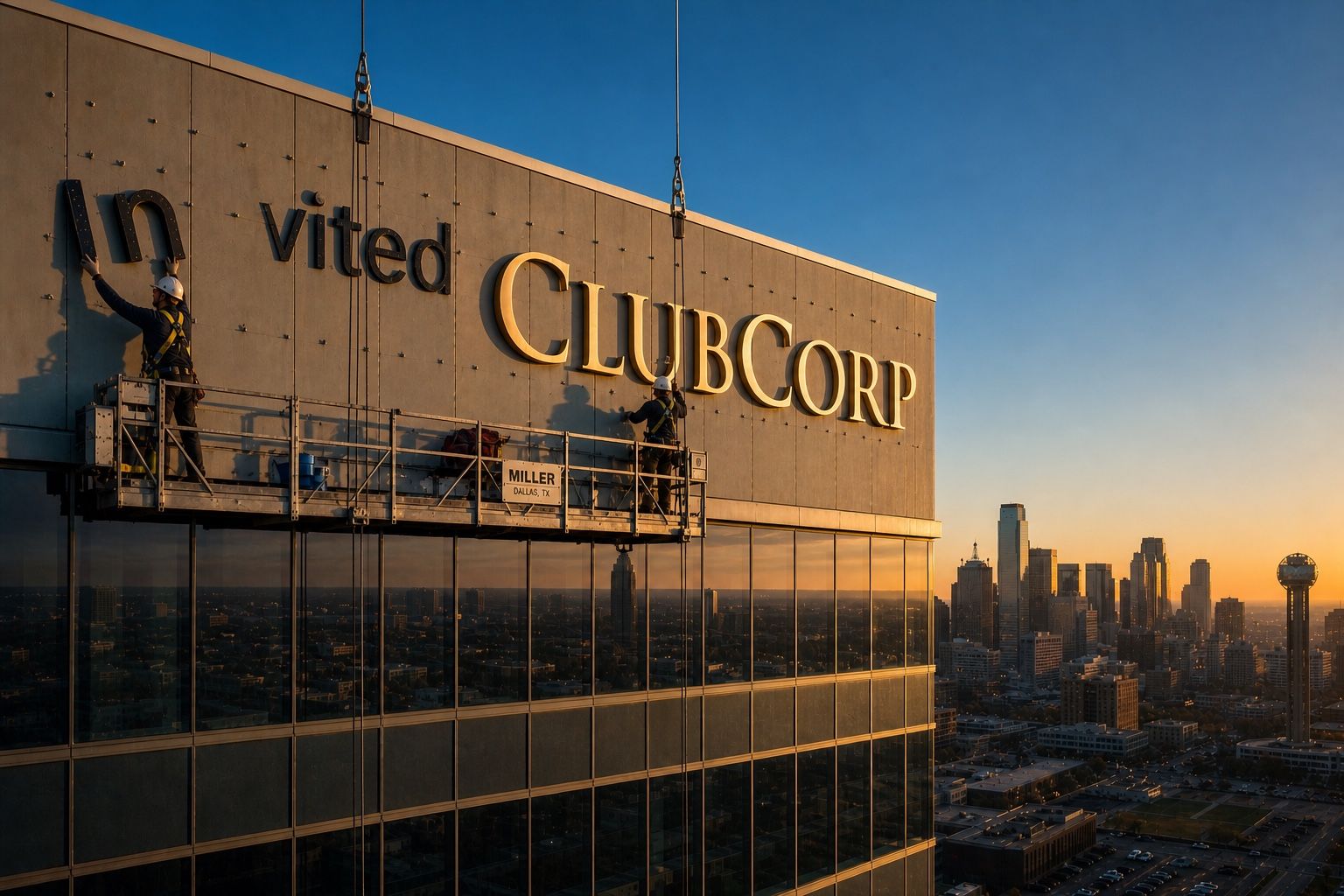
Restore the ClubCorp name.
It is the cheapest line item in the integration plan. It is also the single most legible signal KSL can send to 430,000 members, fourteen-thousand employees, and the institutional capital market that the brand-extraction phase of this asset’s life is over and the operator-stewardship phase has begun. Every quarter the firm waits, the signal weakens.
What Was Actually Erased in 2022
Robert H. Dedman Sr. broke ground on Brookhaven Country Club in 1957 and founded the company that would, over the next half-century, become the largest private-club operator in the country. The name “ClubCorp” entered the trade lexicon during a period when American private-club membership was building the cultural footprint that still drives the asset class today. By the time the company listed on the NYSE in September 2013 under the ticker MYCC, the four syllables had become functional shorthand inside the industry — every general manager, every food-and-beverage director, every membership consultant in the country could place the brand inside a competitive set without explanation.
That is not marketing equity. That is operational equity, accumulated across sixty-five years of member tenure, course pedigree, and trade-press coverage. It is the kind of asset that does not appear on a balance sheet and does not show up in an EBITDA build, which is precisely why it tends to get spent first when financial owners look for ways to signal change.
The 2022 rebrand to Invited landed during the second Apollo holding period, with stated plans to take the company public again. The press release leaned on welcoming language and a broader hospitality positioning. What it actually did, in market terms, was retire a sixty-five-year identifier in exchange for a generic English verb that pre-existed the company by several centuries and that competes for search-engine real estate with every wedding invitation, calendar app, and SaaS onboarding flow on the internet.
Three years in, the trade hasn’t adopted it. Industry insiders quoted in Forbes coverage of the KSL transaction still referred to “ClubCorp” reflexively when describing operating culture, even when the corporate name in the same paragraph was Invited. That isn’t nostalgia — that’s the market telling you which name carries information.
The Tropicana Test
The case for restoring a retired name is not theoretical. There is a published, repeatable corporate-history pattern of large brands rebranding for reasons that look strategic on a slide deck and then quietly reversing course within twelve to twenty-four months when the equity loss shows up in the numbers. The reversals tend to take longer than the original rebrands because the legal, signage, and digital costs of unwinding a rollout dwarf the costs of executing one. Boards under-budget for the unwind almost every time.
Four data points worth holding in mind as KSL’s integration team builds its first hundred-day plan:
Tropicana’s 2009 packaging redesign is the one that ends up in MBA classrooms, because the math is unusually clean. Sales fell 20% in the first two months of rollout. The brand reverted within two months. Total program cost across rollout and reversal landed in the $50 million range, against roughly $30 million in lost sales during the visible-from-shelf window. The lesson the case is usually taught to deliver is about packaging legibility. The lesson it actually delivers is about ownership patience: the company recognized within sixty days that the equity loss was outpacing the strategic benefit and reversed course before the cost compounded.
HBO Max provides the more recent, more directly analogous case. Warner Bros. Discovery dropped “HBO” from the streaming brand in 2023 to broaden the umbrella, then restored it in 2025 — explicitly citing the brand’s signal value to subscribers. The market read on the original change had been that it traded a sixty-year prestige asset for a generic three-letter name in pursuit of audience expansion that never materialized. The reversal, when it came, was framed as confidence-building rather than apologetic. KSL has the chance to do the same thing on a faster clock and with less collateral damage, because Invited is three years old, not three decades.
Weight Watchers — which rebranded to “WW” in 2018 in pursuit of a wellness positioning beyond dieting — provides the cautionary version. The company filed Chapter 11 in May 2025 with $1.15 billion in debt. The rebrand did not cause the bankruptcy; GLP-1 drugs did. But the brand simplification removed the most recognizable, most search-friendly asset on the company’s balance sheet at exactly the moment its core market was being disrupted, leaving fewer levers to pull. The instructive line is that giving up an inherited name does not buy strategic flexibility. It removes a tool from the kit.
What “ClubCorp” Communicates That “Invited” Does Not
The branding question for KSL is not aesthetic. It is informational. Names communicate to four audiences simultaneously — existing members, prospective members, employees, and the institutional capital market — and the right metric for evaluating a name is how much information each audience can extract from it without context.
That last row is the one institutional investors will read most closely. The Apollo holding period coincided with a stretch of cost-cutting on staffing and course maintenance that industry insiders have publicly described as having eroded brand prestige. The “Invited” identity is now bonded to that period in trade memory, fairly or not. A KSL re-launch under the original ClubCorp name would put visible distance between the new operator’s tenure and the optics of the period that just closed — without requiring anyone to make a public-relations argument about it.
The 8x Multiple Was Already a Brand Verdict
The transaction that closed this month gave the market a chance to price the brand directly. Eleven days after Richard Caring sold Annabel’s, The Ivy, and Scott’s at 24 times earnings, KSL paid 8 times for Invited. The structural reasons for the gap are real — F&B-heavy versus real-estate-heavy, urban versus distributed, brand-led versus dues-driven. They do not account for the full spread.
The remaining gap is the part the market is willing to price for brand-operator stewardship versus financial-owner stewardship. A 24x multiple is what institutional capital pays when it believes a brand is being protected. An 8x multiple is what it pays when it suspects the brand has been spent down. Restoring the ClubCorp name will not, by itself, close that gap. But it changes the narrative the next bidder reads into the asset when KSL eventually sells it back into the market, which on the firm’s typical hold cadence will be inside seven to ten years. The cheapest mark-up KSL can build into the eventual exit multiple is the one that costs nothing but a press release.
A 90-Day Brand Restoration Playbook
If KSL elects to restore the name, the operating cadence is well-rehearsed in the corporate playbook. The model is HBO Max’s 2025 reversion, executed cleanly across legal, signage, and digital surfaces in a single quarter, framed as confidence rather than retreat.
The Decision Window Is Sixty Days, Not Six Years
One feature of brand decisions that distinguishes them from operational decisions is that they are time-bonded to ownership transitions in ways that capex and personnel decisions are not. A new operator gets exactly one chance to define what its tenure means to the market. The gravitational pull of the existing system reasserts itself within months. The longer KSL waits to address the name, the more the next press release about a course renovation, a culinary partnership, or a leadership hire flies under the “Invited” masthead and silently reinforces it as the operating identity of the new ownership era as well.
The transaction analytics already published on this question are unambiguous. The sixty-five-year asset that built ClubCorp into the largest private-club operator in the country is still on the books. It has not been sold. It has been temporarily filed under another name. The cost of restoring it to the masthead is a fraction of one quarter’s marketing spend. The cost of not restoring it compounds quietly across the next holding period, and shows up in the multiple at the next exit.
If KSL is genuinely reacquiring this asset because it believes the brand is worth more than the market is currently pricing, the first place to demonstrate that conviction is the letterhead. Everything else — the capex, the operating culture, the course pedigree — gets to argue itself out over the next decade. The name is the only argument the firm gets to make on day one.
Free Download
The 2026 Private Club Benchmark Report
The membership, amenity, and pricing data reshaping private clubs — from a 1,200-club analysis. Enter your details and we'll send it to your inbox.