
The most valuable calendar at your club right now is not the tee sheet. It is the banquet book for October, November, and December — and the dates that will fill it are being decided this month, not this fall.
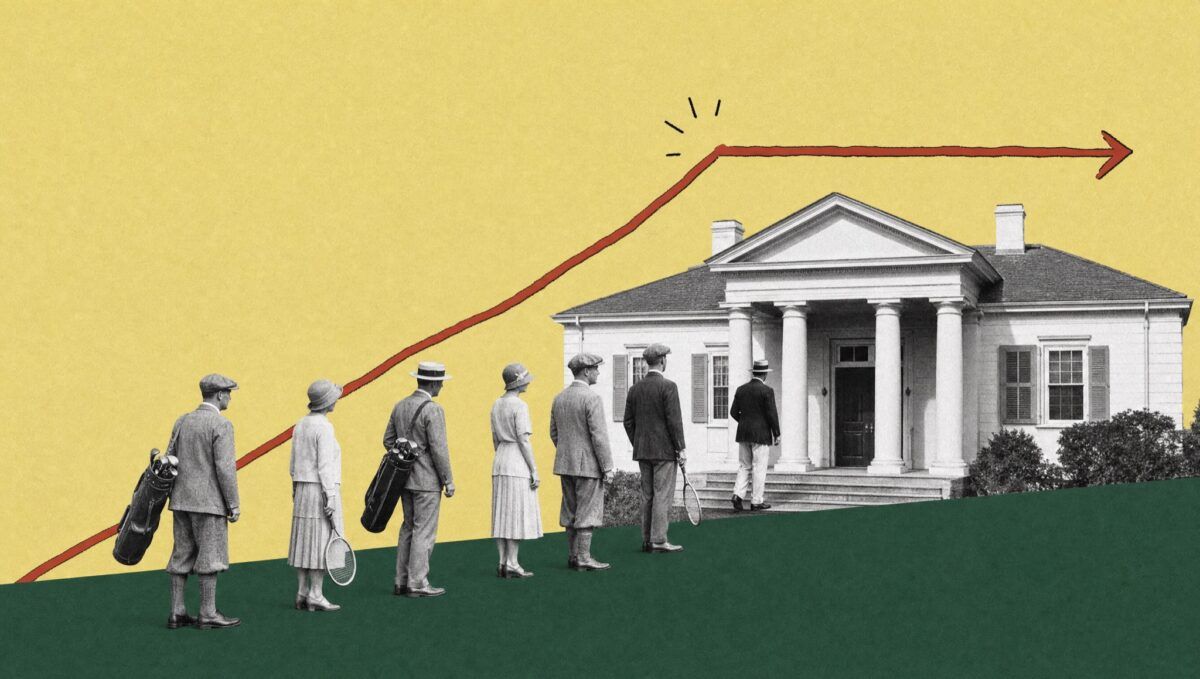
That is the part most clubs get backwards. Operators treat private events as an autumn revenue harvest, something that arrives when the leaves turn. In reality, fall is the delivery window. July is the sales window. October is the single most popular month to get married in America, and December’s corporate holiday dates are largely spoken for by late summer, per event-industry booking guidance. By the time a club’s team is decorating the ballroom, the booking decision that put the party there is three to five months old.
There is a name for this on the retail side — “Christmas in July,” the idea that the fourth-quarter number is made on a summer decision. Private clubs sit on one of the highest-margin versions of that dynamic in hospitality, and too many of them let the window pass without a deliberate sales push. This is a look at why the fall book closes in July, which clubs are treating events as core revenue rather than an amenity, and how the best-run rooms monetize non-members without touching their exclusivity or their tax status.
October is the number-one wedding month, and it is not close
Start with the demand curve, because it explains the urgency. Fall is the peak wedding season in the United States, and October is the peak month within it, according to The Knot’s wedding-season data — October alone hosts 17% of all weddings, per the same Real Weddings Study.
The dollars behind that month are substantial. The average American wedding now runs $34,200, or roughly $292 per guest, per The Knot’s 2026 Real Weddings Study, which surveyed more than 10,000 U.S. couples married in 2025. A club that books even a modest slate of fall weddings is looking at six figures of catered revenue from that category alone — revenue that lands at banquet margins, not a la carte margins.
The catch is the lead time. Couples do not book a marquee October date in September. They book it six to twelve months out, and the desirable Saturday dates in a good ballroom are claimed first — a pattern The Knot’s wedding-planning guidance confirms, noting that couples send vendor inquiries as early as possible given how competitive peak-season dates become. A club that wants its share of that 17% October share has to have its rooms in front of buyers, priced, and closing in the spring and early summer, per The Knot’s booking-timeline data — the same lead time that data implies when it shows couples booking six to twelve months ahead of their date. A July inquiry for an October wedding is already late for the best dates. That is why the fall calendar is, functionally, a July decision.
The corporate side runs on a similar clock, compressed into summer. Industry vendor guidance is consistent on this point: venues and event planners across multiple markets report that companies typically finalize December holiday-party venues between June and September, with the strongest push to lock in prime Thursday, Friday, and Saturday dates by late August. That guidance is directional rather than a single authoritative study, but the direction is unanimous across sources — if a club’s sales team is waiting until September to chase December corporate business, the calendar is already thinning out.
Army Navy Country Club runs events like a business line, not an amenity
The volume a serious events operation can move is easy to underestimate until you see it at scale. Army Navy Country Club in Arlington, Virginia, hosts more than 40 weddings a year on top of 2,000-plus catered events and 3,000-plus member events annually, and serves roughly 100,000 a la carte covers, according to the club’s own reporting to Club + Resort Business. That is not a club that treats banquets as a side business. That is a club with an events engine.
What makes Army Navy instructive is not just the volume — it is the structure underneath it. Non-member events at the club require member sponsorship: to host a wedding or other outside event at the club, a person must either be a member or be sponsored by one, a policy confirmed by the club’s own banquet documentation and independently by wedding vendors who work the venue regularly. Every outside wedding, every corporate function, every gala on the property is tied back to a member who sponsors it. The club captures the outside revenue while keeping the transaction inside the membership relationship. The room fills; the exclusivity does not leak.
The booking rhythm is where the July thesis lives, so it is worth hearing directly from the people who manage that calendar.
The sponsorship model is the quiet part worth studying. It lets a club say yes to lucrative outside business while never selling access to the public. The member stays at the center of the transaction, which matters for reasons that go well beyond etiquette.
The $3.77 million line item nobody talks about
Look at a top club’s tax filing, and per that same public IRS Form 990 data, you find the number that private-events revenue actually adds up to. Congressional Country Club in Bethesda reported total revenue of $51,737,413 on its most recent IRS Form 990 (fiscal year ending October 2024), according to ProPublica’s Nonprofit Explorer, which hosts the club’s filings. Inside that figure sits a single line, per the same Form 990 data: $3,774,025 of “Income From Public Use of Club Facilities.”
That line is the sponsored-event model made visible on a federal filing. It is the money a member-owned club earns by letting outside functions use its rooms — weddings, corporate events, galas — under the sponsorship and access rules the club controls. Nearly $3.8 million in one year, at one club, from facilities the members already own, according to the club’s own reported IRS filing.
This is where the 501(c)(7) tax status becomes central rather than incidental. Under IRS rules, a tax-exempt social club may receive up to 35 percent of its gross receipts from nonmember sources, including investment income, without losing its exempt status — but no more than 15 percent of gross receipts may come specifically from nonmember use of club facilities and services. That nonmember income is also taxed as unrelated business income even within the safe-harbor limits. That is precisely why the sponsored-event structure matters: booking outside events through member sponsorship, and reporting the public-use income cleanly, is how a club monetizes its rooms without drifting past the line that protects its exemption. The discipline is not bureaucratic overhead. It is what keeps a nine-figure asset tax-advantaged.
The lesson for operators is that private events are not a rounding error to be managed by whoever answers the banquet phone. At Congressional’s scale, public-use income is a multimillion-dollar line that lives on the same document as the club’s tax exemption. It deserves a sales strategy, a calendar discipline, and board-level attention.
Banquets subsidize the member experience — not the other way around
Here is the reframe that should change how boards think about the events team. Banquets are not a distraction from the member experience. They fund it.
Research comparing club food-and-beverage operations backs this up, though the shape of the finding is a bit different than the “median vs. top decile” framing often repeated in club marketing. In Concepts of Profitability for Private Club Food and Beverage Operations, a widely cited industry analysis by Terra Waldron and MacDonald Niven, clubs that run profitable F&B operations draw 39% of their F&B revenue from banquets, compared with 30% at clubs whose F&B operations are not profitable — a nine-point gap. Per the same study, profitable clubs also lean less on member a la carte dining (47% of F&B revenue, versus 54% at unprofitable clubs) and carry substantially lower labor costs as a share of revenue. The pattern holds regardless of the exact framing: clubs that make money in F&B skew more heavily toward banquets, not less.
That inversion is the whole argument. A la carte dining at most clubs runs thin or at a loss; banquets carry the department. When you hear “the banquet business gets in the way of member dining,” the numbers say the opposite: banquet margin is a substantial part of what makes member dining affordable in the first place. A club that under-books its fall calendar is not protecting the member experience. It is quietly making the member experience more expensive to deliver.
Union League of Philadelphia is a clear case of what happens when a club treats events as central to its growth. Under General Manager and CEO Jeff McFadden, the Union League grew from a club generating roughly $7 million annually when McFadden arrived in 1998 to one driving more than $100 million annually today — membership has also grown substantially over that period, though public reporting on the exact historical trajectory varies by source, with the club’s own materials and recent reporting placing current membership at roughly 3,500 to nearly 5,000. Events are part of that scale: the club operates 22,000 square feet of private event space across 14 rooms, and its signature ballroom, Lincoln Hall, hosts weddings and functions for up to 380 guests. A club does not multiply its revenue more than tenfold on dues alone. It scales by building a hospitality business the membership sits on top of.
This is where an operator’s instinct earns its keep — and where the club-industry playbook rewards discipline over improvisation. The clubs winning the fall calendar are not the ones with the prettiest ballroom. They are the ones whose sales process starts in the spring, whose July is spent closing October and chasing December, and whose events revenue is treated as the strategic line it is. The same rigor that governs membership pipelines belongs on the banquet book too. And because banquet dollars flow straight into the economics that keep dues reasonable, a full fall calendar is one of the most member-friendly things a club can build.
What operators should do now
The fall book is decided in July. Here is where to spend the month.
- Audit your October and December availability today, not in September. If your prime fall Saturdays and December corporate dates are still open, that is a sales problem to solve this month — those dates are already being claimed elsewhere.
- Put your sales team on outbound, not inbound. Peak-season events do not sell themselves in July because buyers book six to twelve months out. Chase the June-through-August December corporate window and the couples still shopping fall dates now.
- Formalize the sponsorship model. If non-member events run through member sponsorship the way they do at Army Navy, you capture outside revenue while keeping the transaction — and the exclusivity — inside the membership. Make the process easy for members to use.
- Report public-use income cleanly and watch the cap. As detailed above, Congressional’s public-use income sits within the IRS safe-harbor limit that protects a 501(c)(7)’s exemption. Treat that discipline as a revenue enabler, not paperwork.
- Show the board the banquet math. Clubs with profitable F&B operations draw roughly 39% of F&B revenue from banquets, versus 30% at clubs that lose money in F&B. Frame the events calendar as what subsidizes member dining, and the case for investing in the sales function makes itself.
Sources
- The Knot — Fall is the most popular wedding season (October = 17% of weddings) — peak fall/October wedding demand
- The Knot — 2026 Real Weddings Study, average wedding cost — $34,200 average wedding, $292 per guest
- Club + Resort Business — Army Navy Country Club profile — 40+ weddings, 100,000 a la carte covers, 3,000+ member events, 2,000+ catered events annually
- Erin Winter Photography — Army Navy Country Club wedding — member-sponsorship requirement
- ProPublica Nonprofit Explorer — Congressional Country Club Form 990 — $51,737,413 total revenue; $3,774,025 public-use-of-facilities income, FY ending Oct. 2024
- IRS — Social Clubs (501(c)(7) requirements) — 35% and 15% nonmember income safe-harbor limits
- Concepts of Profitability for Private Club Food and Beverage Operations (Waldron and Niven) — banquets account for 39 percent of F&B revenue at profitable clubs, compared with 30 percent at unprofitable clubs
- ClubMarketing.com — Jeff McFadden and the Union League of Philadelphia — revenue growth from roughly $7 million to more than $100 million under McFadden
- Susan Stripling Photography — Union League of Philadelphia venue details — 22,000 sq. ft. across 14 rooms; Lincoln Hall capacity up to 380 guests
Free Download
The 2026 Private Club Benchmark Report
The membership, amenity, and pricing data reshaping private clubs — from a 1,200-club analysis. Enter your details and we'll send it to your inbox.