

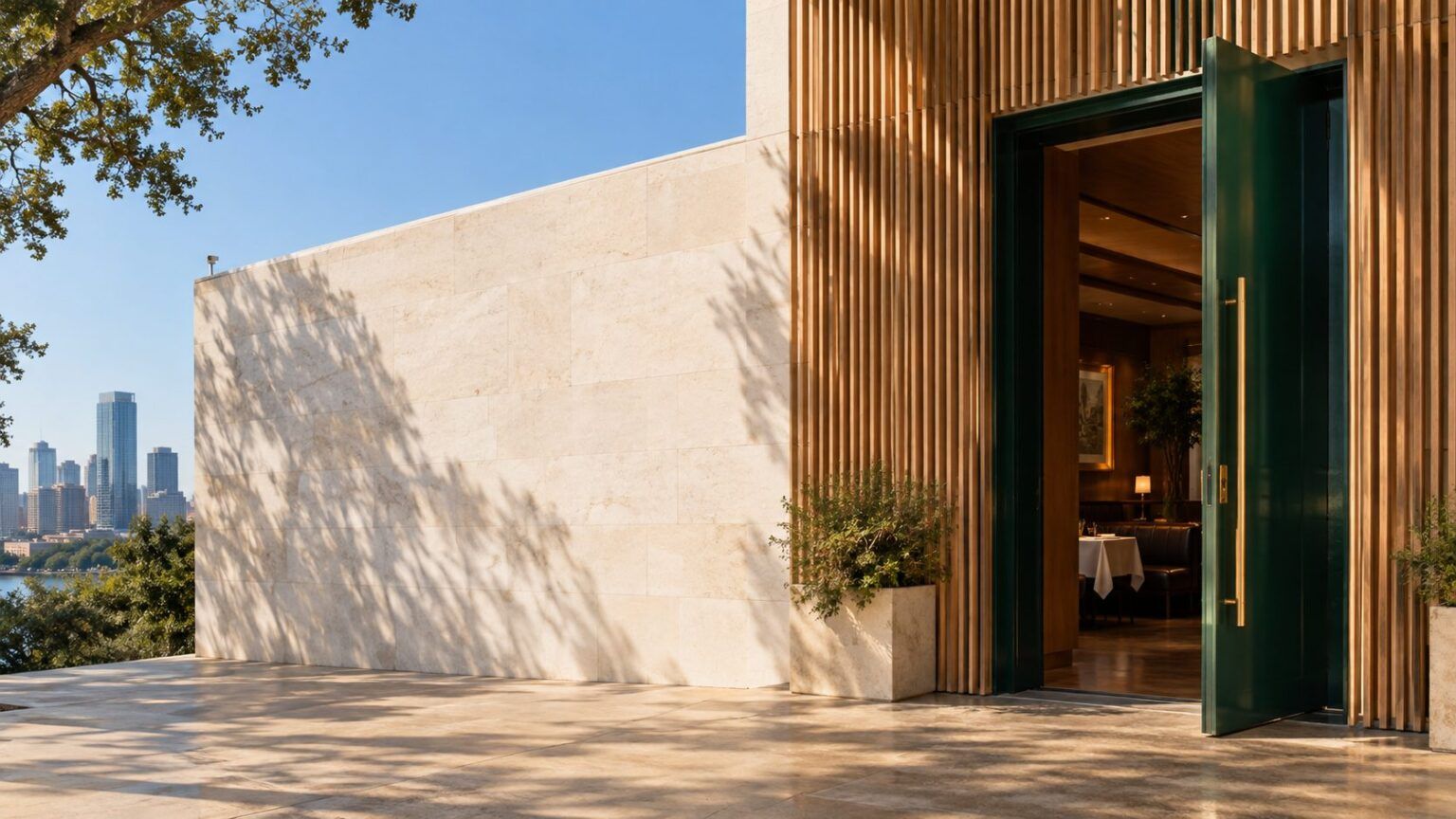
A Restaurant Named Club
On September 10, a 4,723-square-foot room opens on the ground floor of the Hanover building at Third and Brazos in downtown Austin. Kevin Durant is behind it, with his longtime business partner Rich Kleiman through Boardroom Hospitality, Airbnb co-founder Joe Gebbia, and the Austin operator Lobos Hospitality — the group already running Toasty Badger on South Congress, Manny’s, and the Powder Room. Texas Department of Licensing and Regulation filings — first reported by Hoodline and corroborated by Yahoo Sports — put the buildout at roughly $2.4 million. The menu runs to caviar, prime ribeye, and sports-themed cocktails. Reservations go through SevenRooms. Game-day tables on NFL Sundays and college Saturdays carry food-and-beverage minimums. It is called Austin Sports Club, and it is not a club. That is not a criticism. The operators say so themselves — the venue is open to the public, walk-ins accepted subject to availability, no dues, no roster, no board. What is worth the attention of every general manager and membership director reading this is the deliberate choice of the word, and the specific tradition it invokes. The concept is pitched as the classic American athletic club reimagined for the modern athlete, executive, and tastemaker. Someone in that partnership decided the most valuable available positioning for a downtown restaurant in 2026 was club.4,723
Square Feet
$2.4M
Estimated Buildout
3
Named Principal Partners
0
Members
What the Word Is Actually Worth
The Club Management Association of America, Club Benchmarking, and the National Club Association define a private club with unusual precision: a member pays dues to belong, services and amenities are reachable only as a member or a member’s guest, and joining requires some form of invitation and approval. Their 2024 economic impact study identified 5,659 private clubs in the United States, of which 3,887 had identifiable revenue totaling an estimated $32.6 billion in 2023. Austin Sports Club meets none of the three tests. It has borrowed the noun and discarded the structure underneath it — which is precisely why it is instructive. The partners are betting that the feeling of the athletic club is separable from the machinery of one, and that the feeling is the part guests will pay for. Look at where the industry’s economic weight actually sits, and the bet looks sharper still.Share of U.S. Private Club Economic Activity, by Club Type
9%
of U.S. private club economic activity comes from city and athletic clubs — the smallest segment, and the one most exposed to commercial imitation.
Club Benchmarking / CMAA / NCA, Private Club Industry Economic Impact Report, 2024
The New Gate Is a Reservation
Strip away dues and a candidate committee and you still need scarcity, because scarcity is the product. Austin Sports Club replaces the membership file with three substitutes that will look familiar to anyone who has run a clubhouse dining room. The first is the reservation platform. SevenRooms is not a booking widget; it is a guest database with spend history, visit frequency, preference tags, and the ability to hold inventory back for the people the house wants in the room. A well-run SevenRooms account performs most of the functions a membership department performs, minus the legal obligations. The second is the food-and-beverage minimum on game days. That is a cover charge with better manners, and it does the same work an annual dining minimum does at a country club — it converts intent into committed revenue before the guest arrives, and it filters the room by willingness to pay. The third is the dress code. Smart casual, encouraged rather than enforced, is a social signal doing structural work: it tells a prospective guest who else will be there.Private Club
GateInvitation & approval
CommitmentDues + initiation
Guest accessMember-sponsored
GovernanceBoard & bylaws
CapitalMember assessments
Relationship ownerThe club
Austin Sports Club
GateReservation availability
CommitmentGame-day F&B minimum
Guest accessOpen to the public
GovernanceOwnership group
CapitalPrivate investment
Relationship ownerThe platform
Why This Lands on a Generational Fault Line
The reason a celebrity-backed sports restaurant registers as competition at all has less to do with the restaurant than with what club leaders are already telling researchers about their own rooms. In the 2025 Club Leaders’ Perspectives report, produced with CMAA, 58 percent of respondents said concern over overall membership cost skewed toward older members, against just 17 percent who saw it as a younger-member concern. Younger members reported greater satisfaction with the value they receive — and they were more engaged with the non-golf and dining amenities than with the golf course. The same research flagged a caution: younger members tend to form their own tight social networks inside the club, which can limit cross-generational contact.58%
of club leaders say cost concern skews older
Value Perception
17%
say the same concern skews younger
Value Perception
Where younger members engage
Dining, social programming, and non-golf amenities — the exact territory a downtown sports club is built to take.
Utilization
Four Things Operators Should Take From This
Audit your Thursday, not your Saturday. Weekend golf utilization is not where this competition is happening. The contested hours are 5 p.m. to 10 p.m. on a weeknight and the four hours around a televised game. If your clubhouse dining room is dark or thin during those windows, a downtown room is not stealing that business — it is claiming unclaimed ground. Treat the broadcast as programming, not background. Most clubs have televisions. Very few have a curated calendar around them with reserved tables, a menu built for the occasion, and a reason to bring three guests. The Austin concept is explicit that it is a restaurant first and a place to watch the game third — the ranking is the insight. The game is the pretext; the meal is the product. Use the minimum you already have. Clubs invented the food-and-beverage minimum and then largely stopped merchandising it. Members experience it as a penalty discovered in December rather than an entitlement to be spent all year. A quarterly statement that reads as a balance to enjoy rather than a shortfall to settle changes behavior in the direction you want. Own the guest data you are already collecting. The competitive asset here is not the room. It is knowing that a member’s anniversary is in March, that he brings clients on Tuesdays, and that she left half a bottle of Barolo on the shelf. Restaurants pay a platform for a thin version of that. Clubs already hold the rich version and rarely act on it.The Part the Comments Section Got Right
When Boardroom posted the announcement, the replies were not admiring. The most-liked responses turned on access — some version of the sports bar experience without the wrong people in it, and a recurring complaint that the principals had built something most of the public cannot use. Several hundred likes accumulated on that theme within hours. This is the risk of borrowing the club vocabulary without the club structure. A private club’s exclusivity is legible and, in its way, honest: there is a process, it is disclosed, and the people inside have paid for and governed the thing they belong to. A commercial venue that performs exclusivity while selling public admission collects the resentment without the legitimacy — and it has no bylaws, no board, and no member covenant to point at when asked to justify itself. Which is the closing argument for the actual clubs. The proposition Austin Sports Club is selling — that a room full of the right people is worth paying for — is the proposition private clubs have been underwriting for more than a century, with governance, capital discipline, and a member relationship that no reservation platform can repossess. The threat is not that someone opened a restaurant and called it a club. The threat is that a restaurant is now competing for the social hours clubs have quietly conceded. September 10 is a Thursday. That is worth noticing too.Free Download
The 2026 Private Club Benchmark Report
The membership, amenity, and pricing data reshaping private clubs — from a 1,200-club analysis. Enter your details and we'll send it to your inbox.