

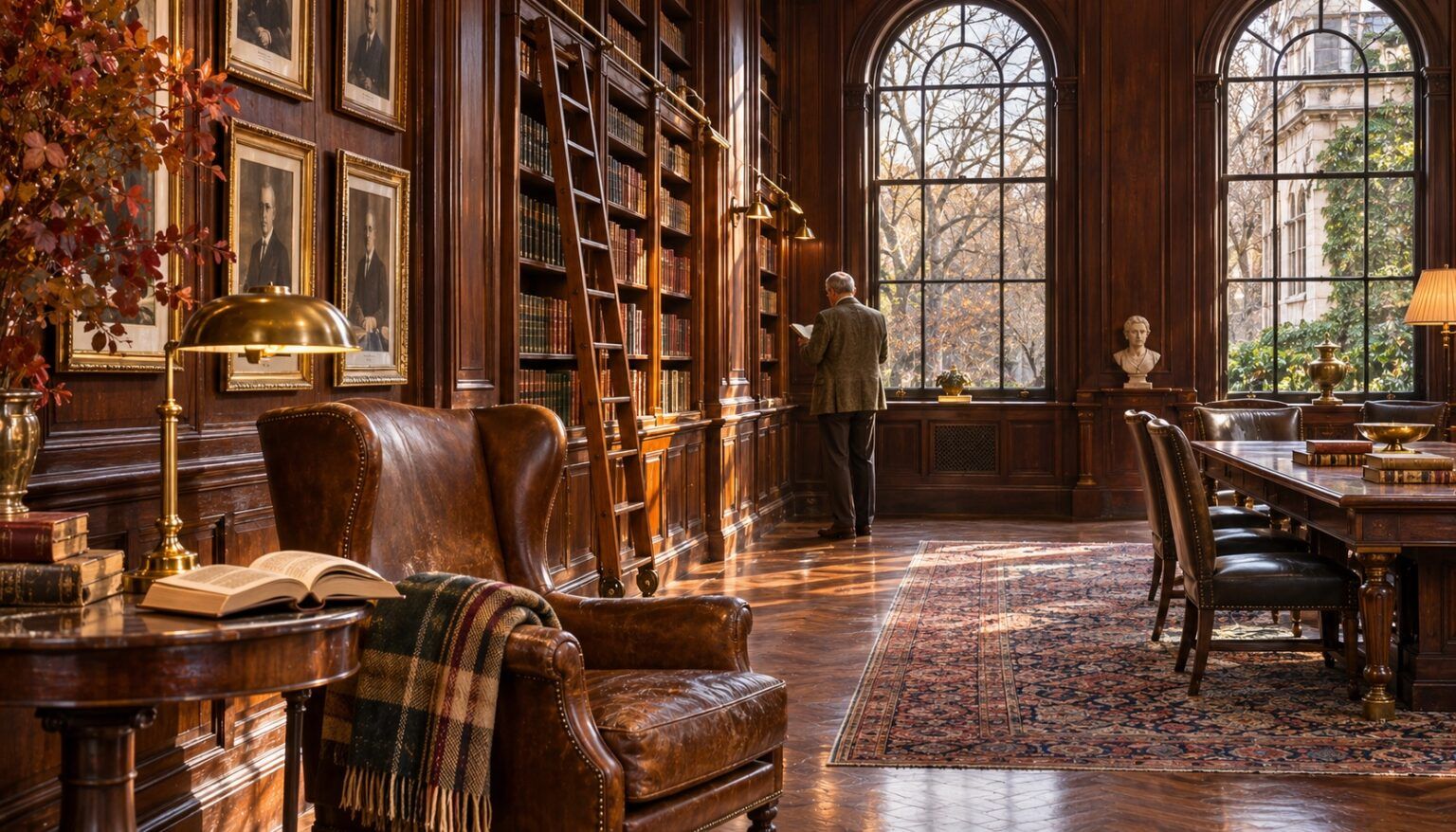
Most Washington clubs are known by who their members know. The Cosmos Club is known by what its members did: Nobel laureates and Pulitzer winners among them. In a city where private clubs usually trade on proximity to power, this one trades on something harder to fake.
The Cosmos Club does not publish what it costs to join, and this profile does not guess. It sticks to what can be sourced: who founded it, how membership works, how it changed and what a membership director can learn from a club that sells achievement, not access.
A Club Founded by Scientists
The Cosmos Club was founded in 1878 by John Wesley Powell, the geologist and explorer, per the Special Libraries Association. A group met at Powell’s home on November 16, 1878, per the Special Libraries Association, and its ten members agreed three weeks later that the club’s purpose was “the advancement of its members in science, literature, and art,” per WETA’s Boundary Stones. The club’s website says its history starts with a question Clarence Dutton, a soldier and geologist, heard from a friend: why Washington had no club like the Century.
Bylaws, rules, regulations and dues were adopted at a January 6, 1879 meeting in the club’s rooms in the Corcoran Building, per the Smithsonian Institution Archives. A history from the Federal Circuit’s library describes the club as a “private social club dedicated to men distinguished in science, literature and the arts.” The club’s tradition of a gathering place for ideas also spawned other institutions. The founders of the National Geographic Society gathered at the club on January 13, 1888, per National Geographic, and The Wilderness Society’s founding documents were signed there in 1935, per The Wilderness Society.
Where the Club Lives
The club moved several times before settling in 1952 at the Townsend House, 2121 Massachusetts Avenue, which it purchased in 1950, per the Federal Circuit’s library history and the D.C. Preservation League. Carrère and Hastings designed the house, and it was listed on the National Register of Historic Places on April 3, 1973, per the D.C. Preservation League. The interior is a wood-paneled library, a gold-and-glass ballroom and small guest rooms over the rooftops of Embassy Row, per Washingtonian in 2015.
The club’s dress code asks men to wear jackets, with ties in the Garden Dining Room, and relaxes to business casual from May 1 through September 30, per the Cosmos Club. The club sells itself on programming too: lectures, musical concerts and literary conversations, per the Cosmos Club, along with holiday events, wine tastings and dinner dances.
Admission by Achievement
The Cosmos Club’s website describes election as honoring men and women distinguished in science, literature, the arts, learned professions or public service, per the Cosmos Club. The club does not require members to be published authors, even though it displays photos of Pulitzer winners, per the Boston Globe in 2025. We found no nomination steps on the club’s own site, so we do not describe them.
This model is the one our piece on the Explorers Club examines. A club that admits on accomplishment, in our view, attracts a different kind of member, and a different kind of conversation.
A Long Road to Opening the Door
The club’s history on admissions is part of the record. It elected its first Black member, historian John Hope Franklin, in 1962, per Duke University Libraries. A controversy earlier that year, when the admissions committee blackballed Carl T. Rowan, led several members, including John Kenneth Galbraith, to resign in protest, per Time in January 1962. The Cosmos and Metropolitan faced the question of women in the 1980s, per Washingtonian in 2015. Members voted overwhelmingly the weekend before to abandon the club’s century-old all-male policy, just ahead of a Supreme Court ruling that upheld a New York City law barring discrimination by private clubs, per the Christian Science Monitor in June 1988.
In our view, a club that tells that story plainly earns more trust than one that omits it. Prospects can research a club’s past before they apply, and the version they find should not be a stranger’s.
What It Costs, and What We Cannot Say
The club’s website lists no fee schedule, and we found none elsewhere from the club. Annual dues at the private social clubs Washingtonian covered ran about $2,000, per Washingtonian in 2015, a figure it did not attribute to the Cosmos alone. We do not give a price. The club’s public tax return, which is a combined income line and not a fee, shows it reported $18,199,127 in total revenue for the fiscal year ending June 2025, per ProPublica.
For the same reason we did in our profiles of the Metropolitan Club of Washington and the Union Club of Boston, we recommend asking the club directly. For the wider city, see our overview of private clubs in Washington, D.C.
What This Means for Your Club
Show the members, not the amenities. The Cosmos’s wall of laureates, per the Boston Globe, does more than any brochure. Feature what your members have done.
Let programming carry the pitch. Lectures, concerts and literary conversations, per the Cosmos Club, answer the question of what a member does there.
Tell your own history. The Cosmos’s admissions record is public, as Time and the Christian Science Monitor reported, and a club that owns its story controls it.
Explain reciprocity. The Cosmos’s website invites reciprocal club guests to dine and stay overnight, per the Cosmos Club, and the Oriental Club in London lists the Cosmos among its reciprocal clubs, per the Oriental Club. Our guide to reciprocal privileges shows how to describe them.
Cosmos Club FAQ
How much does it cost to join the Cosmos Club?
The club does not publish a fee we could verify. The only dues figure we found, about $2,000, comes from a 2015 Washingtonian article, per Washingtonian, and it described clubs generally, so we do not use it as a price.
Who founded the Cosmos Club?
John Wesley Powell founded it in Washington in 1878, per the Special Libraries Association.
Does the Cosmos Club admit women?
Yes. Members voted overwhelmingly in June 1988 to admit women, per the Christian Science Monitor.
How many members does it have?
The club has about 2,500 members, per the Boston Globe in May 2025. We found no other membership figure we could verify, so we do not compare it with earlier counts.
How We Did This
We read the pages linked above and the club’s own website. The site lists no fees and no nomination steps, so history rests on the Special Libraries Association, WETA, the Smithsonian Institution Archives, the Federal Circuit’s library, the D.C. Preservation League, Time, Duke University Libraries and the Christian Science Monitor. The Nobel, Pulitzer and Medal of Freedom counts are the club’s own figures from its website. Details we could not confirm from an open page, including the 1879 fee schedule, the early admission rules, the room count and earlier membership counts, were dropped. We did not estimate any fee and named people only where a cited source did.
If your club wants to put its members and its history at the center of its marketing, Private Club Marketing brings 20+ years in and with top private clubs to country club marketing. Talk with us.
Free Download
The 2026 Private Club Benchmark Report
The membership, amenity, and pricing data reshaping private clubs — from a 1,200-club analysis. Enter your details and we'll send it to your inbox.