Walk up Fifth Avenue to 62nd Street and you pass one of the most talked-about buildings in New York without a reason to look twice. It is a restrained brick house with limestone trim, built to blend in rather than to announce itself. Behind that discretion sits a club that has spent more than a century and a half deciding who gets through the door and telling almost no one how it decides.
The Knickerbocker Club does not publish a fee schedule or a membership page, and we could not find an official website. That silence is part of the product. What is on the record is how the club began, where it lived, how its clubhouse was built and what a city agency wrote about it in 1979. This piece sticks to that record and says where it runs out.
A Club Born of a Complaint
According to the New York City Landmarks Preservation Commission, which designated the clubhouse in 1979, the Knickerbocker was organized on October 31, 1871, as a reaction against looser admissions at the Union Club, which had been changed in the years after the Civil War by new money and a larger roster. The Union Club, founded in 1836 and called the city’s oldest private club by Untapped New York, and the Knickerbocker’s founders wanted something modeled on the Union as it used to be. The commission’s designation report counts eighteen founding members and names Alexander Hamilton Jr., August Belmont, John L. Cadwalader and John Jacob Astor among them.
The founders did their homework. By the official founding, the report says, a constitution had been drafted, a list of prospective members and officers compiled and a possible clubhouse scouted. They argued over names at Delmonico’s and chose Knickerbocker over Crescent, Half Moon and Federal. The choice looked back to Washington Irving’s early New York, a theme the club has carried since.
Three Clubhouses, Moving Uptown
The first home was a former mansion at 249 Fifth Avenue and 28th Street. In 1871, with most of the city’s social life centered on 14th Street, the report says, a club at 28th Street counted as a move uptown. It describes a reputation for exclusivity from the start. The report says the club soon became the favorite haunt of 240 of the city’s most privileged gentlemen, though it also notes that a troubled economy discouraged membership applications in the late 1870s.
By 1881 members were restless with the house and its leadership, per the Landmarks Preservation Commission. The club then moved four blocks north to 319 Fifth Avenue at 32nd Street, where it stayed for 32 years, per the Landmarks Preservation Commission. The third move took longer. By 1909 the fashionable residential district had reached the eastern edge of Central Park, and members who agreed they needed a new house still found a lot at 62nd Street too far uptown. The report notes that the Metropolitan Club, another offshoot of the Union Club, was already planning a clubhouse on this stretch of Fifth Avenue by 1891.
The club bought the corner in June 1913, added the neighboring house to the south, and in February 1914 announced that Delano & Aldrich would design the new clubhouse. The combined lots ran 75 feet along Fifth Avenue and 125 feet along 62nd Street, and were assessed at $780,000, per the Landmarks Preservation Commission. That figure is the assessed value of the two parcels, not the cost of building the clubhouse.
The Building That Tries Not to Be Noticed
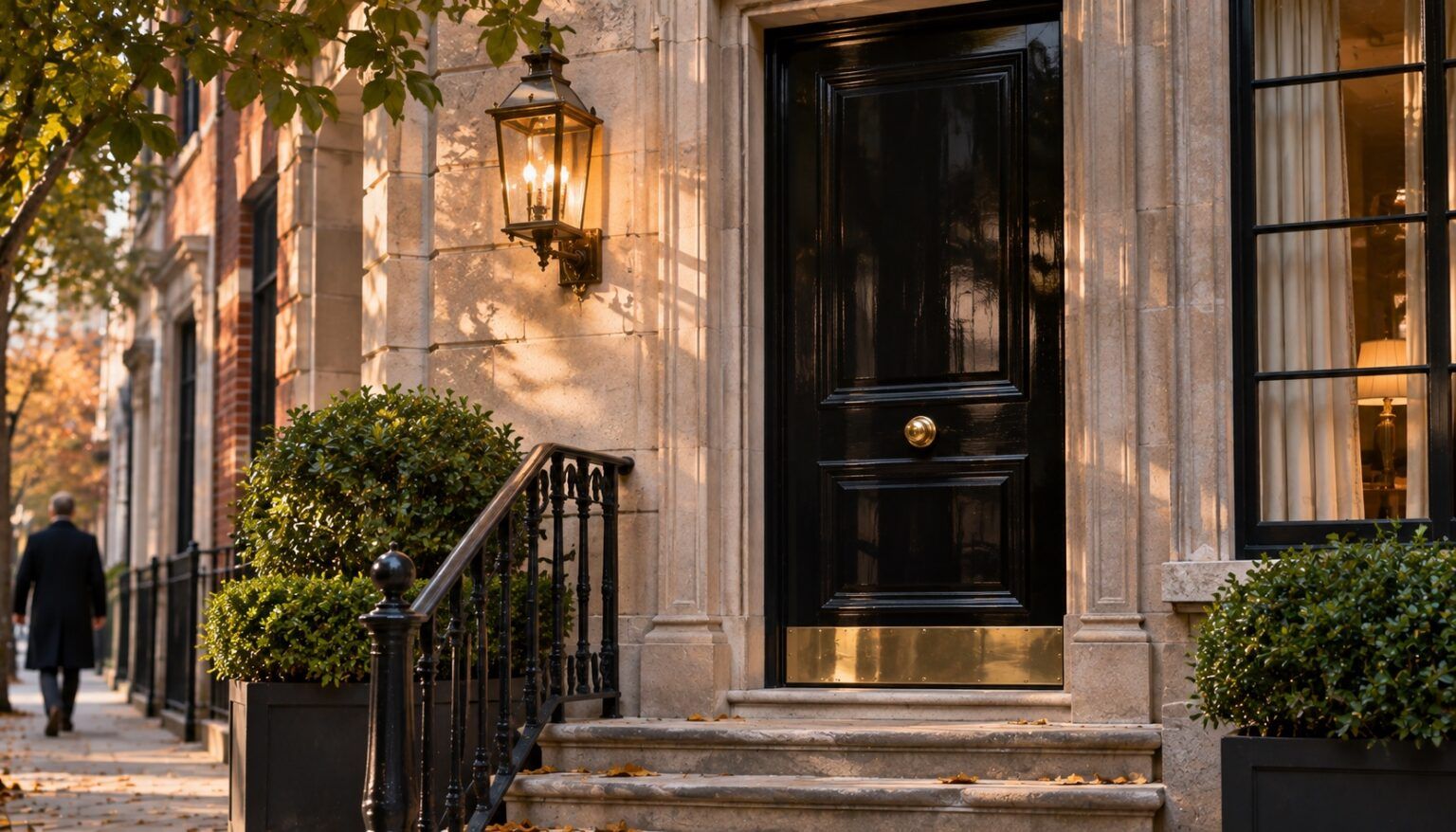
The result, completed in 1915, is a three-story neo-Federal clubhouse that the commission called one of the finest examples of the style in the city. It has a rusticated limestone base, brick laid in English bond, wrought iron balconies and a limestone cornice. The commission’s account says it was designed to fit into the surrounding residential neighborhood and still hold the club’s presence on the avenue.
The report quotes a contemporary press notice that called the building “one of the most attractive of the newer buildings on Fifth Avenue” and said it was “expressive of the conservatism, if not the seclusiveness of the club.” Delano & Aldrich went on to design clubs including the Colony Club in 1924 and later the Union Club, per the same report. The architect William Adams Delano was himself a member of the Century Association and of the Knickerbocker, according to the commission.
What Is Reported, and What Is Not
American Aristocracy is a history site. The original membership cap was 300, with a $300 joining fee and $100 in annual dues, per American Aristocracy. Membership had risen to 450 by the early 1880s, per American Aristocracy. The site also says descent from the old Knickerbocker families was not a requirement. The site lists general references, including the 1979 landmark report and New York Times archives, but it does not tie these figures to any of them, and it states some claims without citation. We treat these figures as reported, not confirmed. We did not find a membership cap, fee or dues in the 1979 report, and we found no current dues, initiation fee or waitlist figure from any source we could open.
The blogger Tom Miller writes Daytonian in Manhattan. The clubhouse cost around $250,000, per Daytonian in Manhattan. He gives no citation for it, and the landmark report does not state a construction cost, so we could not corroborate the figure. The same 2022 survey of the city’s oldest clubs described the Knickerbocker as a rival formed in response to the Union Club’s policies and noted that it, unlike the Union Club, has no public website.
The same 1979 report calls it an exclusive men’s club. We could not find a current statement of its membership policies from the club, so we make no claim about them.
Where It Sits Among New York’s Old Clubs
The Knickerbocker belongs to a family tree. The Union Club came first. The Metropolitan, another offshoot, followed with a clubhouse of its own, and the Century Association, founded in 1847, drew members like Delano who also belonged to the Knickerbocker. In Washington the pattern repeats on a smaller scale, and our look at the Metropolitan Club of Washington shows another old club that keeps its terms private and lets its history do the talking.
What This Means for Your Club
Privacy can be a position. A club that publishes nothing is making a statement, and members read it as one. Decide on purpose what stays private and say so in one plain line.
Let the building carry the story. The clubhouse was designed to be understated, and a century later that restraint is the story. If your architecture, founding date or founding dispute is documented, use it.
Keep your own records. The best-sourced facts here exist because a city agency researched them. A short, dated history page on your site gives writers something firm to cite. Our guide to reciprocal privileges shows how clubs extend their reach without advertising.
Do not invent a mystique. Where a number is unknown, say so. Readers trust a club that distinguishes what it knows from what is rumored.
Knickerbocker Club FAQ
When was the Knickerbocker Club founded?
The Landmarks Preservation Commission gives October 31, 1871, with eighteen founding members. It was formed by members who thought the Union Club had loosened its admissions standards.
Where is the Knickerbocker Club?
At 2 East 62nd Street on the southeast corner of Fifth Avenue, in a clubhouse built from 1913 to 1915 and designed by Delano & Aldrich. It was designated a city landmark in 1979.
How much does it cost to join?
The club does not publish its fees and we found no credible current figure. Joining cost $300 and annual dues were $100 in the club’s early years, per American Aristocracy, though it cites no source for them. Those figures do not describe today.
Does the club have a website?
A 2022 survey said it has no public website, and we did not find an official one.
How We Did This
We opened and read every page linked above, including the full text of the 1979 designation report, which is the primary source for the founding, the moves and the building. The history site and the blog are secondary and are labeled as such. Dates and counts from the 1870s and 1880s are as that record states them. We did not estimate any current fee. For wider context, see our guides to whether a private club membership is worth it and to the Union Club of Boston.
If your club wants to tell its story with confidence while keeping its terms private, Private Club Marketing has worked only with private clubs since 2009 and offers country club marketing. Talk with us.
Free Download
The 2026 Private Club Benchmark Report
The membership, amenity, and pricing data reshaping private clubs — from a 1,200-club analysis. Enter your details and we'll send it to your inbox.