

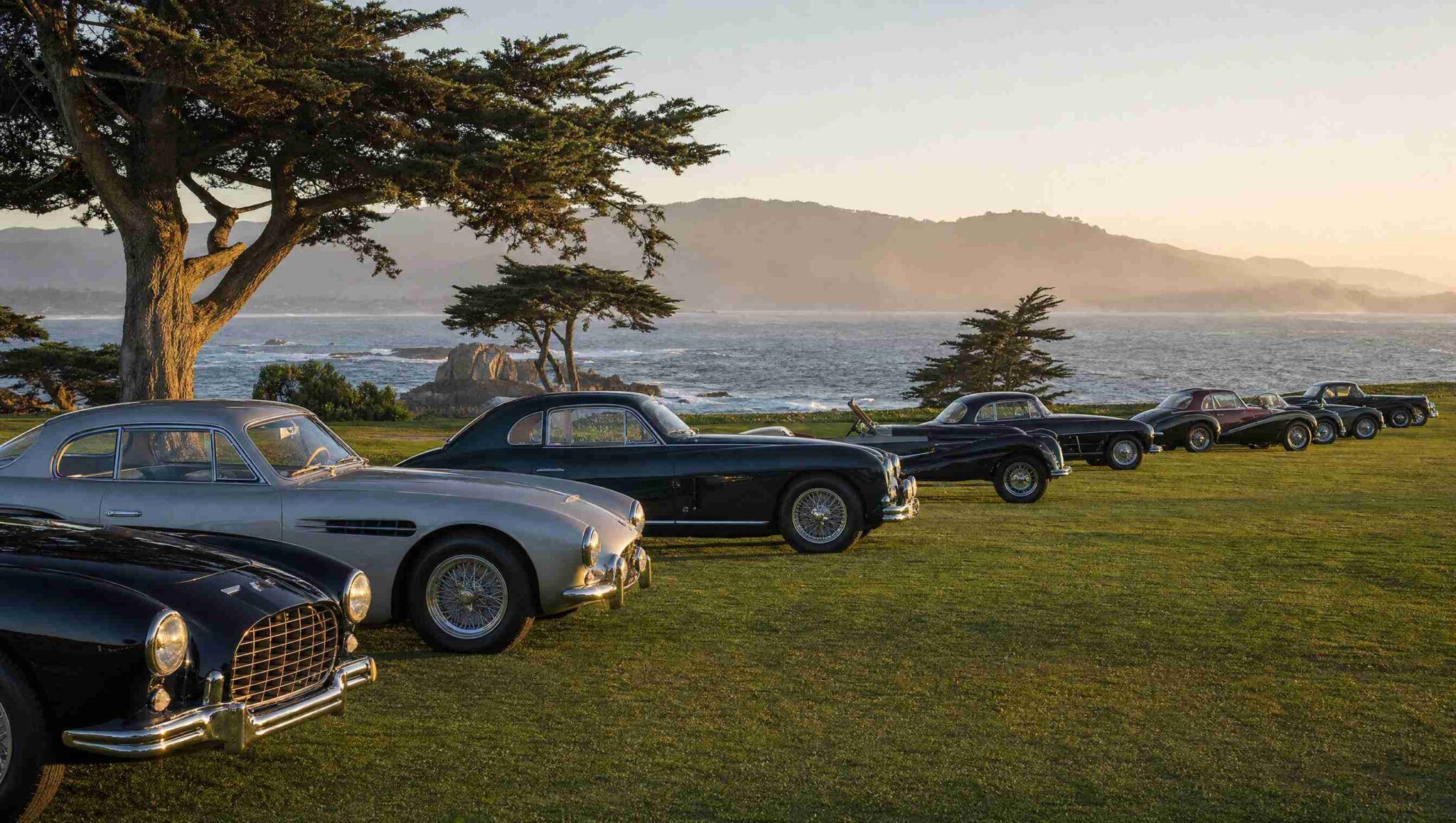
The 75th Pebble Beach Concours d’Elegance anchors a week where Quail Lodge & Golf Club, Monterey Peninsula Country Club, Cypress Point, Corral de Tierra, Tehàma, and Bayonet & Black Horse all convert their calendars into staging grounds for the same audience. Whether or not your club sits on the 17-Mile Drive, the operating lessons of that week are transferable — and most clubs are leaving them on the table.
The collector economy is growing faster than the places that host it
The demand signal behind Car Week is not soft. According to Knight Frank’s The Wealth Report 2025, auctioneer RM Sotheby’s recorded a milestone year in 2024, with global sales exceeding US$887 million. In that same year, per Knight Frank’s The Wealth Report 2025, over 126 vehicles sold for more than US$1 million, 50 auction records were broken, and a 96% sell-through rate underscored demand for rare and historic models. The report describes the appetite for collectable cars as “accelerating at an unprecedented pace.”
Compare that trajectory to the rest of the luxury asset table in the same report. Superyacht spending fell to US$3.6 billion across 131 US$10 million-plus yachts in 2024, down from US$5 billion in 2023. Per Knight Frank’s The Wealth Report 2025, auction spending on artworks priced over US$10 million dropped to US$1.2 billion, from US$2.2 billion in 2023 and a peak of US$3.9 billion in 2022. Per the same Knight Frank report, private jets went the other direction — 874 jets sold for US$22.7 billion in 2024, up 7% from US$21.2 billion — which matters directly to any club within driving distance of Monterey Regional in August. Cars and jets are up. The passive collectibles are down. The assets people want to gather around are the ones holding value.
And the physical constraint is real. Knight Frank’s Alasdair Pritchard, a partner in the firm’s Private Office, describes clients whose collections have outgrown the places they want to live:
“I recently had a European client who had spent a lifetime building an unbelievable specialist car collection. At the same time, he wanted a lifestyle change from his busy resident city and was eyeing up a smaller medieval location.”
The report notes that as collections grow in value and volume, storage and security become increasingly important, pushing buyers toward “bespoke solutions, from underground garages to purpose-built offsite storage.” Read that as a club opportunity, not a real estate footnote. Secure, climate-controlled, member-only vehicle storage is an amenity almost no club offers and a meaningful segment of members would pay to solve.
What Peninsula clubs actually sell in August — and what most clubs can’t
Strip Car Week down and the clubs are selling four things: parking, sightlines, credentialed hospitality, and a bathroom that doesn’t have a line. That sounds unglamorous until you price it against the alternative.
Here is the uncomfortable part. Data from GGA Partners’ 2024 Club Leaders’ Perspectives Report shows how thinly equipped most clubs are for exactly this kind of week. Among respondent clubs surveyed for that report, valet parking exists at only 34%, overnight accommodations at just 12%, and spa/wellness at 24%. Meanwhile the same report found dining amenities are the industry’s default offering — nearly all responding clubs provide both indoor and outdoor dining. Clubs are overwhelmingly built to feed people and underbuilt to host them across a multi-day event. When a marquee week arrives, the constraint is rarely the kitchen — it’s arrival logistics, overnight capacity, and staff depth.
Source: GGA Partners’ 2024 Club Leaders’ Perspectives Report.
The clubs that own August on the Peninsula solved arrival first. Practical implications for any club planning a signature event:
- Solve the car before you solve the menu. Shuttle contracts, satellite lots, and staged arrival windows determine whether the event feels exclusive or chaotic.
- Rent capability you don’t own. With overnight accommodations at only 12% of clubs, per the same GGA Partners research, partner with a nearby property on a room block rather than declining a multi-day format.
- Sell sightlines, not square footage. A terrace overlooking the display, the finish, or the water is a distinct price tier. Price it that way.
- Credential everything. Tiered wristbands turn one event into three products at three price points, with no additional venue cost.
The unbundling lesson: your members already think this way
Car Week runs on à la carte pricing — a paddock pass here, an auction preview there, a single dinner seat. That model is now the consumer default, and the hospitality data is blunt about it. Research from Oracle Hospitality and Skift found that 43.3% of consumers said they would be very likely to book a hotel that allowed them to pay only for the amenities they use, with another 44.2% “somewhat likely” — nearly 90% either enthusiastic about or open to unbundling. The same Oracle Hospitality/Skift study found about 18% of hoteliers now believe more than half their revenue will come from ancillary sources other than the room rate, up from just over 11% the prior year.
Clubs have the harder version of this problem, because dues are the ultimate bundle. But GGA Partners’ 2025 Club Leaders’ Perspectives Report points to the same opening, advising that clubs “can also explore pay-per-use opportunities that may attract younger members willing to spend more while remaining mindful of those with different levels of economic tolerance.” A signature event weekend is the lowest-risk place to test that: nobody’s dues change, and you learn exactly what your membership will pay a premium for.
Gunnar von Hagen of Lindner Hotels, quoted in the Oracle/Skift research, frames the discipline required:
“Upselling is one of the most successful tools in the hotel industry to make additional revenue, and the better the data is, the better we can do that before or on arrival.”
Translation for clubs: capture registration data at the event, then use it. A member who bought the paddock tier this August is your first call next August — and your best prospect for the wine dinner in November.
Why a car event is the best generational bridge on your calendar
The generational math makes this more than a revenue exercise. The 2025 Club Leaders’ Perspectives research found that concern over overall costs skews sharply older — 58% of respondents said this was a more significant concern for older members, compared to just 17% for younger members — while younger members reported being more satisfied with the value they receive and more engaged with the non-golf amenities and activities their clubs offer.
Where the generations converge is telling: per the 2025 GGA Partners Club Leaders’ Perspectives Report, 73% of respondents indicated a balance between generations on interest in socializing across age groups, and 56% reported similar customer service expectations. The report’s headline conclusion is that “regular social events, that bring members together, and effective communication are seen as the most successful ways to overcome generational differences.”
A collector-car gathering is one of the rare formats where a 34-year-old and a 74-year-old arrive with genuinely shared enthusiasm and no handicap gap. It is non-golf programming that older members show up for voluntarily — which is the whole design brief the CLP research hands to club leaders. The 2025 report also warns that younger members “tend to form exclusive social networks that could limit intergenerational interaction,” so build the event to force mixing: mixed-generation judging panels, a members’ choice award, a young-members concours class.
The number to bring to your board
Signature events die in committee for lack of a strategic frame. Two datasets solve that. First, the industry’s own weight: the landmark study by Club Benchmarking, CMAA, and the National Club Association identified 5,659 private clubs in the U.S., of which, per that same study, 3,887 have revenue over $1 million. Those clubs generated $32.6 billion of revenue in 2023, employed 573,000 people, and paid $17.4 billion in payroll, per the same study, with a total economic impact of $157 billion of revenue, $65 billion of total payroll, and 1.5 million jobs across the economy. In the West alone, the report attributes $31.3 billion in revenue, $12.6 billion in payroll, and 253,383 jobs — with 488 clubs in the Pacific division. When a Peninsula club negotiates with a municipality over August road closures, that is the leverage.
Second, the governance gap. The 2025 CLP research found that one-third of respondents do not have a strategic plan, 40% do not routinely update theirs, and 42% do not refer to a strategic plan when making decisions. Signature events are precisely the initiative that gets approved on enthusiasm and then dies in year three when the champion rotates off the board. Put it in the plan, assign it an owner, and give it a three-year revenue target before you sell the first ticket.
The Peninsula clubs did not inherit August. They built a week the collector world reorganizes its calendar around, and they did it by being disciplined about access, ruthless about logistics, and patient across decades. Every club has one week a year with that potential. Most just haven’t named it yet.
Free Download
The 2026 Private Club Benchmark Report
The membership, amenity, and pricing data reshaping private clubs — from a 1,200-club analysis. Enter your details and we'll send it to your inbox.