
Three Sports, One Property, One Decision
Tennis courts sat at 70 percent utilization through 2019 and barely cracked 40 percent in 2023. Pickleball courts went in, waitlists formed, and then — in clubs from Palm Beach to Pebble Beach — the noise complaints started. Now padel is threading through clubhouse renovation decks like a rumor that arrived from Europe with a good pedigree. The question operators are actually asking isn’t which sport is best. It’s which combination of court types produces the highest member satisfaction, the fewest operational headaches, and the clearest return on capital over a ten-year hold. This isn’t a rehash of the culture-war framing that dominated the tennis-versus-pickleball conversation last spring — see our May 8 analysis on the pickleball backlash for that. What follows is a decision framework: how to read your member demand signals, model space and noise constraints, and structure a court program that doesn’t require a do-over in 2028.The Participation Numbers That Justify the Investment
The scale of the opportunity is not in dispute. The Sports & Fitness Industry Association (SFIA) reported 19.8 million Americans participated in pickleball in 2024 — a 45.8 percent year-over-year increase and a 311 percent expansion from three years prior. The SFIA’s 2026 Topline Participation Report put the 2025 figure at 24.3 million, a further 22.8 percent year-over-year jump and a 171.8 percent increase over the preceding three years, making pickleball the fastest-growing sport in the U.S. for five consecutive years, according to the same report. Court infrastructure has followed: more than 82,000 courts are now tracked in the Pickleheads database, with 14,155 new courts added in 2024 alone. Padel’s growth curve is steeper, just starting from a lower base in North America. Globally, the sport surpassed 77,000 courts across 150 nations by end of 2025 — six times the worldwide total from 2016 — with 14,355 new courts built during the year, according to the FIP World Padel Report 2025. The U.S. market had approximately 688 courts across 31 states as of Q2 2025, concentrated in Florida, Texas, California, and select Northeast metros, with more than 112,000 active players, according to Misitrano Consulting’s State of Padel in the U.S. Report 2025. The Playtomic Global Padel Report 2026 identifies the U.S. as a primary long-term expansion market. Misitrano Consulting’s State of Padel in the U.S. Report 2025 separately projects the country could reach 6,800 courts by 2030, assuming strategic infrastructure and investment decisions keep pace with current demand signals. For club operators, the relevant signal isn’t total participation — it’s the demographic overlap. Padel’s core players skew 30–55, affluent, and socially motivated, a profile that maps almost precisely onto the private club membership base. Pickleball, despite its reputation as a retiree sport, drew its fastest growth in the 25–44 age bracket during 2024–2025. Tennis, meanwhile, posted a modest but real participation recovery post-pandemic, with younger players driving most of that lift.24.3M
U.S. Pickleball Players, 2025 — per SFIA 2026 Topline Participation Report
171%
3-Year Pickleball Growth to 2025 — per SFIA 2026 Topline Participation Report
77K+
Padel Courts Worldwide, 2025 — per FIP World Padel Report 2025
6x
Padel Court Expansion Since 2016 — per FIP World Padel Report 2025
Space and Footprint: The Math That Shapes Every Conversation
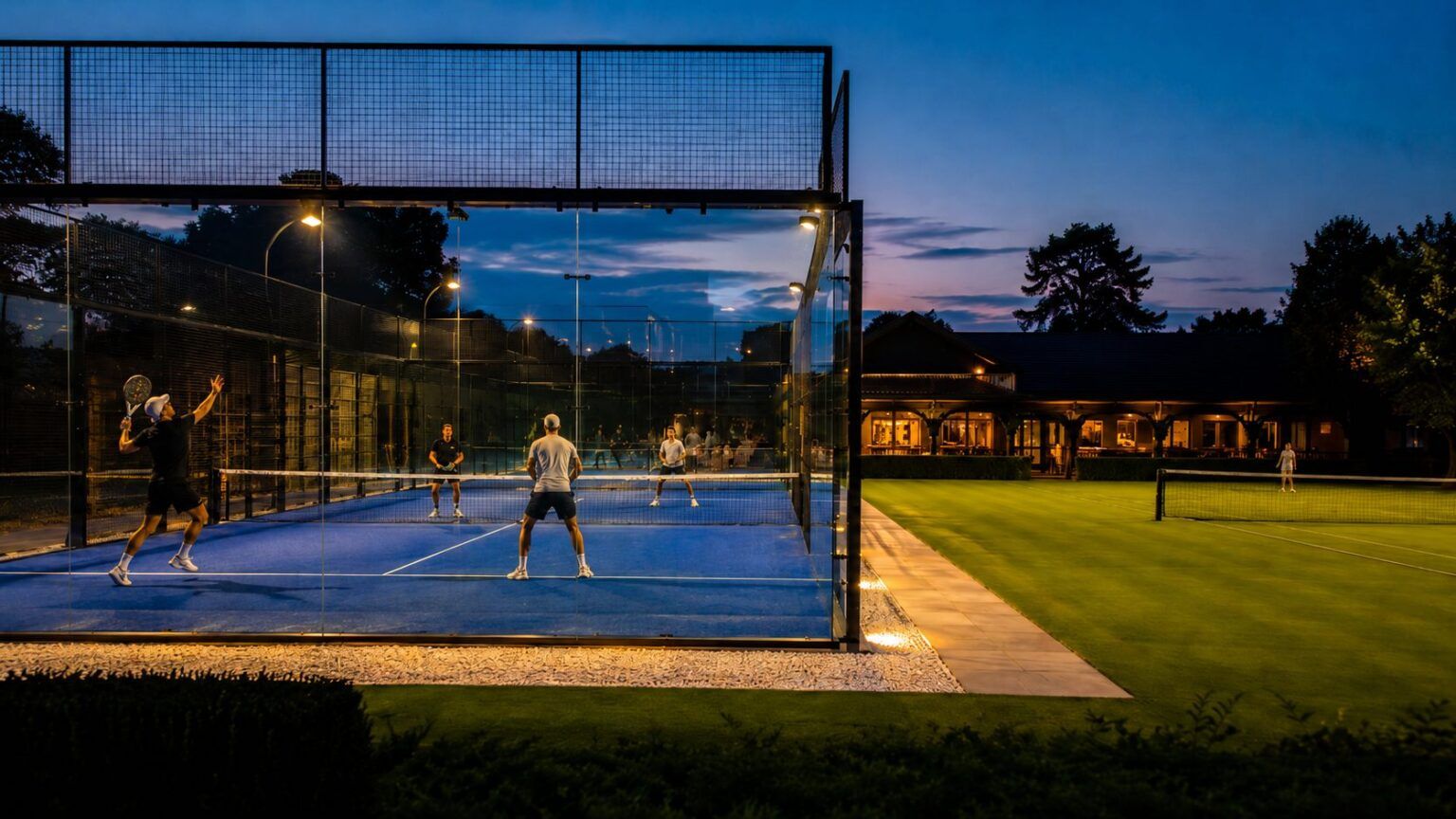
Before any demand analysis, there’s a physical constraint that governs what’s even possible. A regulation tennis court runs 78 feet by 36 feet — roughly 2,808 square feet for singles, 3,888 for doubles — plus the buffer zones a club-quality facility requires. A regulation padel court is 66 feet by 33 feet (200 square meters), enclosed by glass and mesh walls that are integral to the game. A pickleball court is 44 feet by 20 feet, or 880 square feet — small enough that four can be striped within a single tennis court footprint. That arithmetic matters for capital planning in three ways. First, a club converting one tennis court to pickleball can generate four times the court inventory for the cost of paint, nets, and resurfacing — typically $8,000 to $25,000 per conversion — without breaking ground. Second, a padel court’s enclosed glass structure means it cannot share space with another sport; it requires a dedicated footprint and, typically, a foundation pour. Third, the glass enclosure affects sound propagation differently than a standard court: padel produces a lower-frequency thwack rather than the sharp, high-frequency pop that makes pickleball noise so contested.Court Footprint Comparison (Square Feet, Playing Surface)
The Noise Variable Most Operators Underestimate
Pickleball’s sound profile is genuinely different from tennis. The polymer ball striking a hard paddle produces a repetitive high-frequency pop that registers between 70 and 85 decibels at 100 feet — roughly the level of a vacuum cleaner at close range — with individual strikes occurring up to 900 times per hour per active court, according to acoustic analysis published by the Acoustical Society of America. Human hearing is most sensitive in exactly this frequency range. Clubs that sited courts near residential adjacencies, outdoor dining terraces, or reading rooms before the acoustic data was widely understood are now managing the fallout. American Planning Association research published in November 2025 concluded that siting — not acoustic barriers or quieter paddles — is the single most effective mitigation strategy, because distance attenuation compounds with every secondary measure. A court placed 200 feet from the nearest sensitive space is substantially more manageable than one placed at 50 feet. For clubs with constrained sites, dedicated padel or tennis investment may offer a better long-term neighbor relationship than aggressive pickleball court density. Padel’s enclosed glass structure contains and redirects sound. Tennis produces lower-frequency impact noise that most noise ordinances and HOA covenants are calibrated around. Clubs navigating complaints or permit renewals may find that court-type selection is a de facto noise abatement strategy, not merely an amenity decision.Construction Cost Ranges: What You’re Actually Committing
Cost estimates circulating in the industry span a wide range, and the spread is legitimate — site conditions, surface choice, regional labor, lighting, and indoor versus outdoor status all move the number materially. Ranges below are illustrative based on 2025–2026 contractor and industry data; get site-specific bids before committing capital. Pickleball: A single outdoor pickleball court built from scratch typically runs $28,000 to $75,000, depending on base material (asphalt versus concrete), drainage, fencing, and lighting, according to 2025–2026 construction industry data from court-building specialists. Indoor conversions — which involve existing structure but require HVAC adjustment, flooring, and dedicated lighting — generally land between $50,000 and $150,000 per court, per the same industry data. Converting a tennis court to four pickleball courts remains the lowest-cost entry point, often achievable for under $25,000 total, according to GGA Partners data and 2025–2026 court conversion industry specialists. Padel: A standard outdoor padel court in the U.S. currently runs $50,000 to $100,000 fully installed — including the prefabricated steel-and-glass structure, artificial turf surface, LED lighting, and site prep — according to 2025–2026 padel construction industry data, with most quality projects landing in that range. Indoor padel, which requires a clear-span structure with 20 feet of ceiling height, adds significantly to that figure. The April 9 PCM analysis on padel economics covers the revenue side of this investment in detail. Tennis: A new outdoor hard court at club quality runs $45,000 to $100,000, according to published 2025–2026 industry estimates from court construction specialists, with clay courts reaching $60,000 to $90,000 and requiring ongoing maintenance that adds $2,000 or more annually per those same sources. Indoor tennis — rarely a first-build option for renovation projects — can exceed $400,000 per court when structure is included.Estimated Construction Cost Per Court — Illustrative Ranges (2026)
Reading Member Demand Before You Break Ground
The GGA Partners Club Leader’s Perspectives Report (August 2024) identified pickleball among the top capital project categories clubs had started, completed, or would undertake soon — alongside indoor dining and golf course investment. That finding reflects genuine demand, but it also reflects a particular moment. Clubs that installed pickleball capacity in 2021–2023 are now two to three years into operations and producing real utilization data. Clubs building today should be asking for that data before replicating what worked elsewhere. Demand signals worth gathering before any court decision: court reservation lead times (if courts are booking out more than 72 hours in advance consistently, demand is real and supply-constrained); clinic and lesson enrollment rates; member survey responses that distinguish interest from active participation; and wait-list depth for existing programs. Prospective member feedback is particularly instructive — whether racquet sports are appearing in inquiry conversations, and which sport is being named. Padel’s current 2 percent penetration in private clubs means first-mover advantage is available in most markets. But first-mover advantage is only valuable if the demand is present. Clubs in markets where padel is already visible — Miami, Houston, Austin, New York — can assume a more educated member base. Clubs in markets where the sport hasn’t broken through yet should run a pilot or member interest campaign before committing to a padel installation at the construction price points described in the section above. Data in the table below is drawn from the sources cited in this article: court dimensions reflect official regulation standards; cost figures are from 2025–2026 construction industry data as detailed above; U.S. pickleball player count and three-year growth are from the SFIA 2026 Topline Participation Report; pickleball club penetration and the overcapacity finding are from PCM and GGA Partners (May 2026); U.S. padel player count and court figures are from Misitrano Consulting’s State of Padel in the U.S. Report 2025.Pickleball
Court footprint880 sq ft (regulation)
New build cost$28K–$75K (industry data)
Conversion costUnder $25K, 4 courts (GGA Partners / industry data)
Noise profileHigh-frequency pop (ASA)
U.S. demand24.3M players (SFIA 2026 Topline)
Club penetration56% (PCM / GGA Partners, May 2026)
Staffing entryPro pool is large
Programming ceilingModerate
Padel
Court footprint2,153 sq ft (enclosed, regulation)
New build cost$50K–$100K (industry data)
Conversion costN/A — dedicated only
Noise profileGlass-contained thwack
U.S. demand~112K+ active players (Misitrano Consulting, Q2 2025)
Club penetration~2% (first-mover window)
Staffing entryPro pool is thin
Programming ceilingHigh — social + competitive
Programming and Staffing: Where the Experience Lives
A court without programming is a parking space. The clubs generating the strongest racquet-sports ROI — measured in both utilization rates and member satisfaction scores — structure their programs around three pillars: instruction, league play, and social events. Courts that run open play only tend toward crowding at peak times and empty courts at off-peak hours, which creates member frustration without improving revenue. For pickleball, the certified professional pool is now large enough that most clubs can hire or contract qualified instruction. USA Pickleball’s registered membership grew to over 104,000 in 2025, and IPTPA- and PPR-certified instructors are available in most major markets. Lesson pricing in private club contexts typically runs $75 to $150 per hour for individual instruction; group clinics at $25 to $50 per person can drive high-volume revenue during morning and weekend time slots that otherwise see light bookings. Padel staffing is the more constrained variable. The domestic pro pool remains thin — most certified instructors have European training backgrounds, and the certification infrastructure in the U.S. is still developing. Clubs committed to padel in 2026 should budget for instructor travel or remote clinics, or partner with a padel facility operator who can provide programming infrastructure as part of a management arrangement. This is likely to normalize within two to three years as domestic certification programs mature, but it’s a real consideration today. Tennis programming, by contrast, benefits from the most developed professional infrastructure in the racquet world. USPTA and PTR certified pros are available in every market, junior development pipelines are established, and the league structure through USTA is a ready-made member engagement engine. Clubs that have underutilized tennis infrastructure should ask whether a programming investment — not a court conversion — is the right first step.56%
of private clubs now offer pickleball as an amenity, according to PCM and GGA Partners’ May 2026 survey — but the same survey found 41% of club leaders identify it as an overcapacity concern, signaling a shift from installation to optimization.
PCM / GGA Partners, May 2026
The Decision Framework: Four Questions Before Any Court Commitment
1. What does your site actually allow? Noise ordinances, setback requirements, existing impervious surface limits, and ADA compliance paths all constrain what’s buildable before member demand enters the conversation. Engage a civil engineer and review your local zoning code before a board presentation. 2. What is your replacement cost versus your conversion cost? A tennis court being converted to four pickleball courts is a different capital decision than breaking ground on new pickleball inventory. Conversions can often be approved as maintenance expenditures; new construction typically requires capital-project authorization and changes your club’s long-term amenity footprint permanently. 3. Who are you trying to attract, and what sports are they asking for? Membership inquiries are your best leading indicator. If prospective members in the 35–55 bracket are asking about padel in your market, that demand signal is more valuable than any national statistic. If your existing members play pickleball three times a week and your courts are routinely overbooked, additional pickleball inventory probably returns more satisfaction per dollar than a padel installation. 4. Are you prepared to staff what you build? A two-court padel installation that launches without a qualified teaching pro and a structured league calendar will underperform a well-programmed single pickleball court with three active clinics per week. The sport matters less than the programming infrastructure behind it. The clubs that navigate this era well aren’t necessarily the ones with the most courts or the newest sport. They’re the ones that matched their capital to demonstrated demand, sited their courts where neighbors and members could coexist, and staffed their programs with people who build community around the game. That formula works for padel, pickleball, and tennis — and it worked before any of them were trending.Free Download
The 2026 Private Club Benchmark Report
The membership, amenity, and pricing data reshaping private clubs — from a 1,200-club analysis. Enter your details and we'll send it to your inbox.