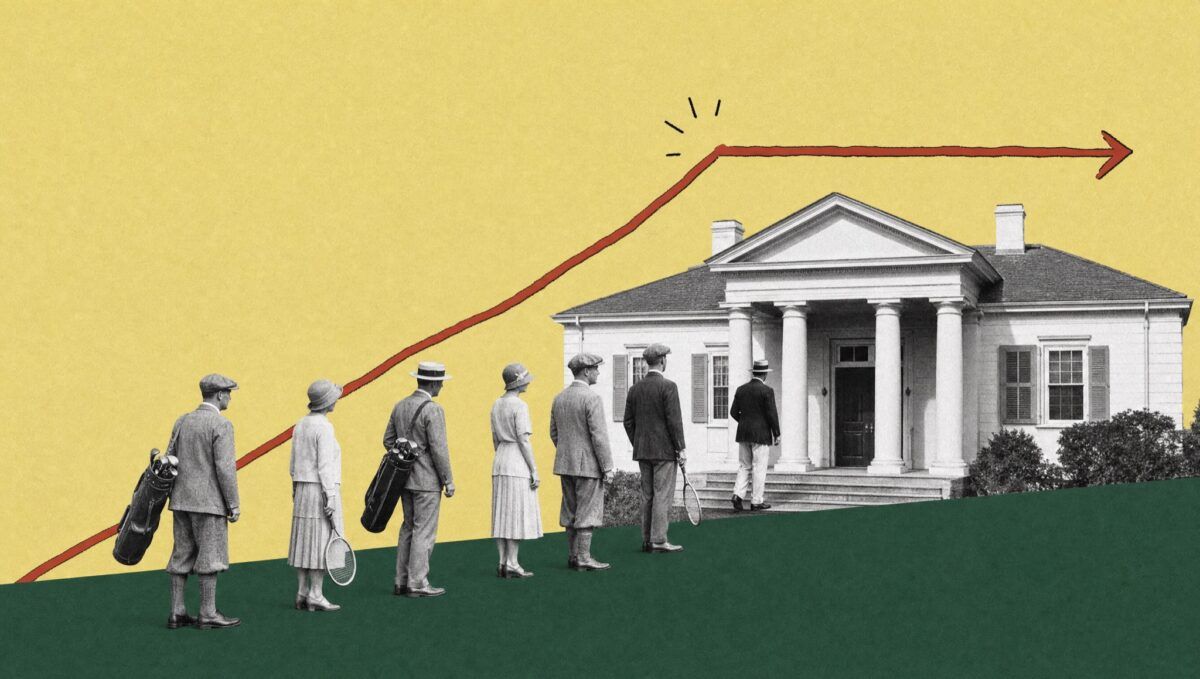

For a decade, the fastest way to start an argument at a country club was to suggest painting pickleball lines on a tennis court. That argument is now largely over, and the clubs that resolved it early are showing what the resolution is worth.
The demand is not speculative. According to the Sports & Fitness Industry Association, 24.3 million Americans played pickleball in 2025, up 22.8 percent year over year and 171.8 percent over three years, making it the single fastest-growing sport in the country. That surge has not come at tennis’s expense. The United States Tennis Association reports tennis reached a record 27.3 million players in 2025 — a sixth consecutive year of growth, up 54 percent since 2019 and nearly 10 million new players over that span. Add padel, which crossed one million U.S. players in 2025 after growing more than 250 percent since 2022, and the picture is unambiguous: the racquet category is not cannibalizing itself. It is compounding.
For private clubs, that compounding is the dividend. The question is no longer whether to capture it, but how to capture it without spending down the goodwill of the members who were there first.
Source: USPA (padel) and SFIA (pickleball). Tennis is not shown — its reported growth is measured from 2019, not 2022.
The demand a club cannot manufacture
Most membership growth levers a club pulls — dining refreshes, fitness build-outs, social calendars — require the club to create demand. Racquet sports are different. The demand already exists, at scale, in the club’s own market. A club adding pickleball or padel is not persuading anyone to want the sport; it is deciding whether prospective members satisfy that want inside the gates or at a public court down the road.
The demographics make the stakes concrete. Roughly 70 percent of avid pickleball players are between 18 and 44, and the sport’s average player age has been falling for years as more than a million children entered the game. For a membership base that skews older and worries — correctly — about generational replacement, that is the most valuable demographic profile in the amenity mix. Padel skews younger and more affluent still.
This is why the strategic frame matters. Pickleball is not a fad amenity to be tolerated. It is a demographic acquisition channel that happens to be inexpensive to build. A single tennis court footprint accommodates up to four pickleball courts, and national court supply — more than 70,000 courts and still short of demand — signals that operators everywhere are racing to add capacity. The clubs that win will be the ones that treat the build as a membership strategy, not a facilities line item.
Where the tension actually lives
The friction between tennis members and the pickleball wave is real, but it is usually misdiagnosed. Boards assume the conflict is about the sport. It is almost always about access, noise, and identity.
Access. The core complaint from tennis members is court time. When shared-use courts get striped for both sports, tennis players experience the change as a subtraction — courts that were theirs are now contested. This is a scheduling and capacity problem masquerading as a cultural one, and it is solvable with capacity: dedicated courts, protected tennis blocks, and reservation systems that guarantee prime-time tennis access rather than leaving it to a scramble.
Noise. Pickleball’s acoustic signature is genuinely different, and adjacency complaints — from tennis courts and from nearby homes — are among the most common operational headaches clubs report. Placement, sound fencing, and quiet-paddle policies are not amenities; they are prerequisites for keeping the peace.
Identity. The deepest tension is symbolic. Longtime tennis members joined a tennis club, and watching it rebrand around a sport they may not play can feel like a loss of standing. This is where marketing and communication do the heaviest lifting — and where most clubs underinvest.
The clubs that navigate this well share a posture: they expand the racquet program without demoting tennis. They frame pickleball and padel as additions to a growing racquet culture, never as a referendum on tennis’s relevance. And they let the data do the reassuring. Tennis is not a declining sport a club is managing down; it is a record-setting sport growing across women, seniors, and communities of color — including 1.1 million more women in 2025 alone, a 10 percent year-over-year gain. A club can grow its pickleball program and its tennis program simultaneously, because the national numbers are doing exactly that. Put the three sports side by side and the trend lines make the case on their own: pickleball participation is up 22.8 percent year over year and 171.8 percent over the past three years, according to the SFIA; padel has grown more than 250 percent since 2022, according to the USPA; and tennis is up 54 percent since 2019, according to the USTA, with women’s participation alone climbing 10 percent year over year.
What the dividend looks like on the balance sheet — and the roster
The membership case for racquet expansion rests on three effects.
The first is acquisition. Racquet-forward clubs report that a diversified court program becomes a headline reason prospects tour and join, particularly younger prospects and young families who might otherwise see a traditional club as not for them. The reported experience of clubs that rebranded around a multi-sport racquet identity — adding pickleball, padel, and platform tennis to a tennis core — has been meaningful membership growth, in some cases moving from a few hundred members to over a thousand, as documented in our own Racquet Renaissance analysis.
The second is retention through crossover. Racquet sports are unusually good at keeping members engaged because members do not stay in one sport. Industry reporting finds that 43 percent of racquet-sports participants now play more than one racquet game, and that crossover is a retention engine: a member who plays tennis Tuesday, pickleball Thursday, and joins a padel social Saturday has three reasons to renew instead of one. Layer in wellness positioning — industry surveys cited by club-management consultants Kopplin Kuebler & Wallace report that a majority of members say they are more likely to stay when wellness amenities are part of their membership — and racquet programming becomes a durable retention asset, not just an acquisition hook.
The third is frequency and spend. A busier court calendar drives lesson bookings, clinics, leagues, socials, and the food-and-beverage and pro-shop activity that follows play. The dividend is not only new dues; it is the higher engagement of existing members who now visit more often and spend more when they do. And because racquet formats are gear-intensive and social by design, that incremental visit tends to carry incremental spend — a paddle in the pro shop, a round on the patio — rather than passing through the gate without touching the ledger.
None of these three effects is speculative at the category level. Pickleball added roughly 4.5 million players in a single year, its casual base alone reaching 16.8 million players per SFIA; tennis retained 20.7 million players and welcomed 4.9 million first-timers in 2025, according to the USTA. A club is not betting on demand materializing. It is deciding what share of demand that already exists it intends to hold.
The marketing playbook for capturing it
Capturing the pickleball dividend is a communications discipline as much as a construction project. Five moves separate the clubs that convert the boom from the ones that merely absorb it.
1. Segment the story. Prospective young families, empty-nesters returning to sport, and competitive tennis players are three different audiences with three different messages. Pickleball’s low barrier to entry sells beginners; tennis’s record growth and depth of programming reassures the serious player; padel’s social, doubles-only format sells the connector who wants a sport that is also a party. One brochure cannot do all three.
2. Communicate to tennis members first, and directly. Every access decision — dedicated versus shared courts, protected prime-time blocks, noise mitigation — should be announced to tennis members before it is marketed to prospects. The members most likely to feel displaced should be the first to hear how their play is being protected. Silence is what breeds the board-meeting revolt.
3. Program the crossover on purpose. Round-robins, learn-to-play nights, and mixed-sport socials that move members from one court to the next are the mechanism that turns a single-sport player into a multi-sport member. Build the calendar to create crossover, then measure it.
4. Make the pro shop and lesson book part of the launch. New courts without a staffed teaching program capture a fraction of their potential. Certified instruction, junior clinics, and league infrastructure are what convert casual interest into recurring engagement and recurring revenue.
5. Lead the market on demographics. The clubs telling the strongest story right now are the ones positioning racquet sports as the front door for the next generation of members — the same instinct that drives clubs to modernize seasonal, lifestyle-led membership programming. Racquet sports are the most credible, lowest-cost version of that generational strategy available today.
The Private Club Partnership Opportunity
The pickleball dividend is real, but it does not collect itself. The clubs realizing it are the ones treating racquet expansion as an integrated membership initiative — positioning, segmentation, member communication, programming, and revenue design working as one system — rather than as a court project the marketing team is asked to publicize after the fact.
That integration is the work Private Club Marketing does. We help clubs build the membership narrative that makes a racquet expansion a growth story instead of a governance fight: audience segmentation that speaks separately to tennis loyalists, young families, and social-first prospects; member-communication frameworks that protect tennis culture while the program grows; and programming and lead-generation systems that turn court demand into tours, joins, and renewals. Our cross-club work with high-net-worth membership bases means the demographic prize at the center of the racquet boom — younger, more affluent, more frequent members — is precisely the audience we are built to reach.
The boom is not slowing. Pickleball added roughly 4.5 million players in a single year, tennis is setting records, and padel is compounding off a small base at triple-digit rates. Every club with courts already owns a claim on that demand. The dividend goes to the clubs that market it deliberately — and protect the members who made the club worth joining in the first place.
Sources
- Sports & Fitness Industry Association — U.S. Pickleball Participation — 24.3 million Americans played pickleball in 2025, up 22.8% year over year and 171.8% over three years; roughly 4.5 million players added in a single year, with the casual base alone reaching 16.8 million
- United States Tennis Association — Tennis participation reaches 27.3 million players in 2025 — record 27.3 million players, a sixth consecutive year of growth, up 54% since 2019; 1.1 million more women in 2025, a 10% year-over-year gain; 20.7 million retained players and 4.9 million first-timers
- United States Padel Association — Padel surpasses one million players in the United States — padel crossed one million U.S. players in 2025, after growing more than 250% since 2022
- Pickleheads — Pickleball statistics — more than 70,000 U.S. pickleball courts and still short of demand
- Racket Business — Racket sports tech, November 2025 — 43% of racquet-sports participants now play more than one racquet game
- Kopplin Kuebler & Wallace — Racquet Sports — member surveys indicating a majority say they are more likely to stay when wellness amenities are part of their membership
Free Download
The 2026 Private Club Benchmark Report
The membership, amenity, and pricing data reshaping private clubs — from a 1,200-club analysis. Enter your details and we'll send it to your inbox.