

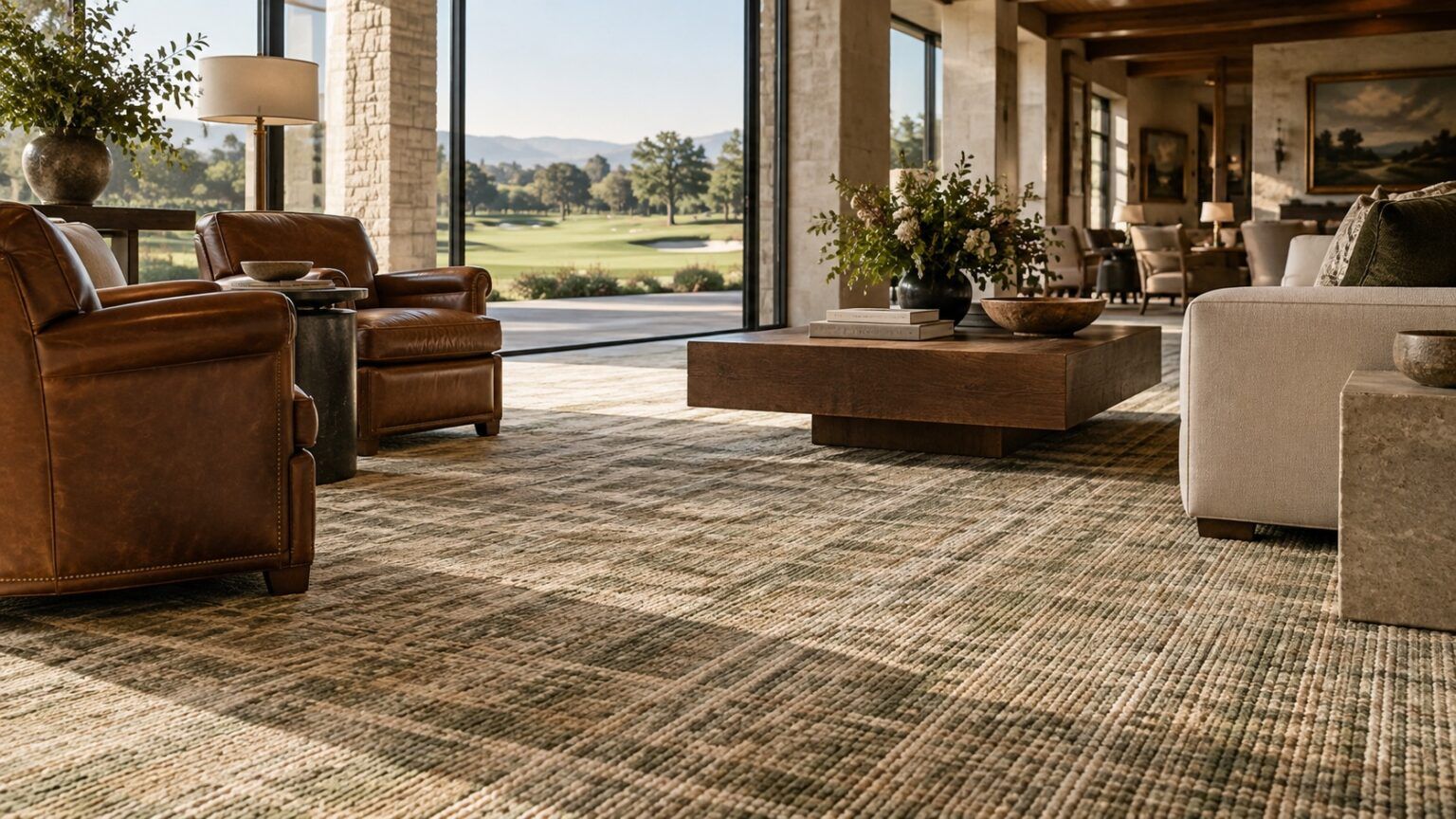
Ask a renovation committee where its new carpet came from and you’ll usually get a brand name, not an answer. The fibre was grown somewhere, spun somewhere else and woven somewhere else again, often with intermediaries in between that nobody on the committee could name.
That matters more than it used to. Clubs are putting serious capital into their clubhouses: new lounges, refreshed ballrooms, reworked dining rooms and corridors. Boards are scrutinising capital plans line by line, and members expect to see where their dues go. Carpet is one of the largest surfaces in any clubhouse and one of the hardest to trace.
Below are five questions every club should put to anyone quoting a clubhouse floor. To show what good answers look like, we use Fieldmark, a New Zealand company that makes bespoke wool carpet for hotels, private clubs and clubhouses, as the worked example.
Why does carpet matter so much in a clubhouse renovation?
Carpet covers more of the clubhouse than almost any other finish, and members feel it every day. It sets the acoustic tone of a dining room, takes the wear of every event in the ballroom, and greets members coming in off the course. A floor that wears badly is one of the first things members notice and one of the most disruptive things to replace.
It is also where the gap between what a club is told and what it can verify tends to be widest. That makes it a good place for a renovation committee to ask harder questions.
1. Where was the fibre grown, and can the supplier document it?
A good answer names a country and a source, not just a fibre type. “Imported wool” or “premium wool blend” is not an answer.
Fieldmark’s answer is specific. It sources New Zealand strong wool from family farms, grown under the animal welfare and environmental regulations that govern all New Zealand farming. Founding principal Andrew Haldane comes from four generations of New Zealand farming, and the supply chain starts in the community he grew up in.
“Coming from generations of New Zealand farming, I’ve experienced firsthand the hard work and pride behind a beautiful clip of wool, only to see it disappear into a commodity market with little recognition of its provenance. I established Fieldmark to bridge that gap — to better reward farmers, elevate this remarkable natural fibre into something exceptional, and bring it directly to those who appreciate quality, heritage and craftsmanship. I believe America’s finest private clubs are a natural home for this legacy and this product.”
Andrew Haldane, Founding Principal, Fieldmark
2. Who handles the fibre between the farm and the loom?
Every step you can’t name is a gap in the story. Ask for the full chain, and ask whether it comes documented.
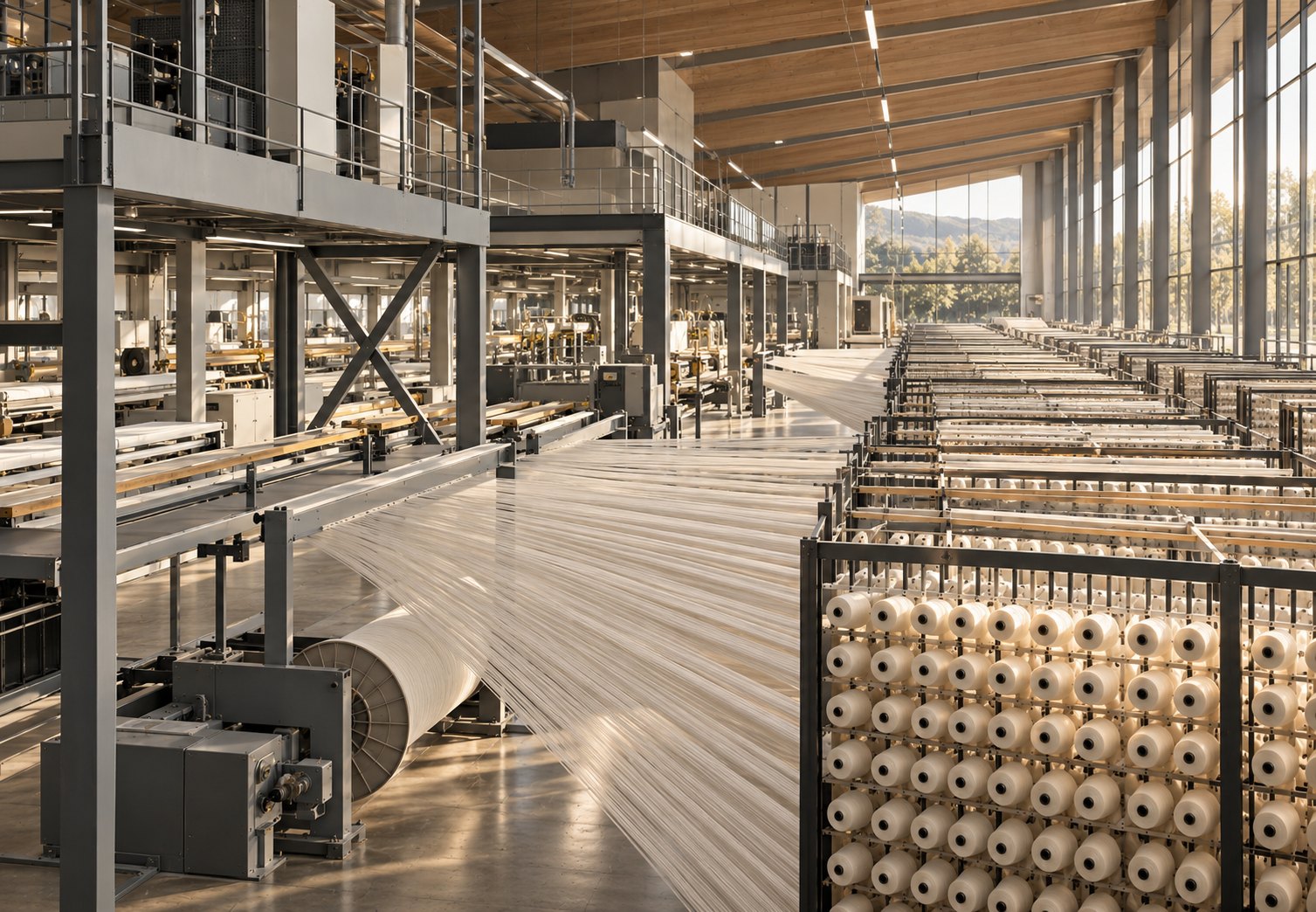
Fieldmark’s chain has four steps across three countries. The wool is scoured in New Zealand before it leaves the country, spun to specification by long-established commission spinners in the United Kingdom, and woven into finished carpet at a long-established mill in America. There are no white-label intermediaries.
Every Fieldmark commission ships with its chain of custody documented: the farmer group the wool came from, and where it was scoured, spun and woven. Fieldmark stays involved at every stage, from fibre selection through delivery to the client, which is what lets it stand behind what it promises.
3. Which carpet construction suits each room in the clubhouse?
A clubhouse is several buildings in one. A ballroom, a high-traffic corridor and a lounge where members walk in off the course all need different things from a floor. Be wary of a supplier who proposes one construction for every room.
Fieldmark works in three weaves:
- Wire Wilton, for fine detail and unparalleled texture creation
- Axminster, for pattern and colour across large rooms
- Karaloc, Fieldmark’s proprietary weave, for textured fields that read as much by foot as by eye
Between them they cover intricate organic motifs, bold geometric repeats and multi-tonal textured fields. The designer or specifier brings the concept, and Fieldmark’s team works it into a construction suited to how each room is used.
4. Is wool carpet worth it for a clubhouse?
For most clubhouse rooms, the case for wool rests on how long it lasts, not what it costs to install. New Zealand strong wool has been bred over generations for durability, lasting appearance and quiet underfoot. Those are the qualities a clubhouse needs from a floor that has to look right for a decade or more.
Wool also brings practical benefits that matter in a busy building:
- It’s naturally fire resistant, without relying on added treatments.
- It sheds dirt and cleans easily, which counts in entrances and dining rooms.
- It absorbs unwanted VOCs from the air.
- It’s quieter underfoot, which changes how a dining room or lounge sounds.
Ask any supplier for installations you can visit, ideally in a room that sees the traffic your highest-use room does.
5. What sustainability claims can the supplier actually prove?
Clubs are asked about sustainability more often now, by members, by boards and by the next generation of joiners. The problem is that most flooring claims are hard to check. “Eco-friendly” on a spec sheet doesn’t tell a board much. Ask what a supplier can prove today, and what is still in progress.
Fieldmark’s position is narrower, and you can check every part of it.
The most sustainable floor is the one you don’t replace. A clubhouse carpet that still looks right in year twelve means fewer tear-outs, less waste and less disruption to members. In a high-traffic building, that is the largest environmental decision on the floor.
A natural fibre, start to finish. Woven construction fuses the wool pile into a single textile. Latex backing is optional. Without it, the result is a fully natural, 100% New Zealand wool floorcovering. Wool sheds no microplastics, which matters more each year as members ask what their children are playing on.
A supply chain short enough to explain. Each step sits in New Zealand, the United Kingdom or the United States, under those countries’ labour and environmental standards, and each commission arrives with that chain documented.
Stewardship at the source, without overstating it. Through its Farm Footing Programme, Fieldmark is building standards for animal welfare, land stewardship and fibre quality at farm level. It describes the programme as in development, not a completed audit. For a club that has to put its name to a sustainability statement, that kind of restraint is worth more than a logo on a brochure.
For a board, the answer comes down to one line it can use: a natural, long-lasting floor from a supply chain we can name at every step.
How should a club use these questions?
Put them in writing. Add the five questions to the flooring section of your renovation RFP, and ask your interior designer to put them to every supplier on the shortlist. Compare answers side by side. If a supplier can’t answer a question clearly, take note. That is an answer in itself.
Then ask to walk a finished installation. A floor that has been down for several years in a busy room will tell you more than any sample board.
If your club is planning a clubhouse renovation and wants help shaping the brief, the Private Club Marketing development and renovation team works with clubs on exactly this kind of decision.
See Fieldmark’s patterns and constructions at fieldmark.co.nz.
Fieldmark is a Private Club Marketing client.
Free Download
The 2026 Private Club Benchmark Report
The membership, amenity, and pricing data reshaping private clubs — from a 1,200-club analysis. Enter your details and we'll send it to your inbox.