
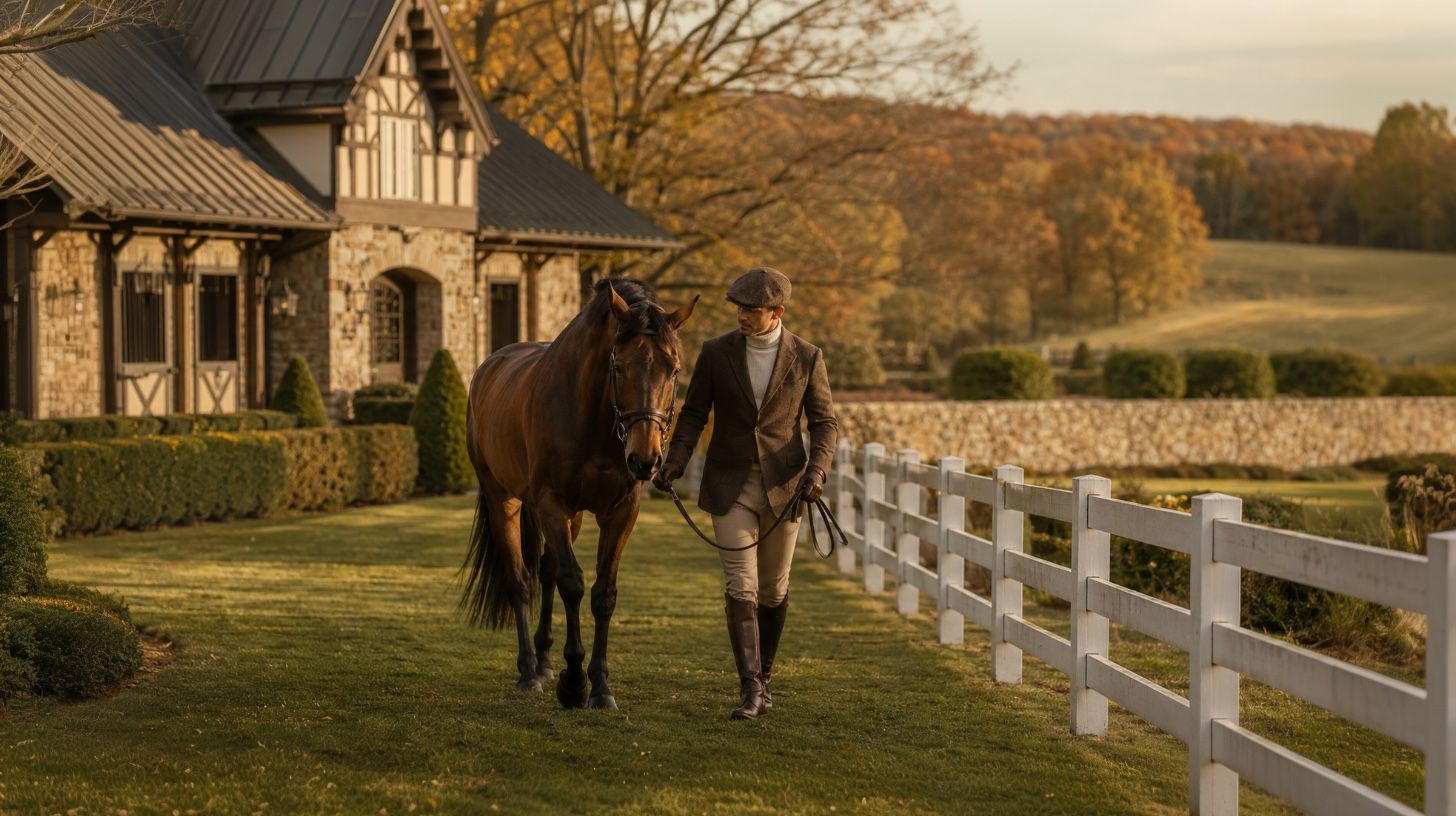
By early September, the light changes at a good riding club. The heat that flattened the arena in July lifts, the footing firms, and the fall calendar — hunter and jumper qualifiers, fall polo, hunt season, harvest hacks across cooling fields — comes alive. For most private clubs, autumn is a wind-down. For the equestrian club, it is a second opening night. Understanding why reveals something every membership director should study, whether or not there is a single horse on the property.
Equestrian clubs sit at an unusual intersection of American private-club economics. They are simultaneously among the most capital-intensive clubs to operate, the most emotionally sticky to belong to, and the most quietly lucrative in the categories that matter — land, legacy, and a member who does not leave. The horse world is also large in a way that surprises people who do not live in it. The industry contributed $177 billion to the U.S. economy in 2023, according to the American Horse Council’s 2023 National Equine Economic Impact Study. That same study found the industry supported 2.2 million jobs, according to the American Horse Council’s 2023 study. It also found the industry touches 12.5 million acres of land owned or leased for horse-related purposes, according to the American Horse Council’s published 2023 impact tables. This is not a fringe hobby. It is a durable, land-anchored economy with private membership at its center.
Membership economics built on land, not just access
The first thing that separates an equestrian club from a golf or city club is the balance sheet underneath the membership. A country club sells access to a course and a clubhouse. An equestrian club sells access to that plus a working agricultural operation — stabling, arenas, turnout, trails, staff grooms and trainers, veterinary and farrier logistics, and often boarding revenue that runs alongside dues. Sixty-two percent of horse owners own or lease property, according to the American Horse Council’s 2023 impact tables, which tells you how much of this membership base already thinks like a landholder rather than a casual participant.
That changes the unit economics in the club’s favor. A boarding member is not a seasonal golfer who disappears in the off-season; the horse is on-site every day of the year, generating board, training, lesson, and show-prep revenue on top of dues. Retention, in effect, is collateralized by the animal itself. Moving a horse is expensive, disruptive, and emotionally fraught, which is why equestrian membership tends to be among the stickiest in the private-club world. Where a golf member weighs whether the club is still worth it each renewal, an equestrian member is weighing whether to uproot a living relationship and a daily routine. Clubs that understand this build their pricing and communication around the household, not the individual — because the barn is where families spend Saturdays.
It also spreads the risk across more revenue lines than a conventional club carries. Dues are the floor; above them sit boarding, training, clinics, lesson programs, show hauling, and the ancillary spend the American Horse Council’s study captures across feed, tack, veterinary, and farrier services. A well-run barn is closer to a diversified small business than to a single-fee amenity, and that diversification is what lets equestrian operations weather the same economic cycles that pressure dues-only clubs. The trade-off is operational complexity and labor intensity — grooms, trainers, and around-the-clock animal care do not scale like tee times — which is precisely why the membership base commands the premium it does and stays as long as it does.
Season is the product
The second lesson is timing. Equestrian clubs are the clearest example in the private-club sector of season as the core product, and fall is a peak the rest of the industry overlooks.
The showcase is winter in Wellington, Florida, where the Winter Equestrian Festival has become the largest annual equestrian competition in the world. The 2025 festival generated $536.2 million in economic impact for Palm Beach County, according to Wellington International’s 2025 Economic Impact Report. That figure marks a 33 percent jump from $403.6 million the prior year, according to Wellington International’s 2025 Economic Impact Report. The festival also generated more than 210,000 hotel room nights, according to Wellington International’s 2025 report. The festival draws nearly 7,000 horses from 42 countries each season, per the Palm Beach County Sports Commission. A single equestrian season now out-earns most professional sporting events a metropolitan area will host all year.
Source: Wellington International’s 2025 Economic Impact Report.
But the calendar does not begin and end in winter. Fall is when the sport re-gathers after summer heat: indoor finals and fall classics, the return of hunt season, fall polo in the warmer markets, and the trail and hacking season across the temperate North before the ground turns. For a club, this means two distinct revenue peaks and two distinct membership-acquisition windows each year, not one. The clubs that market well treat late August and September the way a wine club treats harvest — a natural, sensory, calendar-driven reason to re-engage members and convert prospects. We made exactly this argument about seasonal demand in our June piece on rosé season and direct-to-member wine clubs: the season is not a backdrop to the offer, it is the offer, and the clubs that win are the ones that program against the calendar rather than fighting it.
Fall also carries a psychological advantage most clubs waste. The winter circuit is where the sport’s attention concentrates, which means autumn is when prospective members are deciding where they will spend that season — booking stalls, committing trainers, planning where the family will base for the show months. A club that opens its fall campaign in August is reaching that decision at the moment it is actually being made, rather than competing for attention once the barns are already full elsewhere. The same window applies to lapsed and dormant members: the change of season is a low-friction, non-salesy reason to reach back out, and a fall clinic, hunt breakfast, or member trail ride converts far better than a renewal notice sent in isolation. Programming, not discounting, is what fills the roster — and the equestrian calendar hands clubs the programming for free.
Scarcity is structural, not manufactured
The third lesson is the one most transferable to the wider industry. Equestrian clubs enjoy a form of scarcity that is genuinely structural rather than marketed into existence. Stalls are finite. Arena hours are finite. Trail capacity, trainer attention, and turnout acreage are all hard-capped by physical reality. A club can add a member roster far faster than it can add a barn.
The rest of the private-club world has spent the last several years discovering the value of this kind of scarcity. Median country club initiation fees rose from roughly $29,000 in 2019 to about $50,000 by 2022, a 72 percent increase, according to Front Office Sports. Premier clubs now commonly command six-figure fees and waitlists measured in years, per the same Front Office Sports report. Equestrian clubs have lived in that reality all along, because their capacity ceiling is written in acreage and stall count. The discipline this forces — allocating a finite, high-demand resource across a waitlist — is precisely the discipline we lay out in our waitlist monetization playbook. When supply is truly fixed, the waitlist is not a holding pen; it is an asset with its own economics, and how a club manages deposits, tiering, and communication against it is a revenue lever in its own right.
A large, organized, growing participant base
None of this would matter if the participant base were shrinking. It is not. Combined fans and members passed the 500,000 mark during the 2024 competition year, according to US Equestrian’s 2025 Annual Meeting report. Competing membership grew 8 percent to 83,000 during that same period, per US Equestrian’s 2025 Annual Meeting report. The number of horses competing rose 2.7 percent to 85,970, according to the same US Equestrian report. On the polo side, the United States Polo Association is made up of more than 200 member clubs, per USPA’s own published figures. The USPA also counts over 5,000 registered players nationwide, according to the same USPA figures. These are organized, dues-paying, event-attending audiences with high household income and a demonstrated willingness to spend on access. They are, in short, exactly the audience most private clubs are competing to reach — and they are already sorted into governing bodies, show circuits, and regional networks that a club can market against.
The real estate flywheel reinforces the membership one. Equestrian communities from Wellington to Aiken, South Carolina to Tryon, North Carolina have shown that the club and the surrounding land appreciate together. Events bring visitors, visitors become seasonal renters, renters become second-home buyers, and second-home buyers become full members whose children ride. Wellington’s ongoing village and venue expansion is the most visible version of this loop, but the pattern repeats anywhere a serious club anchors a serious equestrian calendar. For a club board, the lesson is that the membership and the surrounding property values are not separate line items — they are the same asset viewed from two angles.
The Private Club Partnership Opportunity
For Private Club Marketing, the equestrian vertical is a near-perfect case study in the four disciplines we build campaigns around: membership marketing, waitlist and allocation strategy, seasonal programming, and cross-club HNW audience development.
On membership marketing, the equestrian household is a multi-generational, high-retention buyer, and the messaging that works is emotional and lineage-driven rather than transactional. Our role is to help clubs tell that story — the daily ritual, the family in the barn, the horse as a member of the household — in a way that converts prospects without cheapening the brand.
On waitlist and allocation strategy, equestrian clubs operate under the hardest capacity ceilings in the industry. That is not a constraint to apologize for; it is the foundation of a monetization strategy. We help clubs structure deposits, priority tiers, and transparent allocation so that a full barn becomes a signal of value and a revenue engine rather than a source of member frustration.
On seasonal programming, the two-peak equestrian calendar is a gift most clubs underuse. Fall in particular is an acquisition window hiding in plain sight. We build the campaigns — content, email, event marketing, and paid amplification — that turn a fall classic or a hunt-season opener into a membership moment, the same way we treat harvest for a wine club.
On cross-club HNW audiences, the equestrian member is very often already a golf, yacht, or city-club member as well. These audiences overlap, and a club that understands the overlap can market across it. We help clubs and club networks reach the members they share, so that a polo prospect in one market becomes a golf lead in another, and a seasonal Wellington resident becomes a summer member somewhere cooler.
What to do before the fall bell
The practical takeaway for a GM or membership director heading into the fall season is straightforward. Treat autumn as a launch, not a lull: build a genuine fall campaign around the season’s events and the change of light, and start it in August. Audit your capacity honestly — know your true stall, arena, and trail ceilings — and let that number, not optimism, set your waitlist strategy. Market to the household and the horse, not the individual, because that is where retention actually lives. And look sideways at the members you share with the golf club down the road and the yacht club on the coast, because the wealthiest equestrian members rarely belong to only one club.
Equestrian clubs did not invent scarcity, season, or loyalty. They simply cannot escape them, and so they have learned to build a business on all three. As the fall bell approaches, that is a lesson worth borrowing — horse or no horse.
Free Download
The 2026 Private Club Benchmark Report
The membership, amenity, and pricing data reshaping private clubs — from a 1,200-club analysis. Enter your details and we'll send it to your inbox.