

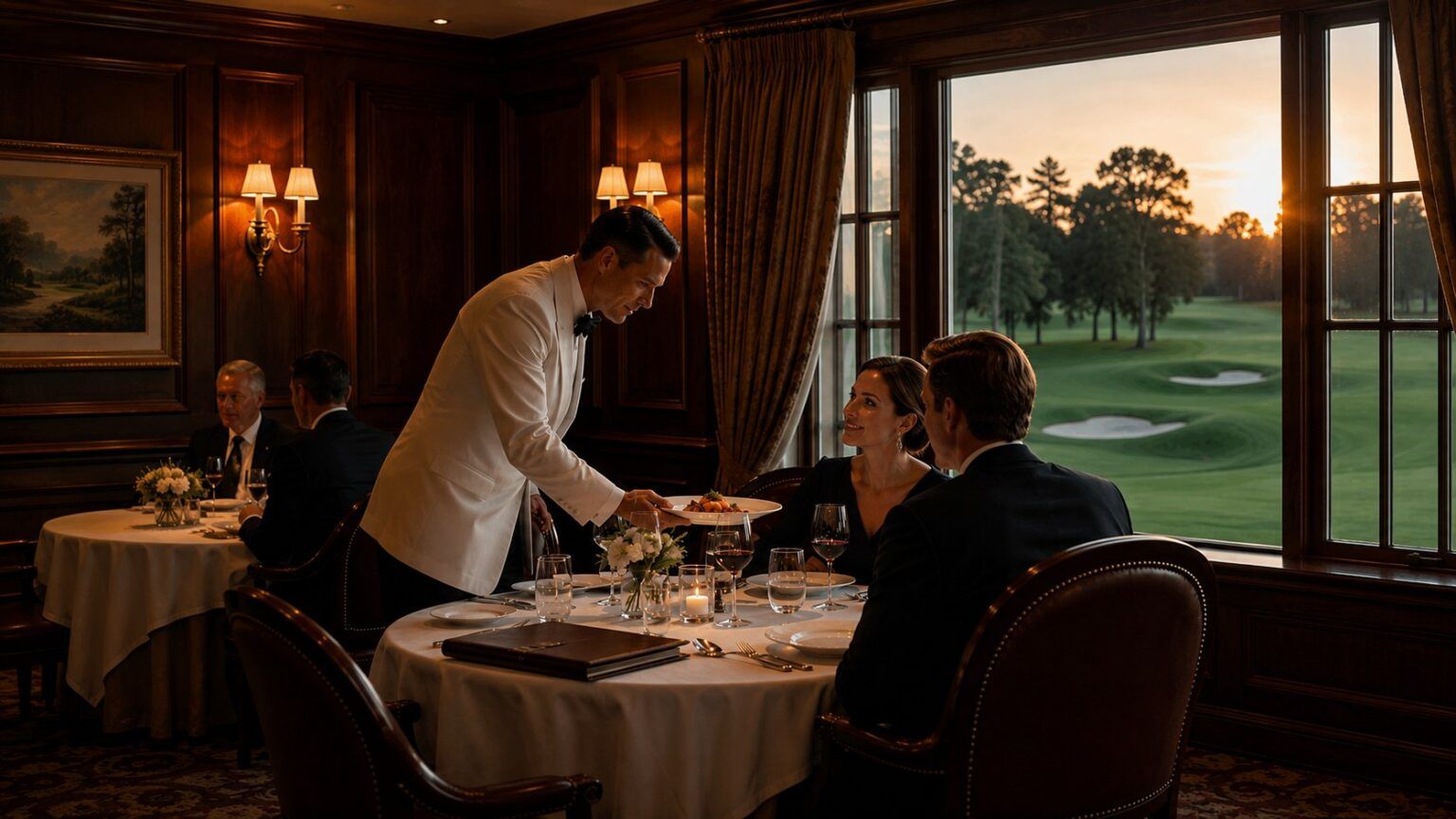
Ask a member what they dislike most about their club bill and a familiar answer comes back: the food-and-beverage minimum. The charge that shows up whether or not they ate. The line that reads, to the member, like a fine for not spending money.
This piece is the next installment in our fee-explainer series — a companion to our breakdown of what monthly dues actually cover — and the F&B minimum deserves its own treatment because it is the most misunderstood charge on the statement. It is not a profit center. In most cases it is a subsidy mechanism for a department that loses money by design. And in 2026, a growing number of well-run clubs are deciding it is the wrong tool for the job.
Here is what a minimum actually is, why nearly every club runs one, the satisfaction math that should make boards think twice, and the three paths clubs are taking now: kill it, keep it, or productize it.
What a minimum is, and how clubs structure it
A food-and-beverage minimum is a floor on member spending. Per Club + Resort Chef, the club requires each member to spend a set amount on food and non-alcoholic beverage over a defined period; if the member does not spend it, they are billed the difference anyway. It is, almost universally, use-it-or-lose-it — unspent balances do not roll forward.
The structures vary by billing cadence. Some clubs run a monthly minimum, some quarterly, some annual, and the dollar figures span a wide range — from around $50 a month at modest clubs to several thousand dollars a year at high-end ones, per Club + Resort Chef. The mechanics are simple; the intent is what matters. The minimum exists to guarantee the food-and-beverage department a baseline of revenue it cannot count on from voluntary member dining alone.
That guarantee is not arbitrary. It exists because the underlying department is, at most clubs, structurally unprofitable.
Why minimums exist: F&B is a subsidized department
The single most important fact about club food and beverage is that it rarely makes money. Roughly 70% of clubs subsidize their F&B operation, according to Club Benchmarking — the department runs at a loss and is covered by dues and other revenue. Only about 8% of clubs report an F&B surplus, and the clubs that do tend to rank among the financially weakest in the industry, according to the 2025 Club Benchmarking F&B report — a counterintuitive pattern the industry calls “the F&B trap.” Clubs that squeeze F&B for profit are, per that same Club Benchmarking research, often doing so because they lack the dues base to subsidize it properly — the surplus is a symptom of financial strain, not health.
That reframes what a minimum is really doing. It is not price-gouging members. Per Club Benchmarking’s framing, it is a device for spreading the cost of an intentionally subsidized amenity across the people who benefit from it, whether or not they personally use it in a given month. The member who never eats at the club is, in theory, still paying toward the fixed cost of a kitchen and dining room that make the club a club.
The pressure on this model is intensifying. Kopplin Kuebler & Wallace’s “State of Private Clubs in 2026” report names food, beverage, and labor costs among those now outpacing historical inflation models. Separately, KK&W’s Club Trends reporting has identified F&B as both the top member-value proposition at most clubs and the leading source of dissatisfaction registered in member surveys. The department members love is the department that loses the most money and generates the most complaints. The minimum sits right on top of that tension.
The satisfaction math that should worry boards
Here is the number every board member should know before defending a minimum. Member satisfaction with food and beverage correlates with overall member satisfaction at 0.47 — versus 0.27 for the golf course, per the 2025 Club Benchmarking report. F&B is nearly twice as predictive of whether a member is happy with the club overall as the golf course is.
Sit with that. The department losing money at 70% of clubs is, per that same Club Benchmarking data, also the single strongest driver of overall member satisfaction of any club amenity. The kitchen matters more to retention than the course does. Which means the minimum is not just a billing mechanism — it is attached to the most emotionally important amenity the club runs.
And that is the problem with using a blunt financial floor to prop up an experience-driven department. A minimum can guarantee revenue, but it cannot manufacture satisfaction — and when the food is not good enough to draw voluntary spending, the minimum simply bills members for a dining experience they chose to avoid. Industry educators have started calling minimums out directly: a CMAA World Conference education session titled “Stop the Ridiculous Practice of F&B Minimums” frames them as “bad profits” — revenue extracted in a way that damages the relationship — and points to alternatives like a member-directed annual spend or a hospitality premium folded into dues.
The insight underneath all of it: members don’t hate spending money at their club. They hate being billed for not spending it. That distinction is the entire design problem, and it is what separates the three paths clubs are now taking.
Path one: kill it — San Antonio Country Club
The most aggressive move is to eliminate the minimum entirely and let the food carry itself. San Antonio Country Club did exactly that. Per 2015 Club + Resort Business reporting, the club’s leadership eliminated food minimums — and F&B revenue rose 20% by the second year, with total annual F&B sales swelling to $5.5 million, and the club’s Poolhouse Grill running as many as 700 covers a day in peak summer months.
The logic is that a minimum can mask a food problem. When members are billed a floor regardless, the club has less signal about whether the dining is actually good — the revenue comes in either way. Remove the floor, and the department has to earn every dollar by being somewhere members genuinely want to eat. San Antonio’s 20% F&B revenue lift came in the second year after the kitchen leadership change that eliminated its minimum, per Club + Resort Business — suggesting that when the product is strong, voluntary spending can outrun what a minimum would have forced. The minimum was leaving money on the table by capping the club’s ambition at “good enough to hit the floor.”
The caveat is real, though: killing the minimum only works if the food is worth choosing. This is a path for clubs confident in their kitchen, not a rescue for a weak one.
Path two: keep it — South Park Country Club
The opposite approach is to keep the minimum but make it simple, modest, and completely transparent. South Park Country Club in Louisville publishes its structure openly: a social membership runs $166 a month in dues plus a $140-per-quarter food and non-alcoholic beverage minimum. No mystery, no fine print, no surprise reconciliation.
There is real virtue in this. A minimum that is small, clearly stated, and published on the membership page does not read as a penalty — it reads as a house rule everyone agreed to upfront. The member knows the number before they join. At roughly $47 a month equivalent ($140 per quarter divided across three months), it is modest enough that most social members clear it through normal use, and transparent enough that nobody feels ambushed. The dissatisfaction with minimums is often really dissatisfaction with opacity: the surprise bill, the unclear period, the sense of a hidden charge. South Park removes the surprise, which removes most of the sting.
Charlotte-area clubs, by comparison, are reported to require roughly $150 to $400 a month in food-and-beverage spending, per a 2026 Charlotte luxury real estate market guide — figures the source itself describes as directional estimates from member sourcing rather than published club pricing, so treat them as reported ranges, not verified pricing. The spread illustrates the point: what members react to is less the amount than whether the club was straight with them about it.
Path three: productize it — The Concession Golf Club
The most interesting path turns the minimum inside out — from a charge members resent into a product they volunteer to buy. Per 2015 Club + Resort Business reporting, The Concession Golf Club in Bradenton, Florida, has 70 “culinary members” who buy a $2,000 annual dining credit and come to the clubhouse to spend more than that over the course of the year, despite having no golfing privileges. Club + Resort Business described the approach as effectively a new twist on the traditional food minimum.
Look at what changed. A traditional minimum is a floor imposed on existing members who did not ask for it. The Concession’s dining-credit model, per that same reporting, is a credit that a specific set of people — those who want the dining and social side without the golf — choose to purchase. Same money, opposite psychology. Nobody is billed for not showing up; they have pre-bought a dining experience they intend to use, and they bought a membership category to do it. The club productized the concept into something that reads as access and value rather than obligation.
How well the productized version performs against a conventional minimum is the question worth putting to the operator running it.
The productize path is not for every club. It works where there is genuine demand for a dining-and-social tier distinct from the primary golf membership. But it points at the future of the whole debate: the winning move is to convert a resented floor into a chosen product.
What each path signals to prospective members
Whichever path a club takes, the minimum is a message to prospects — and worth reading as one. The way a club handles its F&B minimum tells a prospective member how the club thinks about them before they ever pay a dollar of dues, in the same way the club’s scarcity and waitlist posture signals how it values membership.
Here is what to do with that.
- Decide which story your minimum is telling. Killing it signals confidence in the food. Keeping it simple and published signals transparency. Productizing it signals that you have designed value, not obligation. A vague, surprise-billed minimum signals none of those — and prospects notice.
- If you keep it, publish it. Put the number, the period, and the terms on the membership page the way South Park does. Most dissatisfaction with minimums is dissatisfaction with opacity, and transparency is free.
- Pressure-test whether your food can stand without the floor. San Antonio’s 20% F&B revenue lift, per Club + Resort Business, came in the second year after the kitchen leadership change that eliminated its minimum. Before you kill a minimum, be honest about whether members would choose to eat there anyway.
- Consider converting the floor into a credit. The Concession’s $2,000 annual dining-credit model, per Club + Resort Business, works because members pre-buy value rather than get billed for its absence. Even a modified version — an annual dining credit in place of a monthly floor — changes the psychology entirely.
- Remember the satisfaction stakes. F&B correlates with overall satisfaction at 0.47 versus 0.27 for the course, per the 2025 Club Benchmarking report. Whatever you do with the minimum, you are handling the most retention-critical amenity the club runs. Treat it that way.
Sources
- Club + Resort Chef — What is a food minimum at a country club? — minimum structures, cadence, and typical dollar ranges
- Club Benchmarking — Food and Beverage — ~70% of clubs subsidize F&B; satisfaction correlation figures
- Club Benchmarking — A Data-Driven Perspective on Club Food & Beverage — ~8% F&B surplus and the “F&B trap”
- KK&W — The State of Private Clubs in 2026 — food, beverage, and labor costs outpacing inflation
- KK&W — Club Trends: 5 Best Practices for Club F&B Programs — F&B as top value proposition and leading dissatisfaction source
- Creative Golf Marketing — Stop the Ridiculous Practice of F&B Minimums (CMAA session) — minimums as “bad profits”; alternatives
- Club + Resort Business — Keeping the Spirit Alive at San Antonio CC (2015) — minimum elimination and +20% F&B revenue
- Club + Resort Business — An Uncompromising Approach to Success (The Concession, 2015) — $2,000 annual dining credit and 70 culinary members
- South Park Country Club — Memberships — published $166/mo dues + $140/quarter food minimum
- ListReGroup — Charlotte Country Club membership cost 2026 — reported Charlotte-area minimum ranges (third-party, directional)
Free Download
The 2026 Private Club Benchmark Report
The membership, amenity, and pricing data reshaping private clubs — from a 1,200-club analysis. Enter your details and we'll send it to your inbox.