

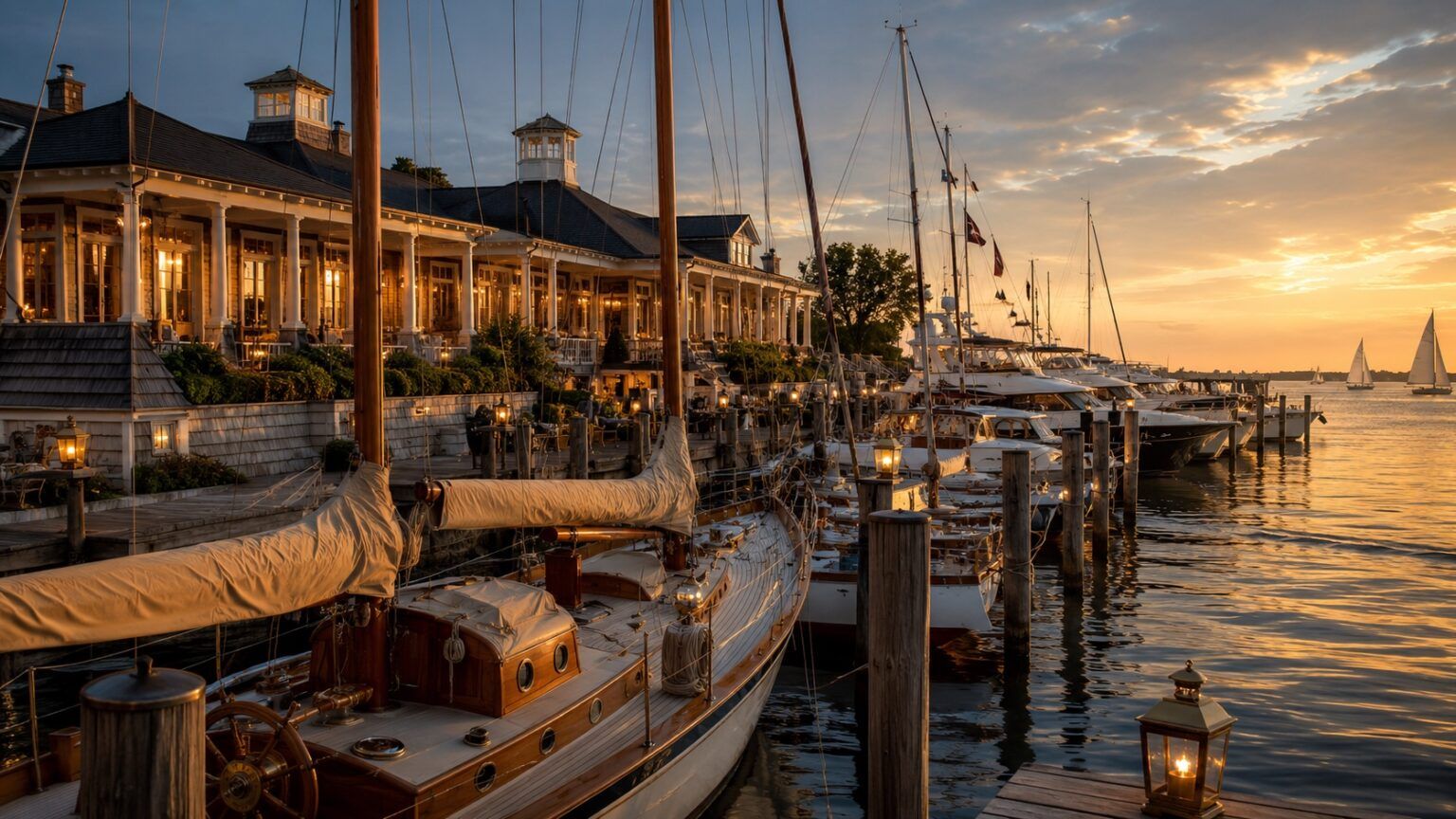
By late July, the harbor is doing the selling. The lines are taut, the tenders are running, the junior fleet is out past the breakwater in a tight, wobbling line, and the club terrace is full at six o’clock with people who may or may not own a boat. For a private yacht or sailing club, this is the high-water mark of the year — the six weeks when the waitlist inquiries arrive, the guest passes get used, and the difference between a club that merely floats and a club that compounds becomes visible on the dock. The question every general manager and board should be asking in that moment is not how full the harbor looks. It is how much of that demand the club is actually converting into membership equity.
Source: GGA Partners’ 2024 Club Leader’s Perspective Report, produced in partnership with CMAA
$32.6B
Direct revenue generated by U.S. private clubs in 2023, per Club Benchmarking / CMAA / NCA
573K
Workers employed by U.S. private clubs, per Club Benchmarking / CMAA / NCA
5,659
Private clubs in the U.S., including yacht and racquet clubs, per Club Benchmarking / CMAA / NCA
$58K
Average club initiation fee, per GGA Partners’ 2024 Club Leader’s Perspective
The Private Club Industry Is Bigger Than the Boat Show
Start with the size of the business the club is actually in. A landmark study conducted jointly by Club Benchmarking, the Club Management Association of America (CMAA), and the National Club Association (NCA) found that America’s roughly 5,659 private clubs — golf and country clubs, city and athletic clubs, and yacht and racquet clubs among them — collectively generated $32.6 billion in direct revenue in 2023, supported a $17.4 billion payroll, and employed 573,000 workers. That study, which drew on the Club Benchmarking database and was led by researchers from Iowa State University, Florida Atlantic University, and the University of Florida, explicitly counts yacht clubs among the private-club categories it measured. Inside that broader private-club economy, GGA Partners’ 2024 Club Leader’s Perspective report, produced in partnership with CMAA, surveyed club general managers directly and found something worth a board’s attention: membership demand is still strong, but it is not evenly distributed by club type. GGA’s survey found that Marina and Yacht Clubs made up 6 percent of respondent clubs, and that year-over-year, more than a third of clubs across the industry saw their waitlists grow even as roughly one in ten saw theirs shrink. That same GGA Partners report found that, nationally, average initiation fees reached $58,000 and average annual dues reached $10,700 across the surveyed clubs, both still climbing — evidence that scarcity, where it exists, continues to translate directly into pricing power. The most strategically useful fact in that data, though, is a structural one: club membership is not evenly distributed across club types, and the categories with the tightest capacity carry the most pricing power. GGA Partners’ report found that clubs with larger staff counts (250-plus employees) posted the highest self-rated performance score of any segment, at 8.5 out of 10, against an all-club average of 8.11 — a reminder that scale and operational depth, not just waterfront, are what separate a club that compounds from one that merely floats. That matters because it reframes what a yacht club actually sells. The boat itself is broadly accessible to a wide range of incomes. The harbor, the berth, the burgee, and the community around them are not — and that scarcity is the entire business.Overall Club Performance Rating by Club Type, 2024 (out of 10)
The Yacht Club Is a Membership Business, Not a Marina
A marina rents space by the linear foot. A yacht club sells belonging, and prices it as membership. The distinction is the whole game, because it decouples the club’s revenue from the one thing it can never manufacture more of — waterfront — and reattaches it to something it can grow indefinitely: the size and engagement of its community. The clearest signal of this shift is the rise of the non-boating member. In “Charting New Waters: 10 Membership Marketing Trends Transforming Private Yacht Clubs in 2026,” Private Club Marketing’s own sector reporting finds that 30 to 50 percent of members at many yacht clubs do not own a vessel, joining instead for the dining, the racing culture, the junior sailing program, and the social calendar. This is not dilution; it is the single most important growth lever a waterfront club has. A club constrained to boat owners is capped by its slip count. A club that sells the waterfront lifestyle — sunset socials on the terrace, a competitive junior program, reciprocal privileges at harbors up and down the coast — is capped only by its dining room and its brand. This is precisely the dynamic we traced in the wine world in June’s companion piece on DTC wine-club membership economics, where the clubs that thrived were the ones that sold identity and access rather than a product you could buy anywhere. A bottle is a commodity; a membership is a relationship. A boat is a purchase; a yacht club is an institution. The economic logic is identical: recurring dues plus high-margin food and beverage, retained over years, is worth far more than any one-time transaction — which is why average member tenure, not sign-up volume, is the number that actually compounds.The Berth Is the Bottleneck — and the Asset
Nothing gives a waterfront club more pricing power than the thing it cannot expand. Coastal berth supply has not kept pace with demand for years. As Wilmington Business Journal reported, regional marina waitlists have stretched two to three years, with some operators at 95 percent capacity, and Port City Daily documented other marinas closing their lists entirely because the wait had become impractical. The pressure is compounded by structural forces: waterfront land is finite, permitting is slow, and marina parcels keep converting to residential and condominium use. Private Club Marketing’s own field analysis, drawn from work with waterfront clubs, puts slip demand ahead of supply by 30 to 40 percent in premium coastal markets. For a club, scarcity is not a problem to solve — it is an asset to manage deliberately. The smartest boards treat berth allocation the way a luxury house treats a limited edition: as a waitlist to be curated, not a queue to be cleared. A transparent, tiered allocation policy — where seniority, membership category, and vessel size all factor into slip access — converts a logistical headache into a membership incentive. It gives prospects a reason to join sooner (to start accruing waitlist priority), gives existing members a reason to stay (to protect their standing), and gives the club a defensible rationale for its dues and initiation structure. The berth shortage is real. The clubs that name it, price around it, and communicate it honestly turn it into their strongest retention tool. There is a second-order effect worth naming. The same forces squeezing marina supply — waterfront conversion to residential use, slow permitting, finite shoreline — are also raising the replacement cost of any harbor that already exists. A club with secured, well-maintained dockage is sitting on an appreciating asset that new entrants cannot easily replicate. That scarcity should inform not just pricing but positioning: the club is not competing on slip rates with the marina down the coast, it is offering something that market cannot manufacture, and its membership communications should say so plainly rather than apologize for a waitlist.Growth Levers for the Modern Club
Four levers do most of the work. Tiered membership architecture. The single-category club is leaving money and community on the table. A well-designed ladder — social, young-professional, associate, full boating, and legacy tiers — lets the club meet HNW prospects where they are and move them up over time. The non-boating social tier is the top of the funnel; the full boating membership is the destination. The junior sailing pipeline. Junior programs are the most underrated growth engine in the sector. They are, in effect, a two-decade membership funnel: kids who learn to sail at a club become the members, board members, and legacy families of the future, and their parents join to be near the program. US Sailing, the national governing body for the sport, anchors a nationwide infrastructure of youth and community sailing that clubs can plug into rather than build from scratch. Food, beverage, and events. For the 30 to 50 percent of members who never untie a line, the club’s calendar is the product. Rosé socials, regatta after-parties, and family nights on the terrace are not amenities; they are the retention mechanism. As we have argued repeatedly in the rosé-season and summer wine-club playbook, emotionally resonant, well-programmed events are what convert a transactional membership into a loyal one. Reciprocity and reach. A burgee that opens doors at harbors up and down the coast — and abroad — is a tangible, marketable benefit that a standalone marina can never offer. Reciprocal agreements extend the value of a single membership across an entire network of clubs, which is exactly the kind of portable, status-carrying benefit that HNW members prize.The Marketing Playbook
Yacht clubs have historically marketed by not marketing — relying on the waitlist, the referral, and the assumption that the right people already know. In a market where the fleet is stable but attention is scarce, that posture leaves the pipeline to chance. The modern playbook keeps the discretion and adds the discipline. It starts with brand and imagery worthy of the setting: cinematic, natural-light photography of the harbor at golden hour, the junior fleet under sail, the terrace at dusk. It runs on a digital presence that treats the website as the club’s most important recruiting asset — mobile-first, membership-forward, and built to capture inquiries rather than merely publish a race calendar. It targets the right audience with precision, reaching HNW prospects through the channels and lookalike audiences where they actually spend attention, and it treats every current member as a referral engine, because in the private-club world the best members arrive sponsored. And it measures what matters: not applications received, but conversion, engagement, and tenure. Seasonality is the final piece. Waterfront demand is compressed into the summer, which makes the shoulder months the real test of a club’s marketing discipline. The clubs that grow are the ones that use the peak weeks to capture inquiries and the off-season to nurture them — booking winter dinners, promoting junior-program registration, and keeping the community warm so that next season’s waitlist is already forming while the boats are hauled out. A harbor that markets only when it is full is leaving its two best growth quarters unworked.34%
of private clubs surveyed reported their membership waitlist grew in 2024, even as demand growth decelerated from the post-pandemic surge.
GGA Partners’ 2024 Club Leader’s Perspective Report
The Private Club Partnership Opportunity
This is the work Private Club Marketing was built for. The yacht and sailing segment sits at the intersection of two things PCM does well: membership marketing for scarce, high-status institutions, and audience strategy across an affluent, cross-club clientele that also belongs to golf, city, and country clubs. Three engagements recur. First, membership marketing and brand: translating a club’s setting and heritage into the photography, website, and campaign infrastructure that convert waterfront demand into applications. Second, waitlist and allocation strategy: helping boards design tiered membership ladders and berth-allocation policies that turn scarcity into a retention and pricing advantage rather than a source of friction. Third, cross-club HNW reach: the same members who anchor a yacht club’s roster are the audience PCM already engages for its country-club, city-club, and residential-community partners, which makes disciplined, privacy-respecting cross-promotion possible in a way no single club could execute alone. The through-line across every vertical we cover — from wine clubs to golf to waterfront — is that durable growth comes from selling belonging, managing scarcity honestly, and retaining members for years rather than chasing signups for a season. For yacht and sailing clubs, the harbor already generates the demand. The opportunity is to build the membership machine that captures it.Free Download
The 2026 Private Club Benchmark Report
The membership, amenity, and pricing data reshaping private clubs — from a 1,200-club analysis. Enter your details and we'll send it to your inbox.