
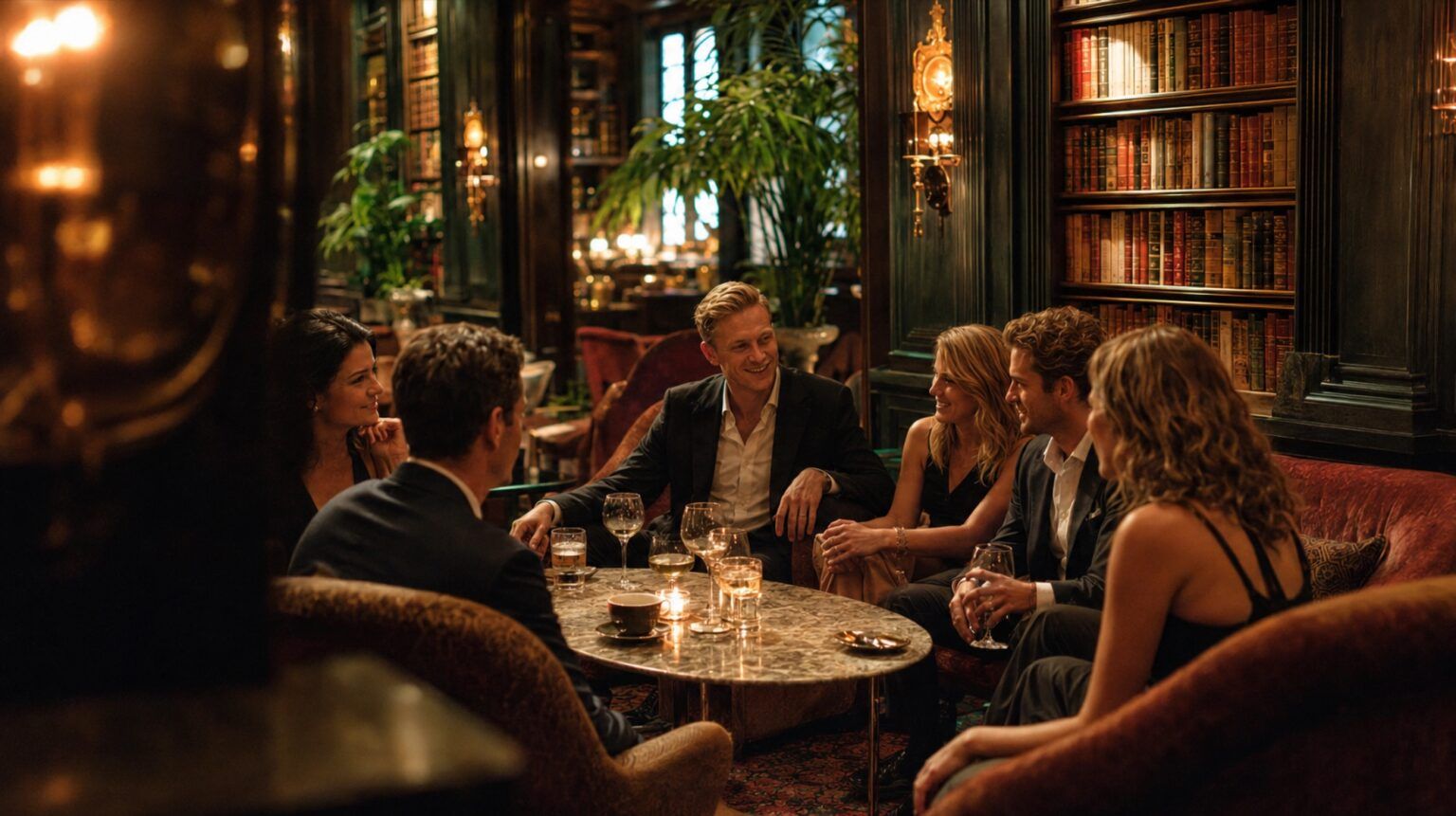
Ask most club marketers what their club offers and you will get a list. The dining room and the wine program. The fitness floor and the spa. The events calendar, the terrace, the guest rooms, the reciprocal network. It is an honest inventory, and it is almost entirely beside the point. Because when a prospective member sits across from a membership director trying to decide whether to write a five- or six-figure check, they are not buying square footage. They are buying a room full of people they want to be among, a curation they trust, and an identity they want to claim. The best social and city clubs in America have understood this for years. They do not sell amenities. They sell belonging — and everything else is just the setting where belonging happens.
This is not a soft or sentimental observation. It is the single most important strategic distinction in the category, and it explains why some clubs with modest facilities carry waitlists in the thousands while others with gleaming buildings cannot fill their rosters. Amenities are table stakes and, worse, they are copyable. Any competitor with capital can build a better gym or hire a better chef. What cannot be copied is a specific community with a specific identity and a curation discipline that has earned members’ trust. That is the durable product. The marketing challenge is that it is also the hardest thing to put in a brochure.
The proof is in the waitlists
If belonging were not the product, the economics of the category would make no sense. Consider the spread. The Aman Club inside Aman New York has been reported by the South China Morning Post to charge an initiation fee near $200,000, with annual dues reported at $15,000 by the SCMP and Salon and at $20,000 by Worth. Zero Bond’s annual dues are reported at $4,400, according to Salon. The club sits on a waitlist believed to number in the thousands while admitting only a few hundred members a year, according to Salon’s 2025 survey of the members-only boom. Casa Cipriani reportedly carries a waitlist in the thousands of its own. These clubs are not competing on price or on the objective quality of their amenities. They are competing on the composition and identity of their membership — on who is inside, and on what being inside means.
The largest operator makes the same point at scale. Soho House & Co reported 271,541 total members at the close of its 2024 fiscal year, with membership revenue climbing 17.2 percent year over year, per the company’s full-year 2024 results. The company’s global waitlist stood at approximately 111,000 applicants, according to Soho House & Co’s second-quarter 2024 results, its most recently disclosed figure as of publication. Soho House does not vet applicants on net worth. It vets on whether they fit and contribute to a creative community — a curation choice, not an amenity choice — and a waitlist of that size is the proof that the choice creates value. A membership organization with roughly a hundred thousand people waiting to get in has, by definition, sold something other than access to a building.
Why belonging became the scarce commodity
Belonging commands this premium now because it has become genuinely scarce. The shift to remote and hybrid work dismantled the informal social infrastructure that used to come free with a job — the daily proximity to colleagues, the ambient sense of being part of a group and a place. Sociologists call the settings that provided this “third places,” and their decline has been well documented. The U.S. Surgeon General’s 2023 advisory went so far as to declare loneliness and isolation a public-health epidemic, reporting that roughly half of American adults had experienced measurable loneliness and that chronic isolation carries a mortality impact comparable to smoking about 15 cigarettes a day.
When belonging is abundant, no one pays for it. When it becomes scarce, a curated community with a real identity becomes one of the most valuable things a person can buy. This is the macro condition every social and city club is now operating inside, and it reframes the entire marketing proposition. A club is no longer selling a nicer place to have dinner. It is selling the cure for a condition the country’s top doctor has flagged as a threat to physical health. Clubs that market accordingly — that lead with community and identity rather than with the wine list — are speaking to what the prospect actually feels the absence of.
The three things clubs actually sell
If the product is belonging, it helps to be precise about its components. Across the clubs that market it best, three elements recur.
Community is the room itself — the specific, curated set of people a member joins. It is why Soho House vets for creative fit and why the top clubs would rather stay undersubscribed than admit the wrong member. The value is relational and compounding: a member joins for the community and stays for the relationships within it. Worth’s survey of the category captured this precisely, quoting hospitality consultant Mark Somen of Craft House, according to Worth. Somen observed of one now-closed New York club that “most people who joined were there because of Alan and returned because of Alan” — a reminder that hosts and personalities, not marble and menus, are what actually retain members. People do not renew a treadmill. They renew a relationship.
Curation is the trust a member places in the club’s judgment — about who is admitted, what events are worth their evening, what the club stands for and against. Curation is what a door policy is really for. It is not exclusion for its own sake; it is a promise that the room will be worth walking into every time. A club that curates well earns the right to program its members’ social lives, and that trust is the foundation of both retention and word-of-mouth acquisition.
Curation is also what makes a club defensible. Two clubs can run identical programming in comparable buildings, but the one with a disciplined, trusted point of view about who belongs and what the club stands for will always command the stronger waitlist, because members are not buying the events — they are buying the confidence that the room has been chosen for them. That confidence is slow to build and easy to squander; a single season of admitting the wrong members to hit a revenue target can undo years of accumulated trust. The clubs that treat curation as a permanent discipline rather than an occasional filter are the ones whose belonging holds its value.
Identity is what membership says about the member. This is where the newest clubs have been most deliberate. The Battery in San Francisco pairs its clubhouse with Battery Powered, a member-led philanthropic program run through the Battery Foundation, a registered 501(c)(3) that has filed IRS Form 990 disclosures every year since its 2014 founding, reporting several million dollars in annual contributions in most of those years. Worth has reported the program’s cumulative giving in the tens of millions of dollars across hundreds of grantees since 2014, according to Worth — so that belonging carries a sense of shared purpose, not just access. Others have built identity around a profession, a generation, or a set of values. In every case, the club is offering the member a way to signal who they are. That signal is the emotional core of the purchase, and it is why identity-led clubs can charge more and wait less.
How to market a product you cannot photograph
The difficulty is obvious: belonging does not photograph. You can shoot the dining room, but you cannot shoot the feeling of being known when you walk in. This is precisely why so many clubs default to amenity marketing — the amenities are visible and the belonging is not. But the clubs that break through do the harder work of making the intangible legible.
They do it through story and through people. They market members and hosts, not rooms. They lead with the community and the programming calendar, treating events not as amenities but as the recurring proof that the community is alive and worth belonging to. They are explicit about who the club is for, because a clear identity is more attractive to the right prospect than a vague appeal to everyone — a discipline this publication has explored in its own analysis of membership trends reshaping private clubs in 2026, where clarity of identity is treated as a key differentiator between clubs that convert prospects and clubs that stall. And they treat scarcity as part of the message, not something to apologize for. A waitlist, communicated well, is itself a statement about the value of belonging — a principle also explored in this publication’s coverage of the seasonal, designed-scarcity model behind direct-to-member wine clubs: the constraint is not a problem to hide, it is the story to tell.
The generational dimension matters here too. The clubs marketing belonging most effectively are also the ones deliberately broadening who gets to belong. Soho House offers a discounted Under-27 membership tier, according to Worth, which the company uses to help increase the generational mix of its membership — a recognition that a community’s identity has to renew itself or calcify. A club selling belonging is, in effect, curating the future of its own membership, and the marketing has to speak to the members it wants next, not only the ones it already has.
The Private Club Partnership Opportunity
For Private Club Marketing, “selling belonging” is not a slogan — it is the through-line of the membership work we do, and social and city clubs are where the principle is most visible and most valuable.
On membership marketing, our starting point is always the same question: what does belonging to this specific club actually mean, and to whom? We help clubs move past the amenity inventory and articulate the community, curation, and identity that are the real product — then build the campaigns, content, and messaging that make an intangible feeling legible to the exact prospect who is looking for it.
On community and programming, we treat the events calendar as the engine of belonging rather than a list of perks. We help clubs design and market programming that gives members a reason to return and gives prospects a reason to want in, because a living program is the most persuasive proof a club can offer that its community is real.
On curation and scarcity, we help clubs turn their vetting, application, and waitlist processes into brand assets. Managed well, a waitlist and a clear door policy communicate value more powerfully than any advertisement, and we build the systems and the messaging that let a club market its selectivity without arrogance.
On cross-club HNW audiences, the belonging-driven member rarely belongs to only one club. The urban social member is frequently also a golf, yacht, or country-club member, and increasingly holds more than one city membership at once. We help clubs and club networks understand and market across that overlap, turning shared high-net-worth audiences into a pipeline that flows between categories and markets.
The one question every club should answer
The practical exercise for any GM, board, or membership director is to strip the marketing down to a single question: if we could not mention a single amenity, could we still explain why someone should join? If the answer is a confident description of a community, a curation, and an identity worth claiming, the club is selling the right thing and the marketing simply has to carry that message clearly. If the answer collapses back into the dining room and the fitness floor, the club has a positioning problem no facility upgrade will fix. The revival of the social and city club has made one lesson unavoidable: in an era when belonging is scarce and loneliness is a public-health emergency, the clubs that sell belonging will always outperform the clubs that sell buildings. Everything else is just the room where it happens.
Free Download
The 2026 Private Club Benchmark Report
The membership, amenity, and pricing data reshaping private clubs — from a 1,200-club analysis. Enter your details and we'll send it to your inbox.