

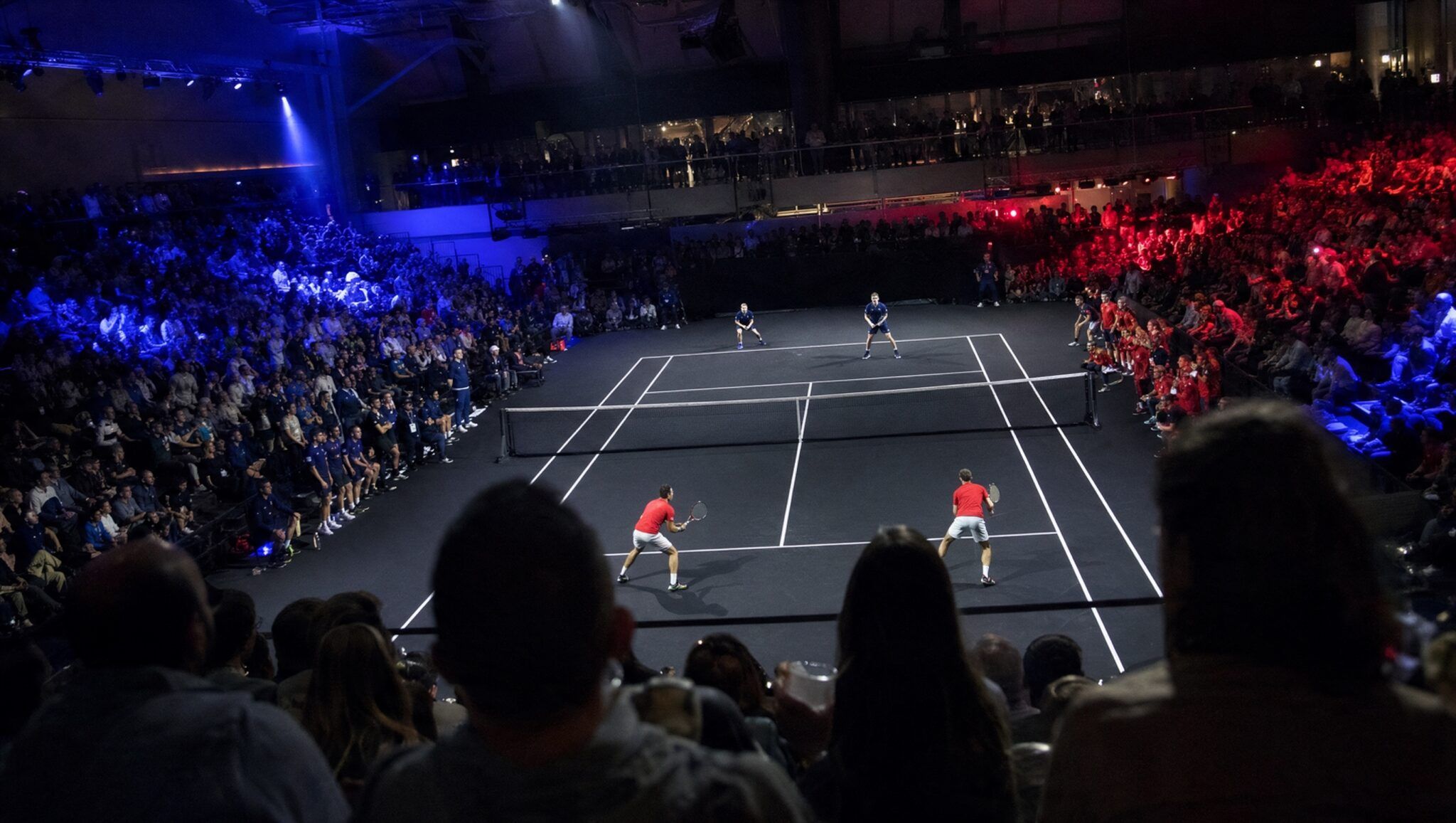
The Laver Cup returns to The O2 in London September 25–27, and the smartest thing a racquets director can steal from it isn’t the star power — it’s the scoring system. The format solves the exact problem that kills most club tennis league programming by late October: matches that stop mattering. Day one is worth one point per match, day two is worth two, day three is worth three, first team to 13 wins. No team is mathematically eliminated until the final session, so the last day is always the biggest day. Compare that to your fall league, where half the draw has checked out by week six because the standings are already decided.
Run your fall league finale on Laver Cup rules — capped field, team draft, escalating points, one loud Saturday — and you convert a fading season into a closing event people fight to get into. Then, critically, don’t just fill it. Waitlist it. The waitlist, not the event, is the asset you carry into winter programming and next spring’s registration.
Why a Team Format Beats a Ladder in Club Tennis League Programming
Club racquet programming has quietly shifted from pure competition toward social competition. The NGCOA’s Golf Industry Key Trends 2025 report found 56% of facility operators rated “encouraging fun vs. competition” as very important to their 2024 promotion strategy — ahead of merchandising, F&B emphasis, and traditional advertising. The players you most need to retain aren’t your 4.5 singles grinders. They’re the 3.0–3.5 social core who renew, bring guests, and book dinner after — if the format gives them a reason to show up.
Laver Cup rules are built for that player: a team draft means your weakest player’s match carries the same points as your strongest player’s, so nobody is filler. Escalating points keep a team down 4–1 at lunch fully alive, so nobody slips out early. Doubles is mandatory every session — the same place cross-generational pairings happen naturally, like a padel-curious 32-year-old drawn alongside a 25-year member. And bench coaching, the Laver Cup’s most photographed moment, is legal and encouraged, turning spectators into participants and content into itself.
This isn’t theoretical. At Royal Oaks Country Club in Dallas, Director of Racquets Jarrett Chirico restructured league programming to push cross-sport participation — funneling tennis leaguers into pickleball and paddle. “Participation has doubled and tripled across the board,” he says. Arrowhead Country Club in Glendale, AZ made a similar bet on structure over ladder, hiring a dedicated Director of Racquet Sports and building interclub leagues, cardio tennis, and a members’ doubles championship. It has built out that structured programming as courts stay in constant use — the same instinct behind trading your ladder finale for a Laver Cup Saturday.
The Rules, Adapted for a Club Saturday
You don’t need three days. Compress the Laver Cup arc into one:
- Field: 24–32 players, hard cap. Two teams named with internal juice (East Course vs. West Course, Founders vs. New Guard). Captains are your two most socially gravitational members, not your two best players.
- Session 1 (morning): Four doubles matches, short sets, one point each.
- Session 2 (midday): Mixed doubles and singles, two points each, lunch service running through it.
- Session 3 (afternoon): Marquee matches, three points each, everyone courtside. Ties clinch late; decided matches still play for margin and bragging rights.
- The close: Trophy, team photo, cocktail hour, and the announcement of winter league registration — opening that night, capped, for people in the room first.
Schedule the finale within a week or two of the actual Laver Cup broadcast. The event does your positioning for you — members have just watched the format work on television, so “we’re running Laver Cup rules” requires zero explanation.
Build the Demand, Don’t Wait for It
The clubs winning at club tennis league programming right now share one trait: they stopped waiting for members to ask and started building first. The Clubs at Houston Oaks in Hockley, TX opened a six-court plexipave facility with stadium LED lighting in 2017 and layered programming across every skill level, including expanded adult and junior programming — beginner series, social tennis, tournaments, and seasonal camps. A capped, waitlisted Saturday is that same philosophy applied to one event instead of a whole facility.
The other lever is lowering the barrier for whoever fills that waitlist. Family- and children-focused programming layered onto league play — outings, casual social events, activities that bring spouses and kids into the fold — consistently outperforms purely competitive formats at clubs that have tried it. Your finale doesn’t need a kids’ bracket to apply the lesson: mandatory mixed doubles, a captain’s pick that pairs generations, and a cocktail hour that includes spouses and kids do the same job — turning a competitive event into a family one, which is exactly the audience that renews.
The Waitlist Is the Product
A full event is a success, but a waitlisted event is a marketing asset that compounds. GGA Partners’ Club Leaders’ Perspectives Report (August 2024) found the post-COVID surge has cooled: 40% of clubs reported membership increases, a 23% year-over-year decline in clubs reporting growth, and the share reporting waitlist growth fell to 34%, down from 55% the prior year. The softening is uneven — clubs under $5 million in revenue felt it more, while clubs in the $10–25 million range were more likely to hold strong.
Demand signals are no longer automatic. Clubs still commanding waitlists — and still raising fees, with initiation fees up 8.7%, operating dues up 6.2%, and capital dues up 12.5% — are manufacturing visible scarcity through programming, not waiting for it at the membership level. A capped, waitlisted event does three things a merely full one can’t: it creates a named, self-selected demand list for winter clinics and spring league; it reframes the next registration (“last event waitlisted at 14 deep” beats “sign-ups now open”); and it disciplines your capacity story, as long as the waitlist exists as structured data rather than a list at the tennis desk.
That means your registration flow has to be online, full stop. Salesforce’s State of the Connected Customer research, drawn from 11,000 consumers, found 74% expect to do anything online that they can do in person or by phone. A waitlist that requires calling the pro shop isn’t scarcity — it’s friction, and it deletes the demand signal you worked all fall to build.
Marketing the Cap, Not the Calendar
The promotion should never lead with the date. It leads with the cap: 32 spots, team draft, Laver Cup rules, waitlist after that. Send it to your engaged players first, not the full membership list — a fast, visible fill beats a broadcast that dilutes the scarcity before it forms. Then let the room sell it: photos of bench coaching, the trophy presentation, and the waitlist itself become opening content for winter registration.
Growth Market Reports flags racquet sports as a primary growth vector for attracting Millennials and Gen Z while keeping Gen X and Boomers engaged, and the spending backs the demand — the Global Wellness Institute’s US Wellness Economy report puts American spending on sports and active recreation at $76.31 billion in 2023, up 11.1% year over year. The appetite for structured, social club tennis league programming isn’t your constraint. Your format is — and the Laver Cup just handed you one, three weeks before your league would otherwise fade out on its own.
You have a three-week window to close the season on your terms instead of its own. Pull the cap, draft the teams, and put the registration link in front of your engaged core before the broadcast wraps — the format sells itself, but only if you build the scarcity around it first. Talk to your racquets team this week about locking the date.
Free Download
The 2026 Private Club Benchmark Report
The membership, amenity, and pricing data reshaping private clubs — from a 1,200-club analysis. Enter your details and we'll send it to your inbox.