
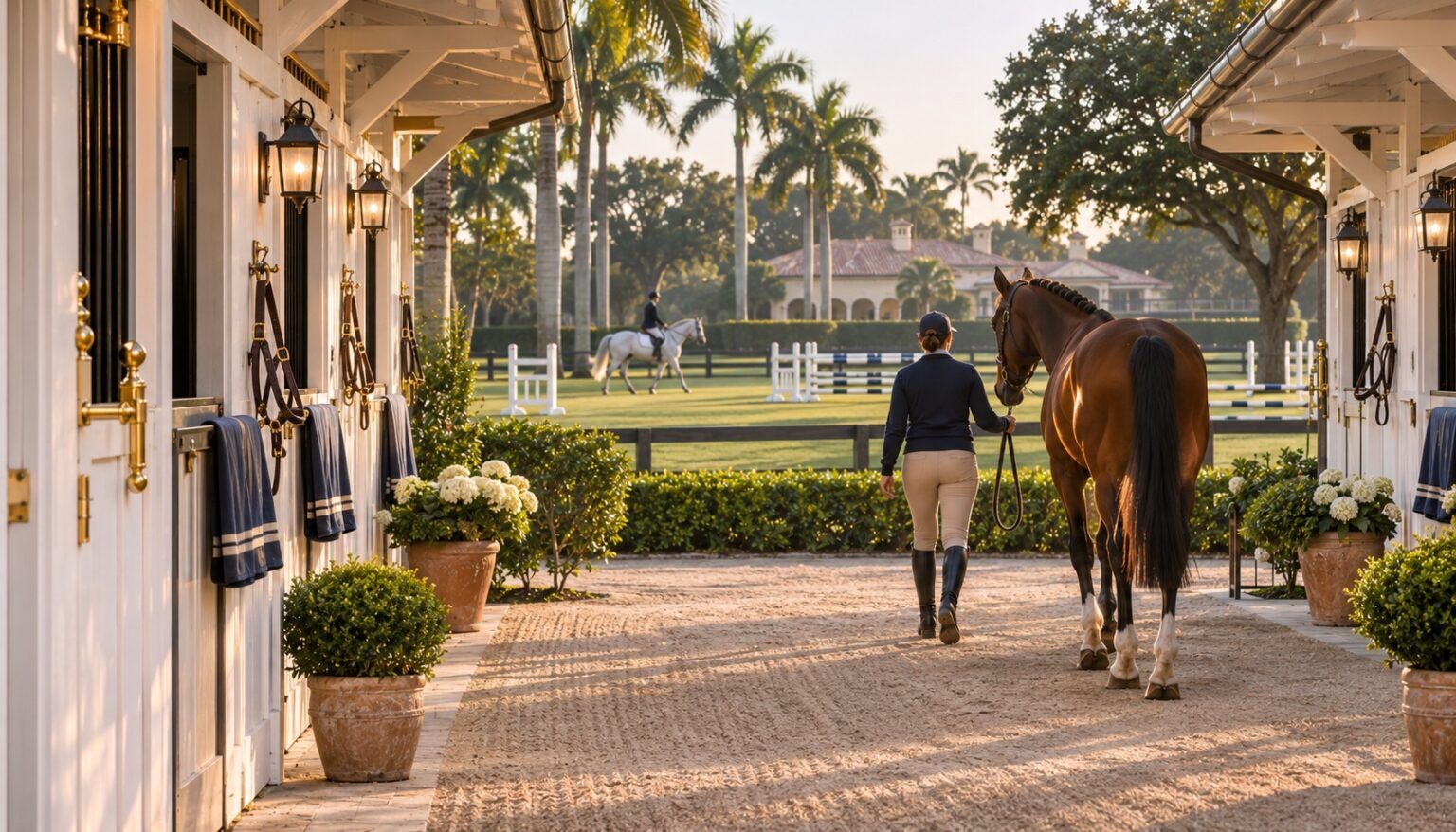
Every January, horses and their people travel to one patch of South Florida for a long winter season at Wellington International. The venue has already published the full 2027 schedule, so any club planning a winter offer is working against a fixed calendar.
The 2027 Winter Equestrian Festival opens in less than seven weeks, which makes this the moment to look at what a season-long event does to the club economy around it. Wellington is a showground first and a club town second, so the useful question is not what a Wellington membership costs. It is how a calendar like this one shapes who joins what, and when.
The 2027 Calendar, Dated
Wellington International lists the season as a run of weekly events, each starting on a Wednesday. Premiere Week runs January 6 to 10, 2027, and the Week 12 Rolex finale closes March 31 to April 4. In between sit Weeks 1 through 11, the first starting January 13 and the last March 24, per the venue’s schedule listing. That is thirteen events across thirteen weeks, with a new event starting every Wednesday.
Dressage moves too. Dressage News reported in October 2025 that Wellington International intends to host the Global Dressage Festival in 2027, in new competition rings and a covered arena. The grounds hold more than 7,000 horses and 6,000 riders from more than 50 countries, per Dressage News, a figure it does not date. The venue’s own impact page, discussed below, cites athletes from more than 34 countries, so treat country counts as approximate. Confirm current details with the venue before booking anything.
What a Season Like This Is Worth
The venue’s economic impact page summarizes a study of the 2023 festival. The full report, Economic Impact of the 2023 Winter Equestrian Festival, was prepared for the Palm Beach County Sports Commission by William B. Stronge and Rupert Rhodd and is dated June 2023. Nonresident participants added $351.7 million to Palm Beach County’s GDP and supported 3,364 jobs, per Palm Beach County Sports Commission. Horse-related spending made up $262.5 million of that, or 74.6 percent, per Palm Beach County Sports Commission. The study counts stabling, feed and bedding, training, farrier and medication costs, equipment, and local paid horse transportation as horse-related. Those costs accrue across a season, which means participants who bring horses for the winter are spending in the county for weeks, not days.
That study covers a season that ended more than three years ago, and larger totals have since been published. The 2024 festival added $403.6 million, per Wellington International’s September 20, 2024 release. The 2025 festival added $536.2 million, per Wellington International’s August 26, 2025 release. The 2026 festival added $607.3 million, per a PR Newswire release published by Wellington International on October 12, 2026. That release says the study was prepared for the Palm Beach County Sports Commission. Horse-related spending was $379.3 million of the 2026 total, per Wellington International. Another figure for 2025 is $538.2 million, per Business Development Board, so treat the later totals as approximate. We read the venue’s summaries of the 2024 through 2026 studies, not the underlying reports. The impact page also describes the festival as drawing athletes from more than 34 countries and all 50 states, which explains why the winter population is so hard to sort into neat member categories.
Where the Private Clubs Sit
Around the showground, the club story is about polo as much as jumping. The United States Polo Association, formed in 1890, runs its office just outside Wellington, a location it describes as the current epicenter of the sport. privateIQ is a directory with its own commercial interest. It describes the Wanderers Club as a private golf and polo club established in 1984 (the same page elsewhere lists 1985), and Palm Beach Polo and Country Club as a 36-hole private golf community originally established in 1979 (its details section lists 1989). privateIQ lists membership at both clubs as invite only, and both pages hide fee estimates behind a sign-up. We found no club-published fees for either. In the 2023 study, horse-related spending made up 74.6 percent of the measured impact, per Palm Beach County Sports Commission, while the clubs’ own fee schedules stay private.
The season also pulls in clubs that are not in Wellington at all. Aiken, South Carolina has had a polo club since 1882, according to a USPA profile from 2016, and that profile describes the club as a convenient middle point for players and teams traveling to Florida. Our companion piece on what an equestrian club costs shows how much of what members pay falls outside a club’s published fee schedule.
For a club operator outside Florida, the lesson is in the structure. A season with fixed weekly events produces predictable arrivals, predictable departures and a long list of nonresidents who are temporarily local. Whether they consider your club depends on whether you give them a reason to, and a published, dated offer is a practical place to start.
What This Means for Your Club
Treat the show calendar as your own. A thirteen-week window with fixed dates gives a membership director a clear calendar. Consider building winter offers that start on the Premiere Week Wednesday, January 6, and end with the finale, and publish the dates.
Consider selling the season, not the year. The 2027 schedule runs from early January to April 4, so participants who travel for it are in the area for a defined stretch. Our look at why fall is the recruiting season argues that prospective members decide where to base for the winter during autumn, so the conversation needs to start well before they arrive.
Mind the route. The Aiken profile describes a club that sits between the North and Florida. A club on that route could promote a stop for teams on their way south. For fall programming ideas, see our piece on fall hunt season programming.
Be honest about what you publish. If you charge for stabling, say so with a date. Directories such as privateIQ publish fee estimates behind a sign-up, so a club that publishes its own dated fees gives prospects a firmer figure.
Wellington Equestrian Season FAQ
When does the 2027 Winter Equestrian Festival start?
Wellington International lists Premiere Week as January 6 to 10, 2027, with Week 1 starting January 13 and the finale running March 31 to April 4.
How long is the season?
Thirteen weekly events, from January 6 through April 4, based on the venue’s listings.
Can I join a private club in Wellington for just the winter?
We found no published seasonal membership terms for the clubs named above. privateIQ lists membership at both as invite only, so ask the club directly.
How big is the economic impact?
The 2023 festival added $351.7 million to Palm Beach County’s GDP, per Palm Beach County Sports Commission. The 2026 festival added $607.3 million, per a release published by Wellington International on October 12, 2026.
How We Did This
We read the venue’s event pages for the 2027 dates and its economic impact page for the 2023 figures, and checked those figures against the Palm Beach County Sports Commission report. The venue’s 2024, 2025 and 2026 totals come from its own summaries and a press release, and we did not open the underlying studies. The USPA and Dressage News pages were also read directly. The two Wellington clubs are described only by a commercial directory, whose pages give conflicting founding years for both, and we found no club-published fees, so we did not state any. The Aiken profile dates to 2016, and the Dressage News figures are undated. Season dates can change, so check the venue before you plan.
If your board is planning a winter or shoulder-season push, Private Club Marketing has worked exclusively with private clubs since 2009 and offers country club marketing. Talk with us.
Free Download
The 2026 Private Club Benchmark Report
The membership, amenity, and pricing data reshaping private clubs — from a 1,200-club analysis. Enter your details and we'll send it to your inbox.