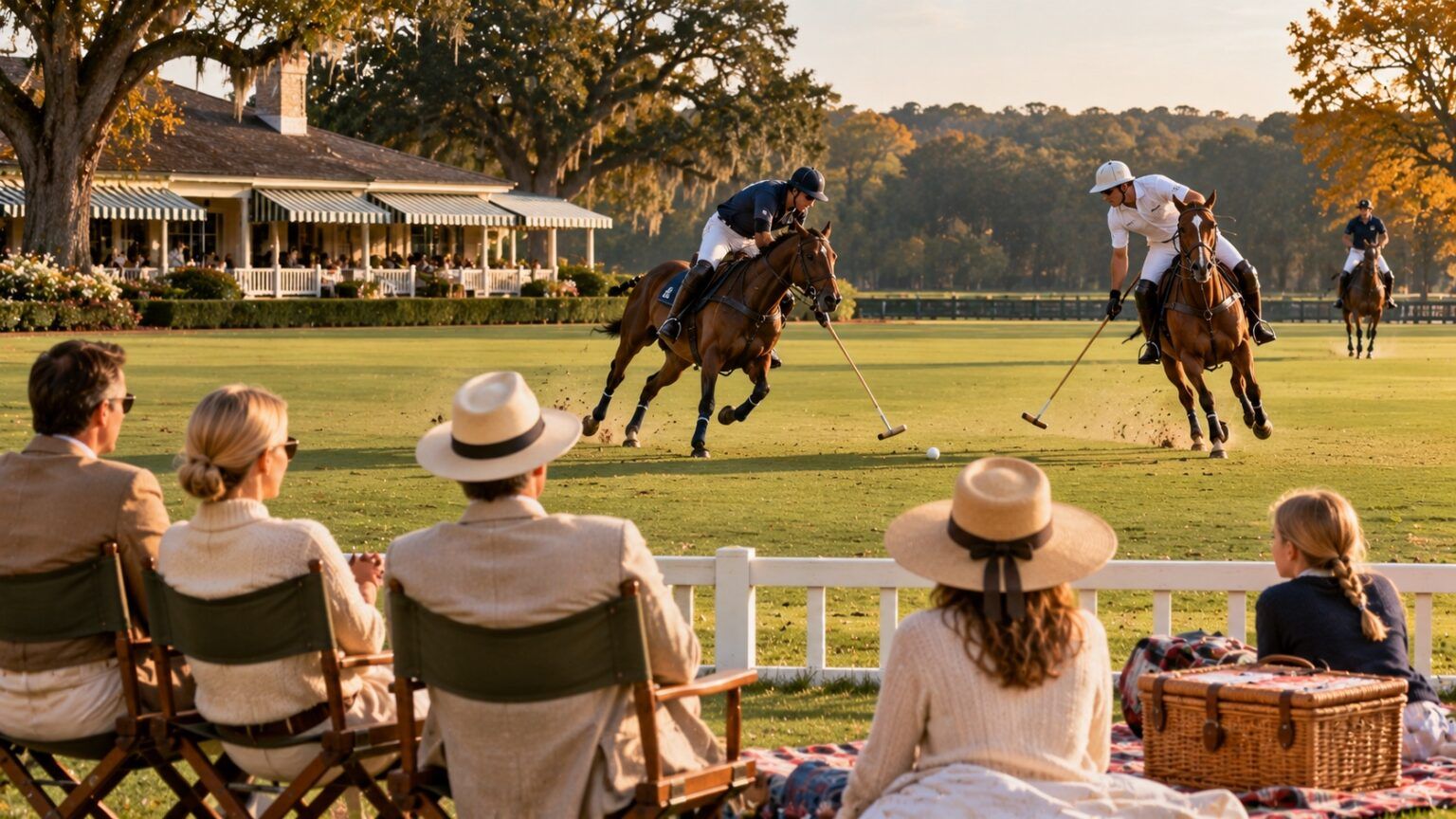
Most private clubs guard the gate. Polo clubs do something stranger: they set out lawn chairs, open the field on Sunday afternoons and let the public watch a half-ton of horse and rider chase a small white ball at full gallop. The sport that looks the most exclusive in America runs one of the most open front doors in the club world, and the clubs that understand why are quietly good at membership marketing.
The result is a category with no single model. Some polo clubs are historic institutions with tennis courts and a social tier, some are barns with a field attached, and some are family-owned grounds that sell a league and a tailgate. What follows is a tour of five, using only what each has put in writing.
A Sport With Its Own Association
Polo reached the United States from England in 1876, and the United States Polo Association was formed in 1890 to coordinate games, standardize rules and set handicaps. It calls itself the largest voluntary sports organization in North America for the sport, and says the first formal U.S. club was Westchester Polo Club. Its history also marks a shift that matters to club operators: polo moved from a society sport to a broader base of horsemen, professional players and sponsors. The clubs below sit on different points of that line.
Five Clubs, Five Models
Aiken Polo Club, South Carolina. A USPA profile dates the club to 1882 and says it joined the association in 1899. Polo there began with the winter colony of northeastern families who came south from November to April. The profile says the Sunday 3 p.m. match draws up to 1,500 spectators to Whitney Field, and that the club runs spring and fall calendars from 4-goal to 12-goal tournaments. The profile is from 2016, so confirm today’s schedule.
Santa Barbara Polo and Racquet Club, California. The club’s history page traces polo to an 1894 exhibition and says the club was admitted to the USPA in 1911. Its membership page calls it the third oldest polo club in the country, a claim the club makes for itself. The page also lists a one-time initiation fee on tennis, swim and fitness memberships but not the amount. The history page gives two dates, 1923 and 1926, for when the current site was bought, so we cite neither.
Houston Polo Club, Texas. A 2022 USPA article says the club was founded in 1928, sits on 26 acres and had more than 140 players that year. It plays spring and fall seasons, with finals open to the public on Sunday afternoons, and its management credits those two seasons with keeping professionals in town.
Denver Polo Club, Colorado. The club’s own site describes a family-owned, family-run operation open to anyone, with tiered leagues six days a week from June through September, lessons and private events. It does not publish a fee.
Greenwich Polo Club, Connecticut. The club’s site says it was established in 1981, hosts Sunday public matches and is preparing its 2027 season, with details to come.
Each club’s own page or its USPA profile gives the starting year; Santa Barbara’s page does not state a founding year, so its USPA admission is used. Denver says only “more than three decades” and is left out.
What Polo Clubs Actually Charge
Almost nothing about price is published, which fits the rest of the private club world. Santa Barbara is the exception worth reading. Its social polo membership lists $1,187.50 for a single, which includes one general admission and one complimentary guest ticket, and $1,312.50 for a family, which includes two of each, per Santa Barbara Polo and Racquet Club. It also lists general admission seating for all 22 Sunday polo weekends, member-only seating areas and a members-only holiday party, per Santa Barbara Polo and Racquet Club. The page is undated apart from a note about accepting new social members from January 2025, per Santa Barbara Polo and Racquet Club, so ask the club for current rates.
The real money for players is the barn. Santa Barbara’s 2026 stabling page lists an annual stall at $2,600, which requires a league membership and payment by January 31, per Santa Barbara Polo and Racquet Club. Monthly stabling for the April-to-August peak season is $600 a horse if paid by January 31 ($650 after that date), and off-peak monthly stabling is $400 a horse, per Santa Barbara Polo and Racquet Club. It also requires monthly boarders to hold a club membership. Stabling is a price, a deadline and a membership requirement in one line, which is a useful design.
Why the Open Door Works
A spectator is a prospect with a lawn chair. Aiken, Houston, Greenwich and Denver all publish public days, and Santa Barbara sells a social tier built around its Sunday polo. Our look at the member-guest pipeline covers the same logic from the golf side, and our piece on equestrian club members at the Keeneland sale shows how a calendar event can become a conversation about joining.
What This Means for Your Club
Give spectators a next step. A public Sunday with no membership prompt is a missed opportunity. Santa Barbara’s social tier is a tidy example.
Put dates on your prices. Stabling with a deadline and a year is clear. An undated membership page is not.
Run two seasons. Houston ties its spring and fall calendars to keeping professionals local, which is a staffing argument as much as a marketing one.
Use your own site as the source. Most of the clubs here describe themselves in public. Compare that with how little we found on equestrian club costs, and see our overview of equestrian programs.
Polo Club FAQ
How many polo clubs are in America?
We did not find a current count we could open. The USPA says it was formed in 1890 and coordinates play across the country, but the page we read gives no club total.
Can anyone watch a polo match at a private polo club?
Several clubs publish public Sunday matches, including Aiken, Houston and Greenwich. Denver describes itself as open to anyone.
What does polo club membership cost?
Few clubs publish it. Santa Barbara lists $1,187.50 for a single social polo membership, per Santa Barbara Polo and Racquet Club. Its 2026 stabling lists $400 a month per horse off-peak and $600 a month per horse in peak season for those who pay by January 31, per Santa Barbara Polo and Racquet Club.
Which is the oldest polo club in America?
The clubs here disagree on how to count. Aiken says 1882, and Santa Barbara calls itself the third oldest. We did not settle the ranking.
How We Did This
We read each club’s own page or its USPA profile directly. The Aiken and Houston profiles are association articles from 2016 and 2022, not club statements, and the history claims are the clubs’ own. Fee figures come from Santa Barbara alone, and its social membership page is undated while its stabling page is titled 2026. We did not include Palm Beach or Wellington clubs because we could not open a club-published source for them. No club here was contacted.
If your board is deciding how to turn spectators into members, Private Club Marketing has worked only with private clubs since 2009 and brings that experience to country club marketing. Talk with us.
Free Download
The 2026 Private Club Benchmark Report
The membership, amenity, and pricing data reshaping private clubs — from a 1,200-club analysis. Enter your details and we'll send it to your inbox.