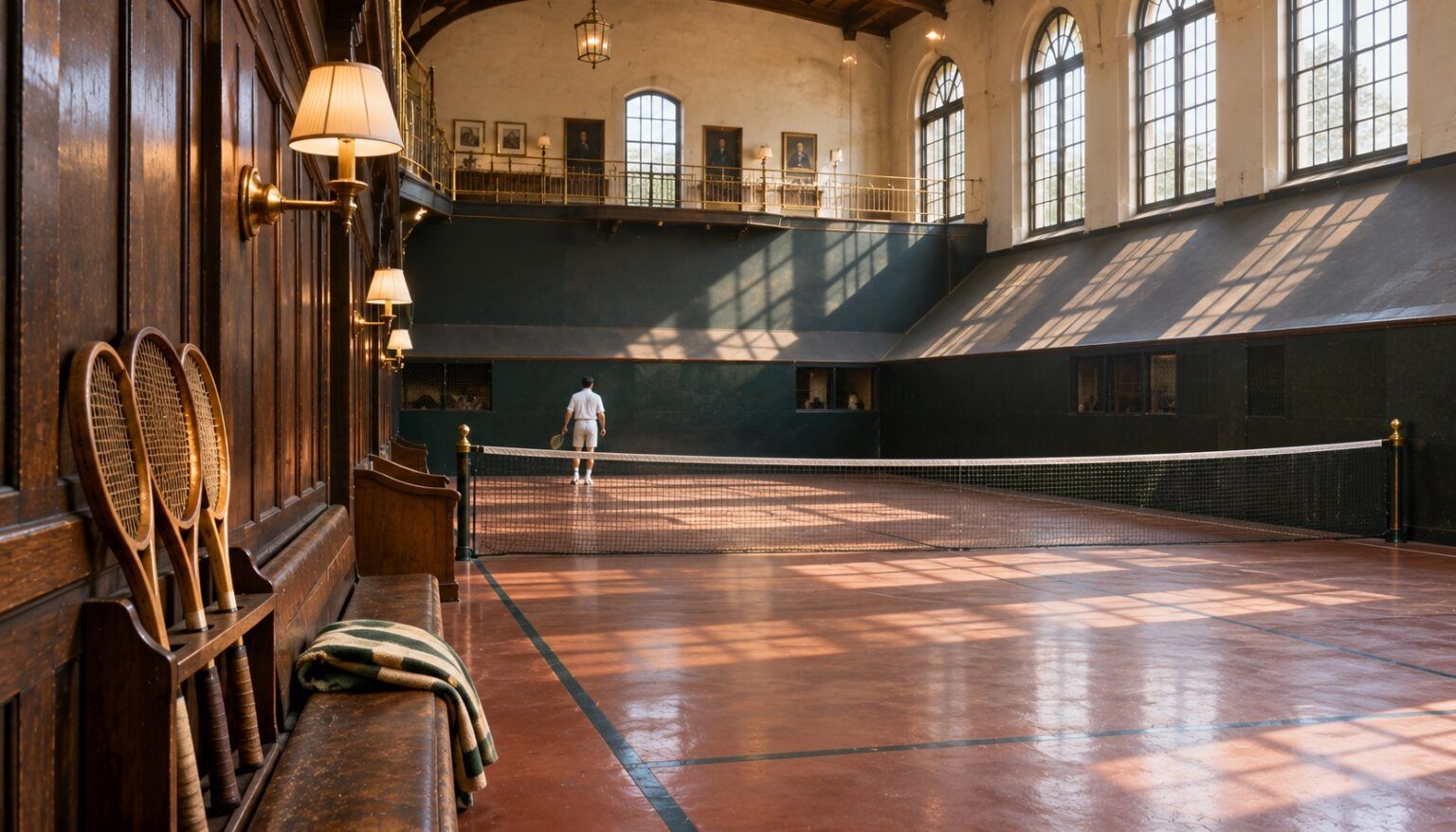
Ask a member of a city racquet club what the sport is, and the answer is usually a room. A tiled court with a sloped roof that players use as a wall, a squash court tucked beside a library, a lounge that still smells faintly of wood polish. These clubs sell a building as much as a game, and the game itself, court tennis, racquets or squash, is so specialized that only a handful of cities can host it.
That specialization is why the cost question is hard to answer. We found no published fee schedule for the clubs profiled here in New York, Chicago and Los Angeles, so what follows is a careful accounting of what is public: the courts, the guest rules, and the few dollar figures that exist. Where a figure does not exist, we say so.
Real tennis, the game court tennis is known as abroad, is played on an indoor court with four irregularly sized walls, per Britannica. A sloping roof, the penthouse, extends around three sides of the court, per the United States Court Tennis Association. Its list of courts names only nine playable courts in the country, per the United States Court Tennis Association.
New York: Two Court Tennis Courts on Park Avenue
The Racquet and Tennis Club at 370 Park Avenue has the earliest origins of the three clubs profiled here. The New York City Landmarks Preservation Commission says in its designation report that the club was first organized in 1875 as the Racquet Court Club and was incorporated on February 21, 1890 as the Racquet and Tennis Club. The same report says the current building, by McKim, Mead & White, was built in 1916-18 as the club’s third home. A club history on Racquet & Tennis 42 also gives 1875, and lists two court tennis courts, one racquets court, four international squash courts and one hardball squash doubles court. The Los Angeles Athletic Club dates itself to 1880, and a program published by the United States Court Tennis Association dates the founding of the Racquet Club of Chicago to 1922.
DNAinfo reported in 2012 that the club was “arguably the most famous New York City club that is still male-only,” and that it did not respond to questions. The same article cites a 2010 Village Voice report saying women may attend special events only if accompanied by a male member. We found no later reporting of a change. The club’s own website shows its address, phone number and a member login, and its guest information page covers dress code, electronic devices and parking. We could not find a club-published membership page, a fee, or a member count, so none is given here.
Chicago: A Court Restored After 76 Years
The Racquet Club of Chicago opened its clubhouse on Dearborn Parkway in 1924. According to the club’s 2011 announcement to United States Court Tennis Association members, the original court opened in 1924 with the clubhouse, and the club later turned it into a lawn tennis facility. The United States Court Tennis Association’s list of courts shows the Chicago court as playable from 1924 to 1936 and again from 2012. A USCTA report says restoration work began on February 20, 2012, which would end more than three quarters of a century without court tennis in the building. A job listing posted by the Tennis & Rackets Association describes the club as having two rackets courts, two doubles squash courts, one international squash court and a refurbished court tennis facility. In 2024 the club hosted the World Doubles Championship from April 24 to 28, and a USCTA program for the event calls it the club’s first Court Tennis World Championship. The United States Court Tennis Association lists Chicago’s as one of nine playable courts in the country.
The club’s own website shows an address, a phone number and a member sign-in, and we found no membership information, fee or court list there, so there is no published fee. The nonprofit’s public tax data, read through ProPublica, adds a useful picture. The club reported $2,033,264 in initiation fees and contributions for the fiscal year ending February 2011, per ProPublica. By fiscal 2023 that line was $151,300, per ProPublica. For fiscal 2025 it was $200,000, per ProPublica. Total revenue was $5.99 million for fiscal 2011 and $6.79 million for fiscal 2025, per ProPublica. The line combines fees with contributions, so it is a trend and not a price. Using $2,033,264 of $5.99 million in fiscal 2011 and $200,000 of $6.79 million in fiscal 2025, per ProPublica, the line fell from about 34 percent of total revenue to about 3 percent. The public data do not show what replaced it, so we draw no conclusion about the club’s other income.
Source: ProPublica Nonprofit Explorer. Bars are scaled to the largest value shown. The line combines initiation fees and contributions, so it is not a fee schedule.
Los Angeles: Squash Inside a Downtown Athletic Club
The Court Tennis Association’s list of nine playable courts includes none in Los Angeles or anywhere in California, so the Los Angeles entry here is a different kind of club. The history page, published by the Los Angeles Athletic Club, gives 1880 as the founding year, with 40 founders, a $5 initiation fee and $1 monthly dues. The page also says the club has the “best squash program in Southern California” and that it hosted the 1998 U.S. Squash National Championships, and it describes a 12-story building with three floors of hotel rooms.
Today’s fee is not published on the club’s membership request page. The club has “a monthly rate in the mid $200s, after a standard initiation fee,” without naming the fee, reported by InsideHook in a September 2024 review. Members can bring up to six guests to social and co-working spaces at no charge, and guests pay $25 each for athletic and wellness spaces, with limitations, per the Los Angeles Athletic Club’s FAQ. That is a clearer guest rule than we found for the New York or Chicago clubs.
What a Published Racquet Fee Looks Like
For a sense of scale, one racquet club prints its numbers. The Newton Squash & Tennis Club in Newton, Massachusetts charges a $2,500 initiation fee (no year given, and marked subject to change by its board), $2,297 in annual dues for regular membership as of 2026, and a $50 non-refundable deposit, per the Newton Squash & Tennis Club’s membership application. The form also says a fee is required to join the waitlist, but does not state the amount. That is a club in Newton, not a Park Avenue one, and it is a reminder of how wide the range can run. For the three city clubs above, the only statement we can support is that we found no published fees. For the broader range at golf and country clubs, see what a country club membership really costs.
These clubs also differ from the historic clubs we covered in the courts that made American tennis. For how court supply and pricing work at racquet clubs, see our look at racquet club court time.
What This Means for Your Club
Publish the guest rule even if you hide the fee. A guest policy with a number on it, like a per-guest rate, answers a practical question prospects are likely to ask.
Show the courts. For the New York and Chicago clubs, court counts were the main facts we could document, and we took them from outside sources rather than club sites. Lead with yours.
Know your fee trend. If initiation income has shrunk in your own books, plan around dues and dining instead of waiting for the old numbers to return.
Date every figure. A price without a year invites a wrong guess. Our city club cost guide shows a similar problem in Washington, where the only fee we found for the Metropolitan Club was a historical figure.
Racquet Club Membership FAQ
How much does a racquet club membership cost?
We found no published fees for the New York, Chicago and Los Angeles clubs. The Newton Squash & Tennis Club in Newton, Massachusetts lists $2,500 to join (no year given) and $2,297 a year for regular membership as of 2026, per the Newton Squash & Tennis Club’s membership application. That is a reference point and not a comparison.
What is the difference between racquets, court tennis and squash?
Britannica says real tennis, the same game as court tennis, has been played since the Middle Ages. It also says squash is a descendant of rackets, which probably began around the middle of the 19th century at Harrow School in England. Of the clubs profiled here, only the New York and Chicago clubs have court tennis, racquets and squash courts.
Do you need a sponsor to join?
We could not confirm sponsor rules from any club page we read. The Los Angeles Athletic Club’s FAQ says you request a membership and the membership team follows up.
Can guests play?
The Los Angeles Athletic Club allows guests in athletic spaces for $25 each, with limitations, per the Los Angeles Athletic Club’s FAQ. The New York club’s guest page covers dress code, electronic devices and parking but gives no guest fee or limit, and we found no guest policy on the Chicago club’s website.
How We Did This
We opened each linked page ourselves. The club sites for New York and Chicago gave almost no membership detail, so the court counts and dates there come from the United States Court Tennis Association, Racquet & Tennis 42, the New York City Landmarks Preservation Commission and the Tennis & Rackets Association, which we named in the text. Where a club has more than one founding or opening date, we gave each and named the source. Facts we could not confirm from an open page, including the Chicago clubhouse’s original design capacity, were left out. The Chicago chart uses the nonprofit’s reported figures as published, the revenue-share percentages are our own arithmetic from those figures, and we did not estimate any fee that a club has not made public.
If your board is deciding how to present a rare facility to prospects, Private Club Marketing has worked only with private clubs since 2009 and brings that focus to country club marketing. Talk with us.
Free Download
The 2026 Private Club Benchmark Report
The membership, amenity, and pricing data reshaping private clubs — from a 1,200-club analysis. Enter your details and we'll send it to your inbox.