
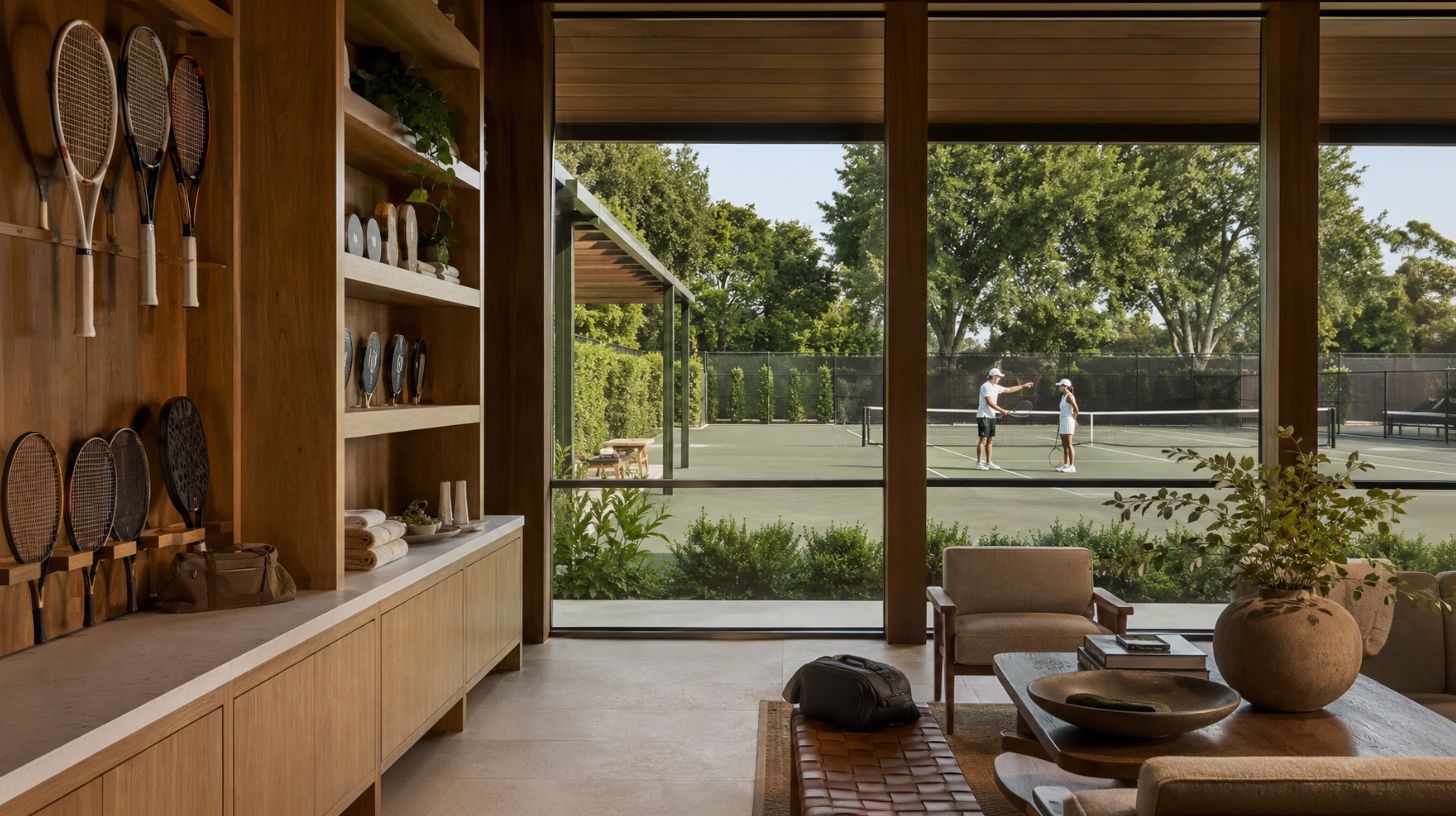
A tennis court is one of the most misunderstood assets a private club owns. On the balance sheet it looks like a cost center — land, surfacing, lighting, maintenance, and a teaching pro whose salary shows up as an expense. In practice, a well-programmed court is one of the highest-yielding square footages on the property, and the gap between those two realities is where most racquet-club economics are won or lost.
The macro tailwind is not in question. Tennis reached a record 27.3 million U.S. players in 2025, up 54 percent since 2019, according to the United States Tennis Association’s “Tennis Participation Continues to Surge” report. Pickleball hit 24.3 million players, up 22.8 percent in a single year, per the Sports & Fitness Industry Association’s Topline Participation Report. Court supply has not kept pace. Pickleheads counts more than 70,000 pickleball courts nationally, according to the SFIA/Pickleheads 2024 State of Pickleball: Participation & Infrastructure Report. The same report estimates roughly $855 million in additional court construction is needed over the next five to seven years to meet demand, according to Pickleheads. For a club, scarce supply against surging demand is the most favorable pricing environment an amenity can have. The task is to convert it into a model that performs.
The unit of analysis is court-hours, not courts
The single most useful reframe for a GM or board is to stop counting courts and start counting court-hours. A court is a fixed asset with a nearly fixed annual cost. Its return is determined almost entirely by how many productive hours it produces and how much revenue attaches to each of those hours.
That means two clubs with identical facilities can have completely different economics. A club whose courts sit at 25 percent utilization outside of weekend mornings is running the same fixed cost as a club at 60 percent utilization — but earning a fraction of the yield. Court-time economics is, first and foremost, a utilization problem.
The levers on utilization are well understood but unevenly applied:
- Time-of-day distribution. Prime-time demand takes care of itself; the money is made in the off-peak hours. Daytime clinics, senior leagues, junior after-school programs, and corporate or social bookings are what convert dead court-hours into revenue.
- Format density. A single tennis-court footprint can host four pickleball courts, multiplying the number of paying players occupying the same land in the same hour. Format flexibility is a utilization multiplier before it is anything else.
- Weather resilience. Covered, indoor, or platform-tennis capacity extends the productive calendar into shoulder seasons and bad weather, directly raising annual court-hours.
- Reservation discipline. No-shows and hoarded prime-time blocks are pure leakage. A booking system that recycles unused reservations recovers court-hours that would otherwise vanish.
The clubs that treat utilization as a managed number — with targets, reporting, and accountability — consistently outperform clubs that treat court availability as a passive service.
Where the revenue actually attaches
Dues pay for access. They do not, on their own, make a racquet program economically healthy. The programs that perform generate several distinct revenue layers on top of dues, each attached to court-hours.
Instruction. Private lessons, semi-private lessons, and clinics are the highest-margin activity on a court and the primary reason a teaching professional is an investment rather than a cost. A pro who is booked is a profit center; a pro who is idle is the most expensive form of the utilization problem. Instruction also compounds: players who take lessons play more, join leagues, and stay members longer.
Programming and leagues. Organized play — leagues, ladders, round-robins, member-guest events, and socials — is what converts a court from a place members occasionally use into a calendar they organize their week around. Programming revenue is meaningful on its own, but its larger value is that it drives the frequency every other revenue line depends on.
Pro shop and equipment. Racquet sports are gear-intensive, and the category churns equipment faster than most. The explosive growth of pickleball and padel has created a demand curve for paddles, stringing, footwear, and apparel that a well-merchandised shop captures and a neglected one surrenders to online retailers.
Food, beverage, and social spend. Racquet play is inherently social — padel and pickleball are doubles-first formats — and play flows naturally into the bar, the patio, and the dining room. Court-time economics does not end at the fence line; a busy court calendar is a reliable demand generator for F&B, and the two should be measured together.
The strategic point is that these layers are multiplicative, not additive. A member who takes a weekly lesson, plays in two leagues, buys paddles at the shop, and closes the evening on the patio is worth many times a member who holds the same dues card and plays twice a month. The entire model rewards frequency, and frequency is manufactured through programming.
This is why the most common budgeting error in racquet economics is to evaluate a court against its dues allocation alone. Dues are the least elastic line in the model — capped by the membership cap and the fee schedule. Instruction, programming, retail, and F&B are the elastic lines, and they scale with engagement rather than headcount. A club that has maxed its roster has not maxed its courts; the ceiling on court-time economics is set by how intensively the existing membership plays, not by how many members it holds.
Source: USTA “Tennis Participation Continues to Surge” report; SFIA Topline Participation Report; USPA 2026 announcement (padelusa.org); IHRSA-attributed retention research cited in Private Club Marketing’s “10 Private Club Trends Defining 2026”
Retention is the highest-value line item
The most valuable economic effect of a strong racquet program never appears as racquet revenue at all. It appears as members who do not resign.
Racquet sports are unusually sticky for a specific structural reason: members do not stay confined to one sport. According to the “Who’s on the Court?” RacqueTrends report, a survey conducted by RacquetX and reported by marketing agency LaneTerralever via The Padel Paper, close to 43 percent of racquet-sports participants have played more than one racquet sport in the past year or intend to diversify their play — tennis and pickleball, pickleball and padel, platform tennis in winter. Each additional sport is another reason to renew and another set of relationships anchoring the member to the club. According to a retention figure attributed to the International Health, Racquet & Sportsclub Association (IHRSA) and cited in Private Club Marketing’s 1,200-club data study, 63 percent of members are more likely to stay when wellness amenities are part of their membership, and racquet programming sits squarely inside that wellness frame.
Retention economics dwarf acquisition economics. Replacing a resigned member costs marketing spend, initiation discounting, and the lost dues of an empty roster spot; keeping one costs a well-run league night. A racquet program that lifts retention by even a few points across a membership base returns more to the bottom line than most new-revenue initiatives, and it does so with far less risk. When a board evaluates a court investment, retention should be modeled as the primary return, not a soft benefit.
The demographic dividend inside the model
Court-time economics also determines who is on the roster over time, and that has its own long-run financial consequence. The average pickleball player is now 34.8 years old and getting younger, according to the Association of Pickleball Professionals’ player demographics research, as republished by Pickleheads. Padel skews younger and more affluent still. U.S. padel players grew more than 250 percent since 2022, according to the United States Padel Association’s 2026 announcement. Club membership in the sport was up 51.5 percent year over year in 2025, according to the same USPA report, citing SFIA’s Topline Participation Report. For a membership base worried about generational replacement, racquet sports are the most cost-effective acquisition channel available for exactly the demographic clubs most need.
This is the throughline connecting racquet economics to the broader modernization every private club is navigating — the same shift toward flexible, experience-led, generationally-aware membership documented in Private Club Marketing’s 1,200-club data study, “10 Private Club Trends Defining 2026”.
Reading the model correctly
A GM building or defending a racquet-program budget should hold a few principles firmly.
First, model the full contribution, not the direct fee line. A court’s economic case includes instruction, programming, pro shop, F&B, retention, and demographic acquisition. Judging it on lesson revenue alone systematically undervalues the asset and produces underinvestment.
Second, utilization is the master variable. Before spending on new courts, most clubs can lift returns substantially by raising utilization of the courts they already have — off-peak programming, better reservation discipline, and format flexibility usually cost far less than construction and return faster.
Third, staff the teaching program as an investment. The single most common failure in racquet economics is building courts and under-resourcing instruction. Idle courts and an under-booked pro are the same problem wearing two costumes.
Fourth, measure racquet and F&B together. The social nature of the sports means the court calendar is a demand engine for the clubhouse. Siloed reporting hides the connection and undersells the program.
The Private Club Partnership Opportunity
Court-time economics is ultimately a demand-generation problem: the model only performs when courts are full, lessons are booked, leagues are subscribed, and the right members are joining and staying. That is membership marketing work, and it is where Private Club Marketing operates.
We help clubs turn racquet assets into performing economics — utilization strategies that fill off-peak court-hours, programming and league frameworks that manufacture the frequency every revenue line depends on, and membership positioning that recruits the younger, more affluent racquet demographic clubs are competing for. We build the lead-generation and communication systems that convert record national demand into tours, joins, and renewals, and we bring the retention discipline — the same instinct behind lifestyle-led offerings like seasonal membership programming — that protects the recurring revenue a club already has. Our cross-club work with high-net-worth membership bases means we understand both sides of the ledger: the acquisition that fills the roster and the experience design that keeps it full.
The demand is historic and the court supply is short. That combination hands racquet clubs a rare pricing advantage. The clubs that capture it are the ones that stop treating a court as a cost to be maintained and start treating it as an asset to be programmed, marketed, and measured — court-hour by court-hour.
Free Download
The 2026 Private Club Benchmark Report
The membership, amenity, and pricing data reshaping private clubs — from a 1,200-club analysis. Enter your details and we'll send it to your inbox.