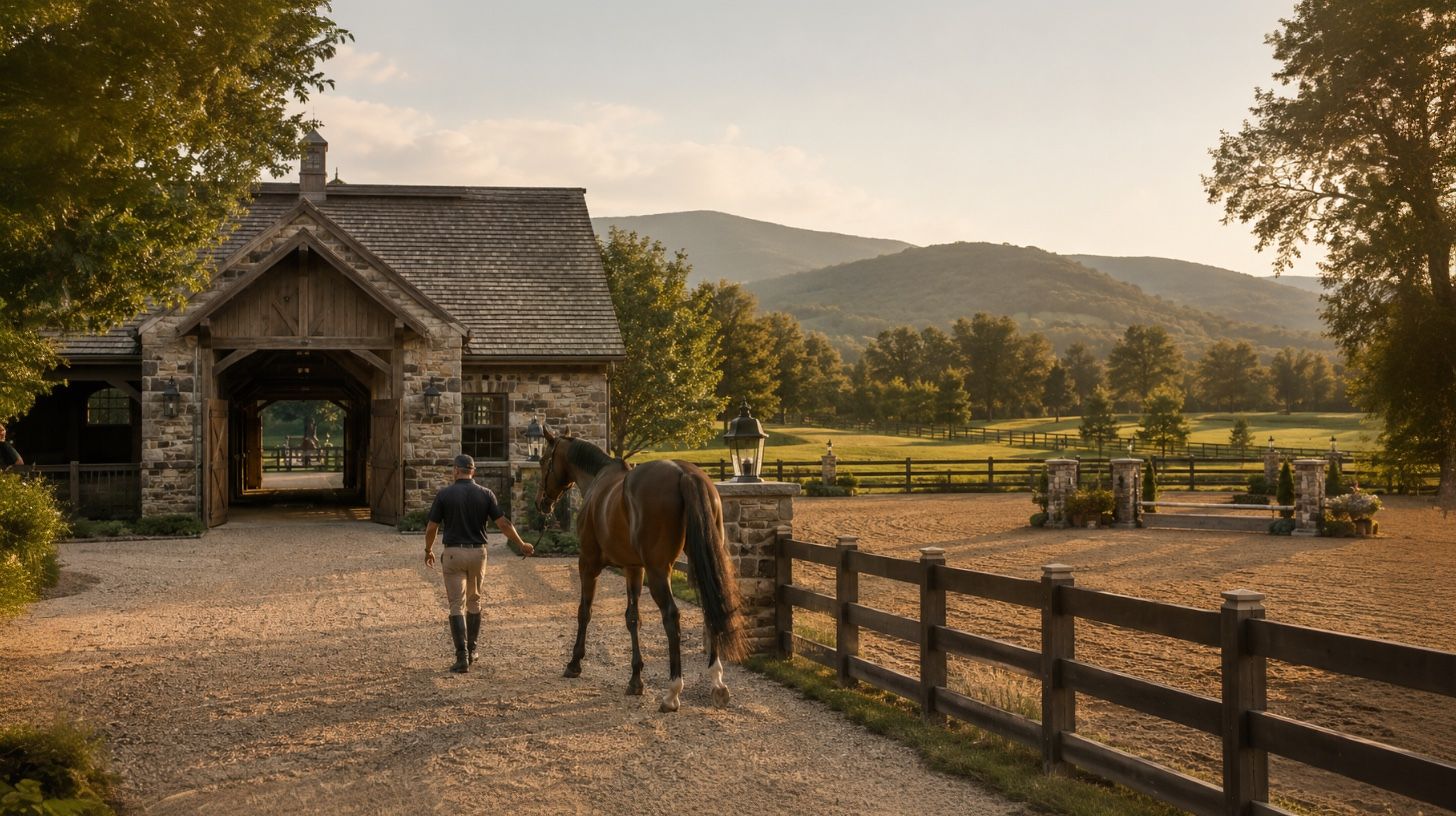
Ask a country club GM how a member pays the club, and the answer is short: dues, an initiation fee, and whatever the member spends in the dining room and pro shop. Ask the same question of an equestrian club, and the answer runs to a page. A single boarded horse pays board every month it is on the property, pays a trainer to work it, pays for the owner’s weekly lessons, pays entry into clinics, pays a day rate and a hauling fee every time it leaves for a show, and pays for feed, bedding, supplements, and blanketing along the way. One member, one animal, six or more revenue lines — recurring, stacked, and largely independent of the dues that most clubs treat as their entire business.
This is the part of the equestrian model the rest of the private-club world should study most closely, and it has nothing to do with the season. In our companion piece on the fall equestrian calendar, we looked at how season and scarcity drive equestrian membership. Here the lens is the balance sheet: the equestrian club is the most diversified operating business in the private-club sector, and that diversification is exactly what makes its members the hardest in the industry to lose.
Dues are the floor, not the business
Start with the structural difference. A golf or city club is, financially, a single-amenity business with a monthly subscription attached. Dues plus a food-and-beverage minimum carry the model, and the club’s fortunes rise and fall with a single number: how many people are willing to pay to belong this year.
An equestrian club sits on top of a working agricultural operation, and that operation generates revenue on lines a conventional club does not have. Board is the recurring base — the monthly fee to stable, feed, and turn out a horse. On top of it sit training (a professional riding and conditioning the horse), lesson programs (instruction for the owner, the owner’s children, and often non-boarding students from the surrounding community), clinics and camps (concentrated, premium-priced instruction with a visiting expert), show services (day fees, coaching, and hauling when the barn travels to compete), and the ancillary trade in feed, bedding, tack, and supplements that the American Horse Council’s 2023 National Equine Economic Impact Study captures across the industry. The U.S. equine industry’s total contribution to the economy was $177 billion in 2023, up from $122 billion in 2017, and the industry supports 2.2 million jobs, according to the American Horse Council’s 2023 National Equine Economic Impact Study — a figure built precisely from this stack of recurring care-and-service spending, not from membership dues.
The important word is recurring. Almost every line renews monthly or per-event without a new sale. Board recurs because the horse lives on the property. Training recurs because a competition horse must be ridden year-round to hold its form. Lessons recur weekly. This is closer to a diversified small business — part self-storage, part service subscription, part hospitality — than to the single-fee amenity model most GMs manage. And because the lines are independent, a soft year in one rarely sinks the whole: a member who cuts back on shows still boards and still takes lessons, so revenue bends where a dues-only club would break.
The unit economics of a boarded horse
Now put a dollar figure on the member. The lifetime cost of owning a single horse ranges from roughly $300,000 to $924,000 over an average 25-year life, with all-in annual costs running between $8,600 and $26,000 per horse before events and competition are counted, according to the Synchrony Equine Lifetime of Care study, conducted for CareCredit and released in April 2023. Not all of that flows to the club — feed brands, veterinarians, and farriers take their share — but a meaningful portion of it is spent on the property, through the club, on lines the club sets the price for.
Consider what happens when a boarding member’s spending is mapped against a golf member’s. Sixty-five percent of competitive horse owners paid an average of $6,747 a year on lessons and training alone; 31 percent of recreational owners spent an average of $3,620, and 8 percent of pasture-boarded owners spent $2,995, according to CareCredit’s Equine Lifetime of Care data as reported by The Horse. That is training-and-instruction spend layered on top of board, and it recurs every year the horse is in work. A golf member’s comparable “extra” spend — a handful of lessons and some range balls — is a rounding error against it. The equestrian member is not a higher-dues version of a golf member; the member is a fundamentally different, higher-value economic unit, because the club is selling that member five or six things at once.
That is also why the equestrian club can absorb the cost of complexity. Grooms, trainers, night checks, veterinary and farrier coordination, and around-the-clock animal care are expensive and do not scale like tee times. But each of those cost centers is also a revenue center. The labor that feeds the horse is billed as board; the professional who rides it is billed as training; the same arena that costs money to drag and water is monetized again as lesson and clinic space. Diversification does not just spread risk — it lets a single fixed asset, the barn, be sold several times over.
Source: CareCredit, “Equine Lifetime of Care” data, as reported by The Horse
Retention is collateralized by the animal
Diversification drives the top line. The animal drives retention — and retention is where the equestrian model quietly outperforms every other club category.
A golf member re-evaluates the club at every renewal: is it still worth it, am I playing enough, is the club down the road better. An equestrian member weighing the same decision is not weighing a subscription. The horse lives at the club. Moving it means a new trainer, a new routine, a new herd for the animal to be integrated into, a new barn community for the family, and the physical logistics and cost of relocating a 1,200-pound animal. The switching cost is not financial friction; it is emotional and practical upheaval for the whole household. Retention, in effect, is collateralized by the animal itself.
The multi-line model deepens that lock-in further, because the lines reinforce one another. A member who only boards can leave more easily than a member who boards, trains with the club’s professional, takes weekly lessons, sends a child to the summer camp, and travels to three shows a year on the club’s trailer. Each additional line the member buys is another root the club puts down into the household. The clubs that understand this do not sell board as a standalone product and hope; they onboard a new member into the lesson program and the show calendar deliberately, because a member wired into four services renews at a rate a board-only member never will.
The lesson program is the growth engine
If board is the base and retention is the moat, the lesson program is the funnel — and it is the line most clubs underprice and underuse.
Lessons are where non-members enter the ecosystem. A parent signs a child up for weekly instruction with no horse, no board, and no membership, at a modest hourly rate that varies by region and format. The child progresses, the family buys or leases a horse, the horse needs boarding, the boarded horse needs training, and within a couple of years that weekly lesson has matured into a five-figure annual relationship and a household that now considers itself horse people. The lesson program is the top of a funnel that feeds every other line beneath it, and it does so using capacity — arena hours, a school horse string, an instructor — the club already staffs.
Clinics and camps sit one tier up as premium, calendar-driven events: a visiting Olympian or a respected clinician draws boarders and outside riders alike into a concentrated, higher-priced weekend of instruction. They function for the equestrian club the way harvest functions for a wine club — a natural, programmed reason to spend that does not feel like a sale. We made exactly this argument about programming against the calendar in our piece on rosé season and direct-to-member wine clubs: the event is not a backdrop to the offer, it is the offer. A well-run clinic calendar is both a profit line and the single best re-engagement tool a barn owns.
The away game: show services and hauling
The final cluster of revenue lines travels. When a competition barn goes to a show, the club or its resident professional bills a stack of services that exist only because the club provides the logistics. Exhibitors face a real fee load before they ever pin a ribbon. Every USEF-licensed competition must collect a USEF Drugs/Medications Fee of $23.00 per horse, according to USEF’s own Checklist of General Prize List Requirements, on top of a separate USHJA fee and additional per-show charges. A June 2025 Plaid Horse Magazine breakdown of show-ring economics by Ariane Stiegler found that, layered on top of those mandatory federation fees, office fees, class entries, grounds fees, scratch fees, and processing charges routinely push a single exhibitor’s total bill well past the mandatory fees alone before they ever enter a class.
For the club, the show season converts the barn’s fixed assets — the trailer, the professional’s time, the training relationship — into a second, mobile revenue center that runs precisely when dues-only clubs are quiet. Show organizers operate at real scale: the company’s June shows in Kentucky can cost $600,000 to $3 million in operating expenses and employ more than 140 people per event, according to Splitrock president Dereck Braun, quoted in the same Plaid Horse article — an ecosystem the traveling barn plugs its members directly into. It also compounds retention: a member who travels and competes under the club’s banner is bound to the club’s professional and the club’s program in a way a member who never leaves the property is not. Show hauling is not a side hustle; it is the away game of a business that has already sold the home stand six times over.
What conventional clubs can borrow
The transferable lesson is not “buy horses.” It is that dues are the least defensible revenue a club owns, because they are the easiest line for a member to cancel. The equestrian club’s durability comes from selling the same member many recurring, interlocking services, each of which raises the cost of leaving. Any club can move in that direction: build genuine instructional programs rather than à-la-carte lessons, create premium clinic-style events that recur on the calendar, and design onboarding that wires a new member into three or four services in the first ninety days rather than leaving them to discover the club on their own. A member who buys one thing churns. A member who buys six stays.
The Private Club Partnership Opportunity
For Private Club Marketing, the diversified equestrian model maps directly onto the disciplines we build campaigns around: membership marketing, waitlist and allocation strategy, and cross-club HNW audience development.
On membership marketing, the opportunity is to market the stack, not the door. Most equestrian and multi-amenity clubs sell the membership and then hope the ancillary lines fill in. We help clubs build the funnel deliberately — lead generation into the lesson program, nurture from lessons into boarding, and event marketing around clinics and shows — so that acquisition and ancillary revenue are one campaign, not two afterthoughts. The messaging that works here is household- and lineage-driven: the family in the barn, the child who started with a Saturday lesson, the horse as a member of the household.
On waitlist and allocation strategy, the multi-line barn runs into the same hard ceiling every equestrian operation faces — finite stalls, arena hours, and trainer attention. When capacity is truly fixed, the waitlist is not a holding pen; it is a monetizable asset, and how a club structures deposits, priority tiers, and communication against it is a revenue lever in its own right. That is the discipline we lay out in our waitlist monetization playbook, and it applies as much to a full training program as to the membership roll.
On cross-club HNW audiences, the equestrian member — carrying an annual commitment of $8,600 to $26,000 per horse, according to the Synchrony Equine Lifetime of Care study — is very often already a golf, yacht, or city-club member as well. These audiences overlap heavily, and a club or club network that understands the overlap can market across it, turning a boarding prospect in one market into a golf lead in another. We help clubs reach the members they share.
The equestrian club did not set out to become the most diversified business in private clubs. It simply cannot sell access to a barn without also selling the care, the instruction, the competition, and the community that surround it. In doing so, it built a model where losing a member is genuinely hard — and that, far more than any single amenity, is the outcome every club board is trying to buy.
Free Download
The 2026 Private Club Benchmark Report
The membership, amenity, and pricing data reshaping private clubs — from a 1,200-club analysis. Enter your details and we'll send it to your inbox.